Rolex OysterQuartz Ref. 17013 - Pre-Owned
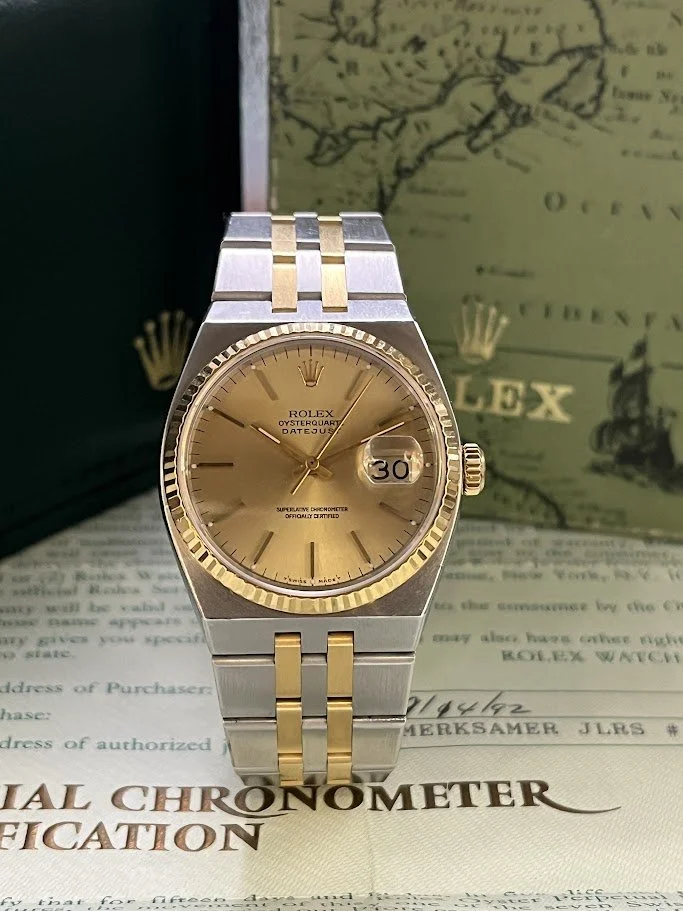
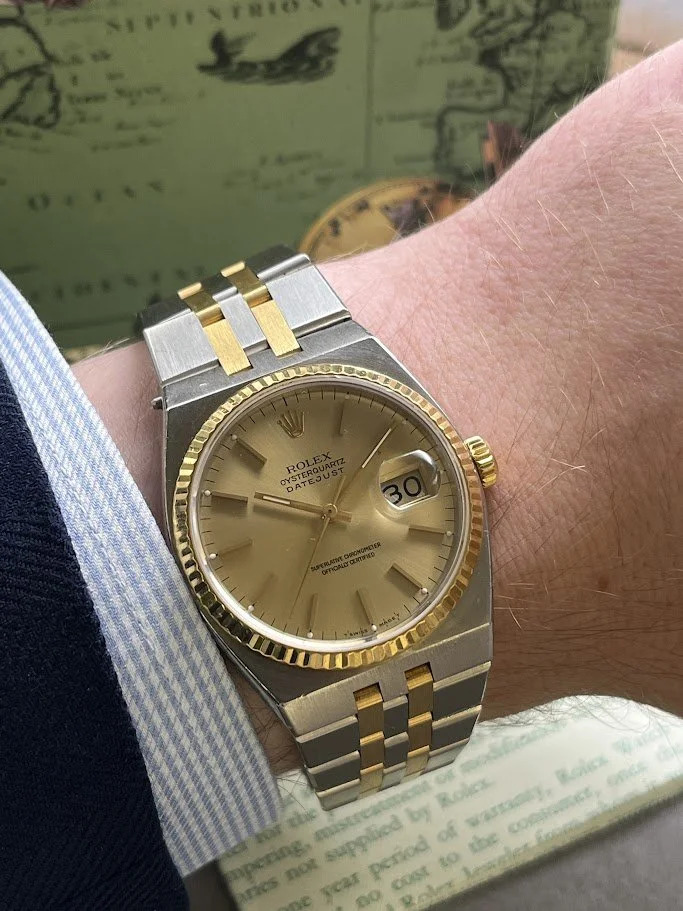
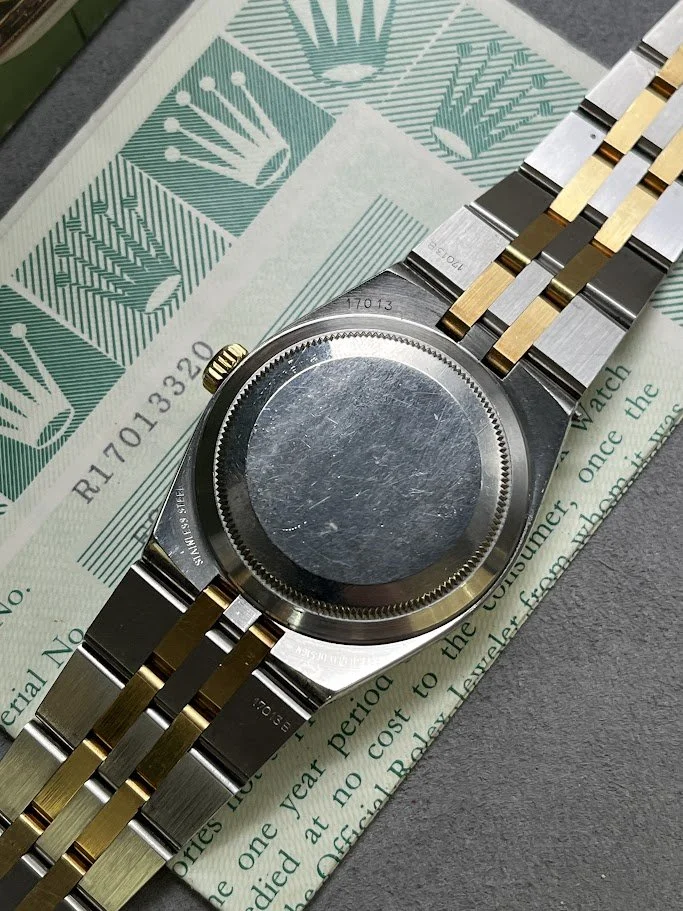
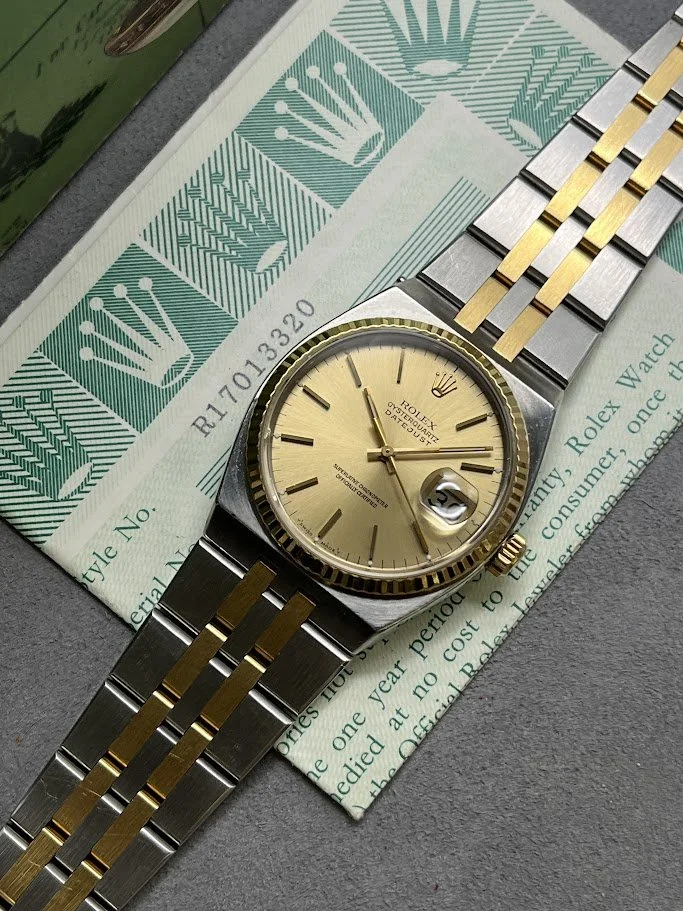
Rolex OysterQuartz Ref. 17013 - Pre-Owned
History of the Rolex Oysterquartz 17013
The Rolex Oysterquartz 17013 is part of one of the most unusual and short-lived chapters in Rolex history. Produced from 1977 to 2001, it represents Rolex’s ambitious—and ultimately limited—venture into quartz technology during a time when the Swiss watch industry was under intense pressure from the Quartz Crisis.
Origins: Rolex’s Quartz Ambition
In the late 1960s and early 1970s, the rise of accurate, inexpensive Japanese quartz watches threatened traditional Swiss mechanical watchmaking.
While Rolex is known for mechanical movements, it didn’t ignore quartz tech.
Rolex joined the Centre Electronique Horloger (CEH) consortium, which produced the Beta 21 quartz movement.
This Beta 21 movement was used in the early Rolex Quartz Date 5100 (1970–1972), a watch produced in very small numbers and regarded as a prototype phase.
Launch of the Oysterquartz (1977)
After withdrawing from the shared Beta 21 approach, Rolex secretly developed its own in-house quartz calibers. In 1977, the brand debuted two movement families:
Caliber 5035 – Oysterquartz Datejust
Caliber 5055 – Oysterquartz Day-Date
These were not outsourced modules—they were high-precision, fully Rolex-engineered quartz systems with mechanical gear trains, jeweled movements, and traditional finishing.
The 17013: A Two-Tone Icon
The Rolex Oysterquartz Datejust 17013 is the Rolesor (steel and yellow gold) version of the watch.
Key Design Traits
Distinct integrated bracelet inspired by 1970s angular design trends (often compared to Genta-style aesthetics).
Fluted 18k yellow-gold bezel paired with a stainless steel case.
Sharp, geometric case profile unique in the Rolex catalog.
Variety of dial colors, including champagne, white, blue, and silver.
Tritium lume on most early examples (marked “T Swiss T”).
Movement: Cal. 5035
Regarded as one of the best quartz movements ever made:
Thermocompensated quartz oscillator
Analog regulation via a micro-screw (unusual for quartz)
+/- 1 minute per year accuracy (far exceeding COSC standards at the time)
11 jewels
Serviced much like a mechanical movement
Production and Rarity
Rolex produced only ~25,000–30,000 Oysterquartz watches total across all models over 25 years—extremely low compared to millions of mechanical Datejusts.
The 17013 is believed to be among the more common OQ variants, but still far from plentiful.
Production slowed drastically in the 1990s, and the entire Oysterquartz line was discontinued by 2001.
Case & Construction
Reference: 17013
Material: Stainless steel case with 18k yellow gold fluted bezel
Diameter: 36 mm
Thickness: ~13 mm
Case Design:
Angular, faceted case unique to the Oysterquartz line
Integrated bracelet architecture
Strong 1970s geometric aesthetic
Water Resistance: 100 meters (Oyster case)
Bracelet & Clasp
Bracelet: Integrated Rolesor (steel + 18k yellow gold) Oysterquartz bracelet
Bracelet Design:
Solid center yellow-gold links
Satin-finished steel outer links
Distinct, flat, tapered “architectural” style exclusive to Oysterquartz models
Clasp: Fold-over clasp with Rolex coronet
Movement
Caliber: Rolex 5035 quartz
Type: Thermocompensated quartz movement with mechanical gear train
Jewels: 11
Notable Features:
Analog fine-adjustment screw (rare for quartz)
Designed and manufactured entirely by Rolex
Engineered for long-term serviceability, unlike most quartz movements
Battery life approximately 2–3 years
Hacking seconds
Accuracy:
Roughly ±1 minute per year (significantly better than COSC at the time)
Dial & Hands
Dial Options:
Champagne (most iconic)
Silver
Blue
White
Markers: Applied baton indexes with yellow-gold surrounds
Lume: Tritium on vintage pieces (“T Swiss T” at 6 o'clock)
Date Window:
3 o'clock with Cyclops magnifier
Instantaneous date change
Hands: Yellow-gold stick hands with tritium lume
Crystal
Material: Sapphire crystal (flat)
Magnifier: Cyclops lens at 2.5× magnification
Bezel
Material: 18k yellow gold
Style: Classic Rolex fluted bezel
Function: Primarily aesthetic; improves wrist presence and reflects light
Caseback
Style: Solid stainless steel
Markings: Typically stamped with reference and production codes
Construction: Screw-down, part of Oyster sealing system
Model Specifics
Complete collector’s set with original box, warranty papers, and booklets. E serial, production dated to 1990, warranty papers dated 09/14/92
Pre-Owned Rolex | Husar Tic-Tok Shop™ at Craig Husar | Brookfield, WI
Shop authenticated pre-owned Rolex watches at Craig Husar Fine Diamonds in Brookfield, WI. As a family-owned jeweler since 1968, we specialize in high-quality, pre-owned timepieces including the Rolex Submariner, Datejust, and Daytona. Each watch is expertly inspected by our seasoned professionals at the Husar Tic-Tok Shop™ to ensure 100% authenticity and precision. Visit Wisconsin's premier destination for luxury estate watches, located conveniently across from The Corners of Brookfield.
The Husar Tic-Tok Shop at Craig Husar is an independent pre-owned Rolex watch and fine timepiece retailer not affiliated with Rolex, S.A., or Rolex USA. The Husar Tic-Tok Shop sells pre-owned Rolex watches and warranties its watches directly through Craig Husar. Aftermarket additions void the warranty of new and used Rolex watches sold by Rolex S.A. or at www.rolex.com. Rolex is not obligated to warranty watches sold by Craig Husar through its service locations. Rolex Day Date President, Presidential, Super President, Submariner, Cosmograph Daytona, Datejust, Explorer, Sea Dweller, Air King, GMT Master, Yacht Master, YachtMaster, Milgauss, Prince, PearlMaster, and MasterPiece are all registered trademarks of the Rolex Corporation (Rolex USA, Rolex S.A.)