
Here's How GE's 'Project Superpressure' Produced the First Lab-Grown Diamond
Superman fans may remember how the Man of Steel crushed a chunk of coal into a diamond in 1983's Superman III. While the superhero's legendary feats of strength are fanciful, his foray into the world of fine gemstones is not as far-fetched as it seems. You see, coal is made from carbon, and pure carbon — under the right amount of pressure and heat — can be transformed into a diamond.
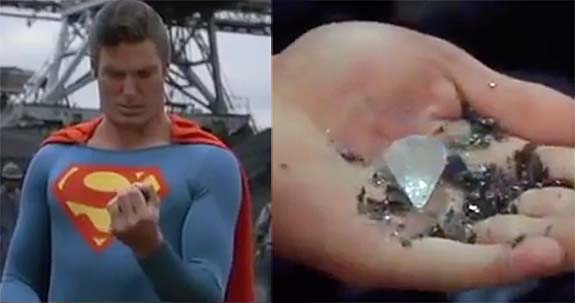
Scientists have long theorized how simple carbon might be turned into the most precious of gems by somehow duplicating in a lab the phenomenon that occurs naturally deep below the earth's surface.
In her new book, Genuine Fakes: How Phony Things Teach Us About Real Stuff, historian Lydia Pyne recounts the experiments that led to the first lab-grown diamond at General Electric's Research Laboratory in Schenectady, NY, in 1954.
Pyne explained how a revolutionary vertical hydraulic piston invented by American Nobel-winning physicist Percy Bridgman in the 1940s allowed for future scientists to generate the pressure necessary to conduct their carbon-to-diamond experiments.

Bridgman's piston — affectionately called "The Bomb" — could produce 4,200 atmospheres of pressure. Legend has it that the scientist's lab at Harvard had holes in the walls, evidence of the power of the machine and dangerous experiments gone awry.
At General Electric, the super secret effort to create diamonds in a lab was code-named “Project Superpressure.” In early December 1954, scientist Herbert Strong conducted Experiment 151, where he deposited into a pressure cone a carbon and iron mixture, along with two small natural diamonds to seed the crystal growth. Building on Pyne's work, GE developed a cone that delivered 50,000 atmospheres of pressure and generated a temperature of 1250°C (2282°F).
Strong ran the experiment overnight, and the next morning removed the two seed crystals and a blob of the iron-carbon material. Strong instructed GE's metallurgy division to polish the material, but that was an impossible task because it was destroying the polishing wheel. The only element that could defeat the wheel was a diamond.
According to Pyne, X-ray analysis confirmed that Strong's experiment had produced a lab-grown diamond.
About a week later, fellow researcher Howard Tracy Hall performed a similar experiment using a high-pressure press called a belt. Two diamond seed crystals plus carbon and iron sulfide were placed in a graphite heater. This brew was heated to 1600°C (2912°F) under 100,000 atmospheres of pressure. Thirty-eight minutes later, octahedron diamond crystals emerged from the belt.
In the weeks that followed, GE researchers were not able to duplicate the results of Strong's experiment, but were able to replicate Hall's success.
GE published the results of its ground-breaking work in February of 1955, just over 65 years ago.
You may read an excerpt of Pyne's book at Science Friday's website.
Credits: Screen captures via YouTube.com. Diamond image by Bigstockphoto.com.
Inspired by a 5th Ave. Window Display, Balanchine's 'Jewels' Hits Theaters Apr. 19
Captured live from Moscow's Bolshoi Ballet, George Balanchine's "Jewels" — with three-parts dedicated to emerald, ruby and diamond — is coming to theaters across the U.S. on April 19.
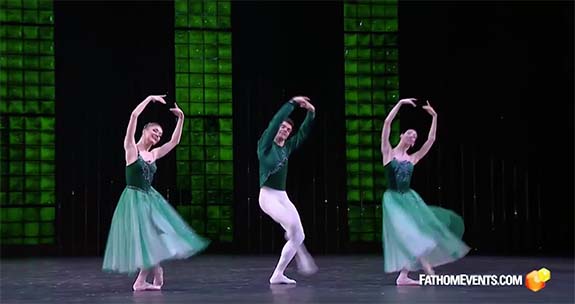
Balanchine, who is often called the father of American ballet, was inspired to create the "abstract" ballet after meeting with jeweler Claude Arpels and viewing a window-display of the famous jewelry boutique Van Cleef & Arpels on Fifth Avenue in New York City in 1966.
According to the official Bolshoi Ballet website, Balanchine was captivated by the shine of the precious stones and set out to create a ballet where the dancers would glow and glitter like the light on the edges of a gem.
"Jewels" is said to represent the three periods in the ballet master’s personal and professional life.
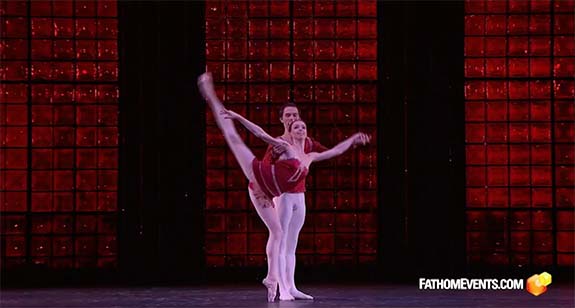
"Emeralds," which features the music of Gabriel Fauré, reflects the sophistication and elegance of a French ballet school; "Rubies," which is set to the music of Igor Stravinsky, is a nod to the sharp off-beat rhythm of Broadway; and "Diamonds," which highlights the music of Pyotr Ilyich Tchaikovsky, is a nostalgic recollection of the crystal purity of St. Petersburg's imperial ballet school.
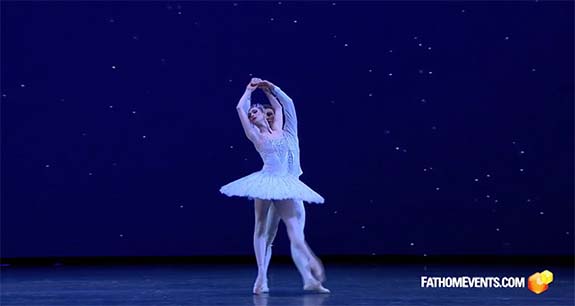
"Jewels" made its debut at the New York City Ballet in 1967 and became a worldwide sensation. Balanchine commented at the time that he thought about adding a fourth part titled "Sapphire" and highlighting the music of Arnold Schoenberg. He eventually panned the idea because the deep blue color of the gem was difficult to present visually.
"The color [of] sapphire is so hard to get across on stage," he said.
Known as one of the most influential 20th-century choreographers, the Russian-born Balanchine co-founded the New York City Ballet and remained its artistic director for more than 35 years. He passed away in New York City in 1983 at the age of 79.
The Sunday, April 19, performance of "Jewels" will be broadcast to theaters all across the U.S. Check out this link to find a venue closest to you...
Credits: Screen captures via fathomevents.com.
Music Friday: Donald Fagen Says His Ex Wouldn't Know a Diamond If She Held It in Her Hand
Welcome to Music Friday when we bring you great throwback songs with jewelry, gemstones or precious metals in the title or lyrics. Today, Donald Fagen likens himself to a precious stone in Steely Dan's 1972 classic, "Reelin' in the Years."

In the song, we learn that the lead singer is having a hard time coming to grips with the fact that his long-time girlfriend has found another man.
He sings, "Well, you wouldn't even know a diamond / If you held it in your hand / The things you think are precious / I can't understand."
Written by Fagen and Steely Dan co-founder Walter Becker, "Reelin' in the Years" has stood the test of time and continues to be one of the band's mosts popular songs.
Beyond the diamond reference, the track is also famous for a memorable guitar solo credited to a guest musician. Elliot Randall, who had been part of a backing band for Jay and the Americans, recounted the story to a journalist from Guitar World Magazine.
“They were having trouble finding the right ‘flavor’ solo for ‘Reelin,’ and asked me to give it a go,” Randall said. "Jeff Baxter played the harmony parts, but my entire lead—intro/answers/solo/end solo— was one continuous take... The whole solo just came to me, and I feel very fortunate to have been given the opportunity to play it.”
How good was the solo? The legendary Led Zeppelin guitarist Jimmy Page told Classic Rock magazine that it was his favorite guitar solo of all time and Q magazine placed the recording at #95 on its list of the 100 Greatest Guitar Tracks.
Steely Dan fans may consider listening to the song's quadraphonic mix, which reveals extra lead guitar fills you don’t hear in the stereo version.
As the second single from Steely Dan’s Can’t Buy a Thrill album, “Reelin’ in the Years” peaked at #11 on the U.S. Billboard Hot 100 chart and #15 on the Canadian RPM chart.
Founded in 1972, Steely Dan is credited with having sold more than 40 million albums worldwide. The group — led by Becker (guitars, bass, backing vocals) and Fagen (keyboards, lead vocals) — was inducted into the Rock and Roll Hall of Fame in 2001.
Becker passed away in 2017, leaving Fagan as the sole founding member of the group. At age 72, he continues to tour, with upcoming engagements scheduled for Austin, TX; Thackerville, OK; Portland, OR; Auburn, WA; Concord, CA; Hollywood, CA; Chula Vista, CA; Phoenix, AZ and Fort Worth, TX.
We hope you enjoy the video of Fagan and the rest of Steely Dan performing "Reelin' in the Years." The lyrics are below if you’d like to sing along…
"Reelin' in the Years"
Written by Walter Carl Becker and Donald Jay Fagen. Performed by Steely Dan.
Your everlasting summer
You can see it fading fast
So you grab a piece of something
That you think is gonna last
Well, you wouldn't even know a diamond
If you held it in your hand
The things you think are precious
I can't understand
Are you reelin' in the years
Stowin' away the time
Are you gatherin' up the tears
Have you had enough of mine
Are you reelin' in the years
Stowin' away the time
Are you gatherin' up the tears
Have you had enough of mine
You been tellin' me you're a genius
Since you were seventeen
In all the time I've known you
I still don't know what you mean
The weekend at the college
Didn't turn out like you planned
The things that pass for knowledge
I can't understand
Are you reelin' in the years
Stowin' away the time
Are you gatherin' up the tears
Have you had enough of mine
Are you reelin' in the years
Stowin' away the time
Are you gatherin' up the tears
Have you had enough of mine
I spent a lot of money
And I spent a lot of time
The trip we made to Hollywood
Is etched upon my mind
After all the things we've done and seen
You find another man
The things you think are useless
I can't understand
Are you reelin' in the years
Stowin' away the time
Are you gatherin' up the tears
Have you had enough of mine
Are you reelin' in the years
Stowin' away the time
Are you gatherin' up the tears
Have you had enough of mine
Credit: Image by Raph_PH / CC BY via Wikimedia Commons.
.jpg)
Alrosa Unearths a Colorful Surprise at Its New Diamond Mine in Yakutia, Russia
Diamond mining giant Alrosa recently pulled an unexpected treasure from its new deposit at Verkhne-Munskoye in the frigid, sparsely populated Russian outpost of Yakutia. The 17.44-carat bright yellow, gem-quality stone could signal a vast new source of super-rare, super-valuable fancy colored diamonds.
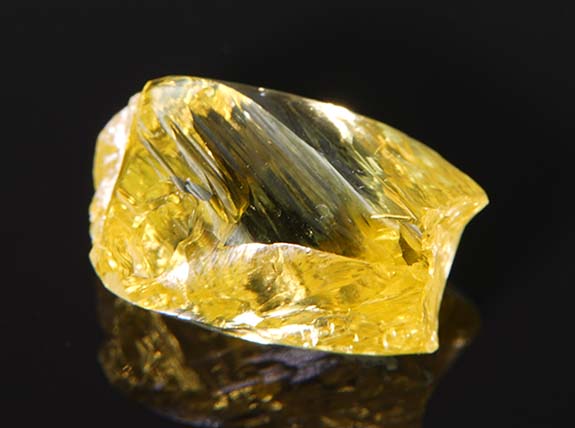
“This is the first rough diamond with bright color found at the Verkhne-Munskoye since it was launched in 2018,” said Evgeny Agureev, Deputy CEO of Alrosa. “The United Selling Organization of Alrosa will assess and evaluate this stone in detail. We hope this deposit will give us more large and interesting discoveries in the future.”
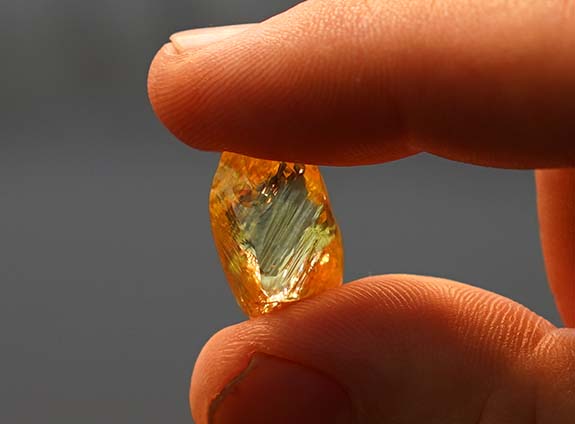
Prior to the recent discovery, Alrosa's supply of natural-color rough diamonds originated in two locations: just north of Yakutia and in the Arkhangelsk region more than 2,000 miles to the west. Fancy colored diamonds are in short supply and can sell for 10 times as much as equivalent colorless stones.
Alrosa is the world's largest diamond supplier by volume, but gem-quality colored diamonds make up less than 0.1% of the company's overall output. The stones are processed at the company's cutting and polishing division, which recently produced such unique pieces as the 20.69-carat fancy vivid yellow "Firebird" and the 14.80-carat fancy vivid purple-pink "Spirit of the Rose."
Alrosa is looking to become a major player in gem-quality colored diamonds, a segment of the industry now dominated by Rio Tinto and Anglo American’s De Beers. Alrosa's new discovery of fancy yellow diamonds comes at a time when Rio Tinto’s exhausted Argyle Mine in Western Australia is scheduled to cease operations. The mine had been the world’s primary source for pink, red and blue diamonds.
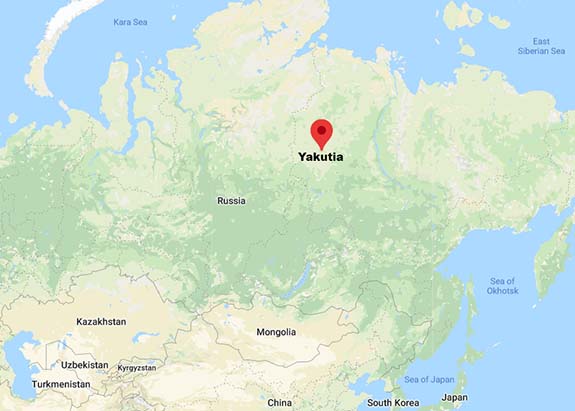
The Verkhne-Munskoye diamond deposit is located west of Yakutia, 170 km from the town of Udachny. Today it is the largest investment project of Alrosa, with expenditures already surpassing $218 million. The Verkhne-Munskoye deposit will supply 1.8 million carats of rough diamonds per year, and its reserves should insure production through the year 2042.
As reported by Business Insider, Alrosa extracted 36.7 million carats of diamonds in 2018. The production was derived from 12 mines in sparsely inhabited Siberia. Most of those are in the Sakha Republic, or Yakutia, a region five times the size of France with only a million inhabitants. Most of Alrosa's 35,000 employees are based in that region.
Credits: Diamond images courtesy of Alrosa. Map by Google Maps.
Pizza Ring Empowers Aussie Woman to Pop the Question During Soccer Match
In early February, we announced that the Aussie division of Domino's was giving away a one-of-a-kind, pizza-slice engagement ring topped with bubbly diamond “cheese” and ruby “pepperoni.” This past Friday, the lucky winner got down on one knee and proposed to her boyfriend just after he scored a goal in the waning minutes of an Adelaide soccer match.

“I went to take the kick and I turned around and saw all the boys lining up,” said Jamie Bowes. “I thought, ‘Oh, the game must be over’ but then I saw Jasmine on the field, and I thought, ‘Why is she here? What is she doing?’"
His now-fiancée Jasmine Ireland pulled off the surprise proposal with the help of Domino's, the referee, Bowes' coach and the players on both teams. With their friends and family in the stands, Ireland marched onto the field and the teams parted "like the Red Sea," according to the official Domino's account.
“When she got down on one knee, I just couldn’t believe it," Bowes said. "I was in shock! I’m still in shock. I had no idea she had been planning this with the rest of the team and my coach!”
Ireland and Bowes have been together for two years and are the parents of seven-month-old Jarvis. Inspired by Leap Day (a time when traditional roles are reversed) and International Woman’s Day (March 8), Ireland decided to take matters into her own hands.
“I was so nervous and excited," she said. "It was amazing to have all my family and friends around me, including my sister who made a special trip from Brisbane to Adelaide just to be here to watch me propose.”

Fabricated in 18-karat white and yellow gold, the ring has a value of AU$9,000, which is equivalent to about US$6,000. The design features a triangular “slice” of yellow gold pizza garnished with three pieces of ruby “pepperoni” of varying sizes and six smaller accent diamonds that look like bubbling cheese.
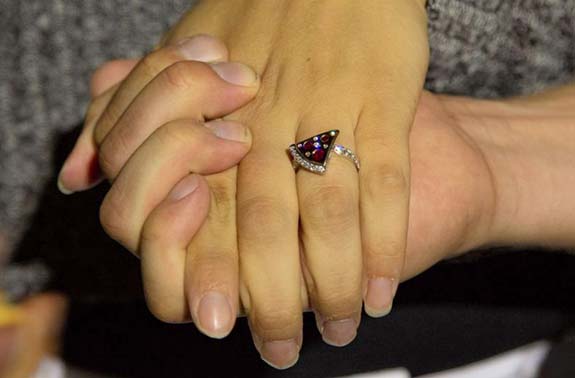
“The ring is everything I thought it would be and more," she added. "I can’t stop staring at it… I can’t believe it’s mine!”
In order to win, contestants had to submit a 30-second video detailing how they will involve pizza in their proposal.
In her submission, Ireland described how pizza is the cornerstone of the couple's relationship.
“We met playing club soccer and we had a bet that whoever got a goal, the other one had to shout 'pizza,'” she said. After each game, the couple would head to Domino's for dinner.
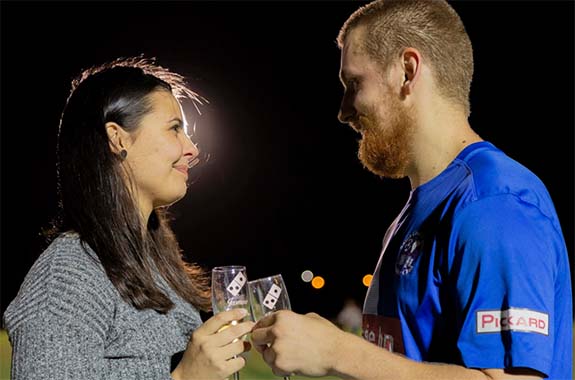
After the on-field proposal, Domino's treated the newly engaged couple and their guests to a Garlic Bread Guard of Honor and a special Domino’s feast.
Nearly 300 video entries were received in Domino’s pizza proposal competition from across Australia and New Zealand.
“We were overwhelmed by the power of pizza to bring people closer,” said Domino’s chief marketing officer Allan Collins. “It just goes to show that sometimes all it takes is great conversation over some great food for sparks to fly."
Credits: Images courtesy of Domino's.
Royal Canadian Mint Launches World’s First Diamond-Shaped Collectible Coin
The Royal Canadian Mint has created an extravagant, three-dimensional diamond-shaped collectible coin adorned with an actual diamond. Crafted from three ounces of 99.99% pure silver, each 2020 $50 coin is punctuated by a 0.20-carat square-cut Forevermark© Black Label diamond sourced from Northern Ontario's Victor Mine.

With a limited production of 700, the offering has already sold out.
The unique coin is aimed at the collectors’ market and is the world’s first coin to be shaped like a multi-dimensional diamond. Designed in collaboration with Crossworks Manufacturing and Forevermark diamonds, the coin displays a matte proof finish.
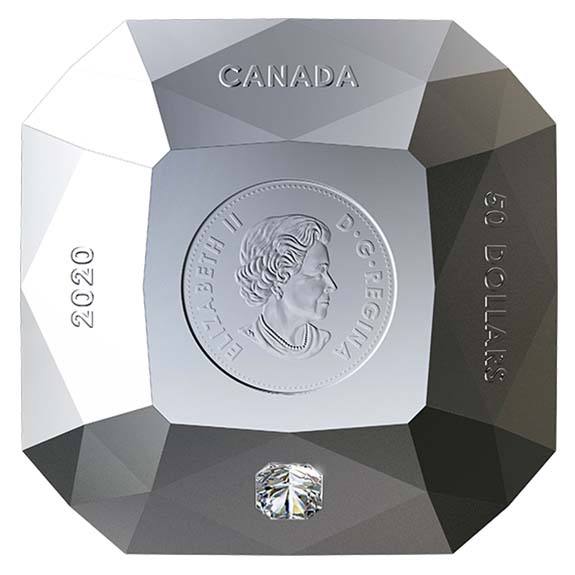
The four main crown facets of the coin include the square-cut diamond, the year "2020," the word "Canada" and the face value "50 Dollars." The table facet features the likeness of Her Majesty Queen Elizabeth II by Susanna Blunt.
The coin’s patented square diamond cut is exclusive to Crossworks, a Canadian company and the top diamond manufacturer in North America.
According to the Mint's R&D team, it took more than a year to design and develop the diamond-within-a-diamond showpiece, as many challenges were overcome. Getting the right shape, size and angles was an enormous undertaking, and each step of the process underwent rigorous testing to ensure the finest quality.
“This coin is an incredible example of the capabilities of our Research and Development lab,” said Royal Canadian Mint Product manager Erica Maga. “Getting this coin right took months and months of testing!”
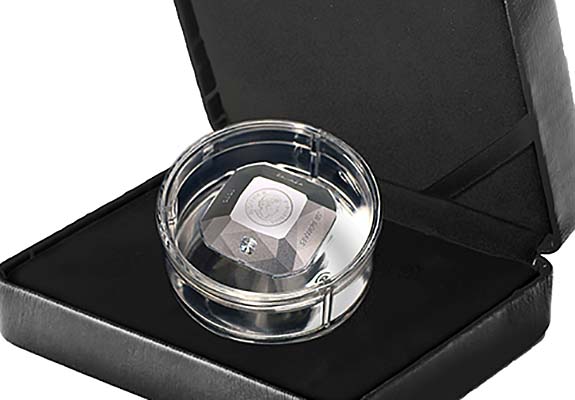
The premium luxury collectible is packaged in a specially designed Royal Canadian Mint-branded clamshell with a black beauty box. The mirrored bottom reflects light on the angled diamond cuts. Although the engraved face value is $50 CAD (about $37), the coin was priced at 30 times that, or $1,500 CAD ($1,117).
The Royal Canadian Mint is recognized as one of the largest and most versatile mints in the world.
Credits: Images courtesy of CNW Group/Royal Canadian Mint.
Music Friday: Hoping to Save His Relationship, Frankie Valli Points to a 'Little Chip of Diamond'
Welcome to Music Friday when we often bring you throwback songs with jewelry, gemstones or precious metals in the title or lyrics. Today, Frankie Valli makes a last-ditch attempt to save a failing relationship in his 1965 hit, "Let's Hang On!".
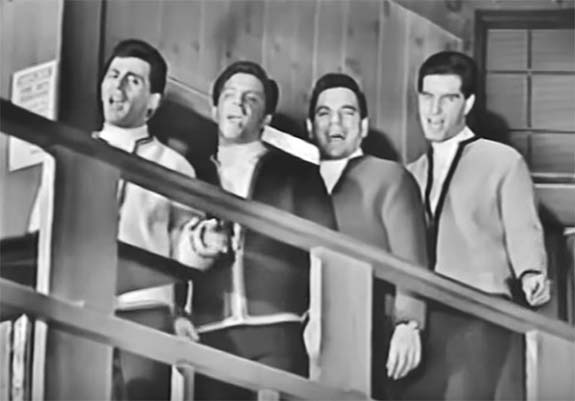
As the song begins, we learn that Valli's significant other is looking to "call it quits," but the falsetto-crooning frontman of The Four Seasons makes his case by pointing to the diamond ring on her finger.
He sings, "That little chip of diamond on your hand / Ain't a fortune, baby, but you know it stands (for the love) / A love to tie and bind us (such a love) / We just can't leave behind us / Baby (don't you go) / Baby (oh no no) / Baby, stay-ay."
Composed by Bob Crewe, Sandy Linzer and Denny Randell, "Let's Hang On!" was one of The Four Seasons' most memorable tunes, ascending to #3 on the U.S. Billboard Hot 100 singles chart. Sixteen years later, Barry Manilow released his rendition of the song, but it only got to #32 on the Hot 100 chart.
According to music historians, the popularity of "Let's Hang On!" stems from several unique devices in the arrangement.
The first is Valli's three-line introduction: "There ain't no good in our goodbye-in' / True love takes a lot of tryin' / Oh I'm cryin'."
The next is the use of two fuzz guitars (with one musician playing high notes and the other playing low notes).
Still another is Valli's extreme falsetto, and the last is the use of backing vocals that provide counterpoint to Valli's main phrasing.
Founded in 1960, The Four Seasons included four Newark, N.J., natives: Bob Gaudio, Frankie Valli, Tommy DeVito, and Nick Massi. The origins of the group are chronicled in the long-running Broadway musical, Jersey Boys.
The Four Seasons were inducted into the Rock and Roll Hall of Fame in 1990 and are credited with selling more than 100 million records. The 85-year-old frontman is still touring, with upcoming stops in Thousand Oaks, CA; Windsor, Ontario; Orillia, Ontario; Las Vegas, NV; Philadelphia, PA; New York, NY; Kingston, NY; and Port Chester, NY.
Trivia: Frankie Valli's real name is Frank Castelluccio. The inspiration for his stage name came from the female country singer Texas Jean Valley.
Please check out the audio track of Frankie Valli and The Four Seasons singing "Let's Hang On!". The lyrics are below if you'd like to sing along...
"Let's Hang On"
Written by Bob Crewe, Sandy Linzer and Denny Randell. Performed by Frankie Valli and The Four Seasons.
There ain't no good in our goodbye-in'
True love takes a lot of tryin'
Oh I'm cryin'
Let's hang on to what we've got
Don't let go, girl, we've got a lot
Got a lot of love between us
Hang on, hang on, hang on to what we got
Dooh doo, dooh doo, dooh doo
You say you're gonna go and call it quits
Gonna chuck it all and break our love to bits (breaking' up)
I wish you'd never said it (breakin' up)
Oh no, we'll both regret it
That little chip of diamond on your hand
Ain't a fortune, baby, but you know it stands (for the love)
A love to tie and bind us (such a love)
We just can't leave behind us
Baby (don't you go)
Baby (oh no no)
Baby, stay-ay
Let's hang on to what we've got
Don't let go, girl, we've got a lot
Got a lot of love between us
Hang on, hang on, hang on, to what we've got
Dooh doo, dooh doo, dooh doo
There isn't anything I wouldn't do
I'd pay any price to get in good with you (patch it up)
Give me a second turnin' (patch it up)
Don't cool off while I'm burnin'
You've got me cryin' dyin' at your door
Don't shut me out, ooh let me in once more (open up)
Your arms I need to hold you (open up)
Your heart, oh girl I told you
Baby (don't you go)
Baby (oh no no)
Baby, stay
Let's hang on to what we've got, girl
Don't let go, girl, we've got a lot
Got a lot of love between us
Hang on, hang on, hang on, to what we've got
Dooh doo, dooh doo, dooh doo
Credits: Screen capture via Youtube.com.
Missouri Man Delivers Surprise Proposal to 'Ellen' Superfan With Help From the Host
A Missouri couple who admitted to doing things a little "backward" recently got engaged on the Ellen DeGeneres Show in front of a live studio audience and 4.2 million viewers at home.
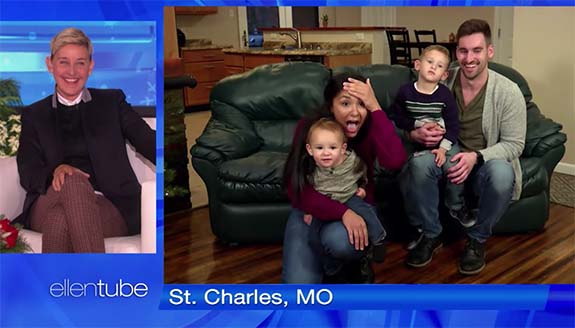
Rachel Anderson and Dane Wobbe had been surprised on December 16, 2019, when the popular host visited their living room in St. Charles, Mo., via a video feed during the show's "12 Days of Giveaways."
Among the prizes awarded to the couple and their two children, Carter and Jaxson, was a trip to Los Angeles to see a taping of the highly rated daytime show. One of Anderson's life goals was to meet DeGeneres, who she finds inspirational.
During the episode that aired February 27, DeGeneres showed video clips of her lively December 16 encounter with Anderson and her family. Then she invited the couple on stage, where she interviewed them about how their lives have changed since they made their debut on national television.
Anderson told DeGeneres that she and her show are changing the world.
"I could never express how much I appreciate everything you do every day because you give some much light and love to people," she said, "and there is a ripple effect and you effect so many more people than you think."
Unbeknownst to Anderson, Wobbe and DeGeneres had plotted a special surprise for Anderson, a nurse who recently had to give up her job to take care of her ailing grandmother.
Here's how DeGeneres set the stage...
"So you have two adorable children. How long have you been married?" DeGeneres asked.
"Not married," said Anderson. "We do things backward a little bit, but that's totally fine."
At that moment, Wobbe stood up and reached into the front right pocket of his jeans and pulled out a diamond engagement ring.
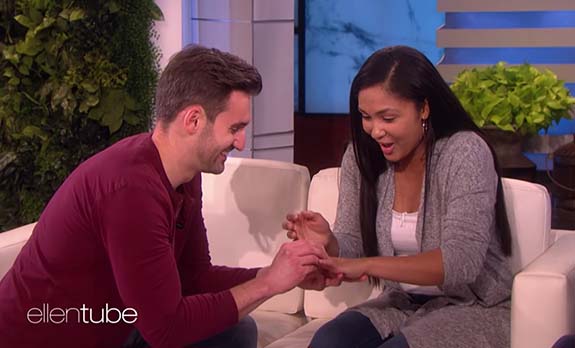
Then he went down on one knee, looked Anderson in the eyes and said, "You're the best partner, the best mother I could possibly ask for. Would you marry me?"
"Yeah, yeah," said his stunned girlfriend.
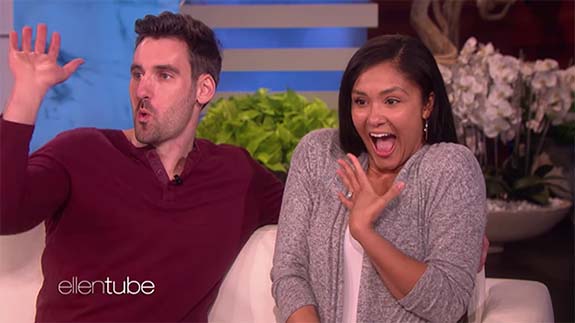
He slipped the ring onto her left hand and she pulled him in for a kiss. Then they both stood and embraced to the cheers of the studio audience.
"I love you so much," she whispered to her new fiancé, a sweet sentiment that was picked up by a stage microphone.
Anderson asked DeGeneres to attend their wedding and the TV host seemed excited by the invitation.
She also told DeGeneres that her patients often watch the Ellen DeGeneres Show to lift their spirits.
“You are the best medicine that they can get at that time,” Anderson said.
DeGeneres told the couple how much she admired their positive attitude and willingness to help others ahead of themselves.
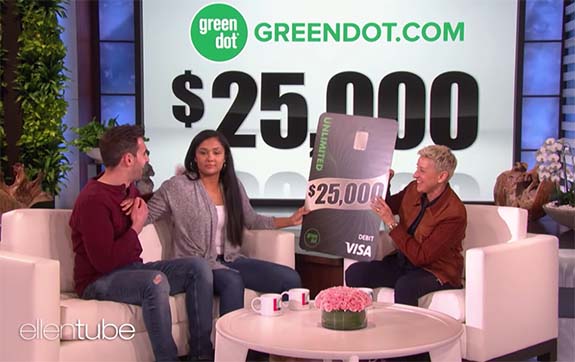
Anderson and Wobbe could hardly contain their excitement when a stage hand delivered an oversized check for $25,000, an early wedding gift courtesy of Green Dot Bank.
Check out the full segment here...
Credits: Screen captures via Youtube.com/TheEllenShow.
Here’s One More Reason for Proposal Procrastinators to Finally Put a Ring on It
Despite the best of intentions, many young suitors let the winter season slip away without proposing to the loves of their lives. They couldn't gather enough courage on Christmas Day (the single most popular time of the year to pop the question) and missed a wonderful opportunity on New Year's Eve. Then, Valentine's Day came along and, once again, the day passed with no glittering diamond and no pledge of eternal love.

For those needing a little more motivation, the calendar is about to deliver another fabulous reason for lovers to take a deep breath, get down on one knee and change their lives forever. Friday, March 20 is National Proposal Day.
Conceived by John Michael O’Loughlin decades ago as a perfect time for procrastinators to finally ask for their partners’ hand in marriage, National Proposal Day has slowly become an accepted part of our holiday lexicon.
O’Loughlin was motivated to push for this special day after watching his cousin wait years for a proposal that never came. He felt that a day earmarked for proposals would put a fire under some partners who have waited a bit too long to pop the question.
O’Loughlin scheduled National Proposal Day to fall on the first day of spring, which also represents the vernal equinox (the special time of the year when day and night are equal lengths across the globe). O’Loughlin reasoned that the vernal equinox symbolizes “the equal efforts of the two required to comprise the successful marriage.”
(The first day of spring generally falls on March 20, but due to 2020 being leap year, spring will arrive on March 19).
Of course, the autumnal equinox — another perfectly balanced day — carries the same symbolism as the spring version, so there is a second National Proposal Day set for the first day of fall, September 22.
National Proposal Day is promoted as a worldwide event, and O’Loughlin encourages romantic couples to meet up with like-minded friends via social media using #proposalday or #NationalProposalDay.
O’Loughlin clarified that March 20 doesn’t have to end with a proposal. Couples can use it, instead, to spark a conversation about their future together.
WeddingWire’s recently published “Newlywed Report” revealed that 8% of the year's marriage proposals occur during the month of March. We're guessing that a great portion of those will be slated for March 20.
Credit: Image by Bigstockphoto.com.
Congratulations, March Babies! Your Official Birthstone Is Sea Blue Aquamarine
As the official birthstone for the month of March, aquamarine is the sea-blue variety of the mineral beryl, whose family members include the intense green emerald and the pink to orange-pink morganite.
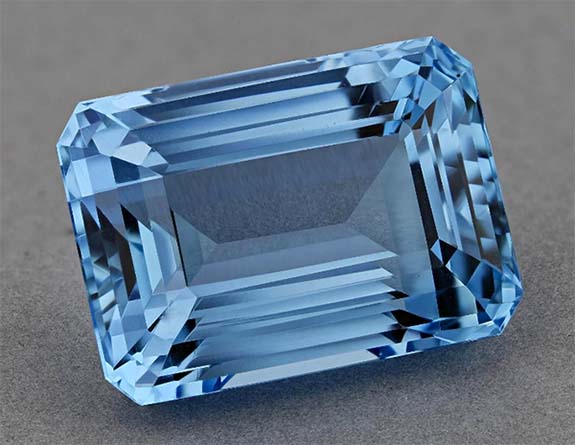
Aquamarine can range in color from rich blue to greenish-blue, with each variation dependent on trace amounts of iron in the gemstone’s chemical composition. Interestingly, pure beryl is absolutely colorless.
The antique cushion-cut aquamarine seen above possesses the classic, coveted color of a natural aquamarine, according to the Smithsonian. Sourced in Brazil, the 65.44-carat gem was faceted by Insu Kang and gifted to the museum by David Yurman Enterprises LLC in 2015. The exquisite aquamarine is now part of the National Gem Collection in Washington, D.C.
In addition to its role as the official March birthstone, aquamarine is also the designated gemstone gift for a couple celebrating their 19th wedding anniversary.
Aquamarine is a symbol of youth, hope, health and fidelity.
Legend states that Neptune, the Roman Sea God, gifted aquamarines to the mermaids, thus bringing love to all who have owned it. In ancient times, it was believed that aquamarines kept sailors safe at sea. Medieval brides wore aquamarine to ensure happy marriages.
Beryl scores a 7.5 to 8 on the Mohs hardness scale, making it suitable for fine jewelry and everyday wear.
According to the Gemological Institute of America, the care and cleaning of aquamarine is simple. Using warm water, mild dish soap and a toothbrush, aquamarine lovers should scrub behind the birthstone where dirt can collect. Ultrasonic cleaners and steam cleaning are usually safe options as long as there are no fractures or liquid inclusions in the gem.
The largest gem-quality aquamarine ever mined weighed in at 244 pounds and was sourced from the Minas Gerais region of Brazil in 1910.
Aquamarines can be found in many countries, including Nigeria, Madagascar, Zambia, Pakistan, Myanmar, Madagascar, Vietnam, Mozambique and the U.S., but the finest-quality specimens come from Brazil.
Credit: Photo by Greg Polley / Smithsonian.