
Stanford Scientists Transform Fossil Fuel Molecules Into Pure Diamond
A new study from Stanford University and SLAC National Accelerator Laboratory reveals how — with the right amount of pressure and a modest amount of heat — a substance found in crude oil and natural gas can be transformed into pure diamond. The findings were published February 21 in the journal Science Advances.
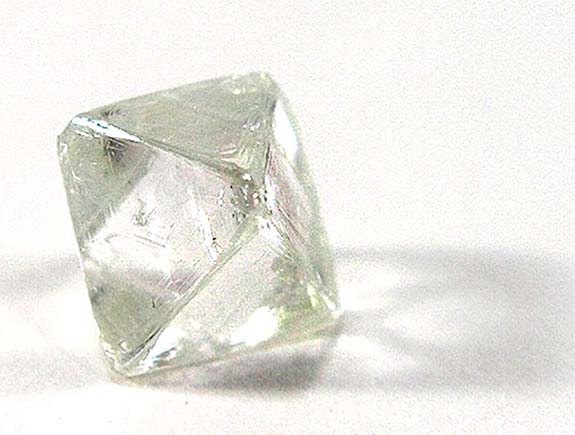
“Starting with these building blocks, you can make diamond more quickly and easily, and you can also learn about the process in a more complete, thoughtful way than if you just mimic the high pressure and high temperature found in the part of the Earth where diamond forms naturally,” said Wendy Mao, a Stanford mineral physicist who heads the lab where the study’s experiments were performed.
The research team began with three types of powder refined from petroleum. The odorless, slightly sticky powders resemble rock salt, but with atoms arranged in the same spatial pattern of those that make up diamond crystal. Unlike diamond, which is pure carbon, the powders (called diamondoids) also contain hydrogen.
The diamondoid samples were guided into a small pressure chamber called a diamond anvil cell, which pressed the powder between two polished diamonds. With a turn of a screw, the device mimicked the intense pressure found deep within the Earth. After squeezing the diamondoid samples and blasting them with a laser, a second, cooler laser beam was used to help shape the resulting diamond. Finally, results were examined through a battery of tests and computer models, which helped to explain how the transformation had unfolded.
“A fundamental question we tried to answer is whether the structure, or number of cages, affects how diamondoids transform into diamond,” said study senior author Yu Lin, a staff scientist in the Stanford Institute for Materials and Energy Sciences (SIMES) at SLAC National Accelerator Laboratory. The three-cage diamondoid, called triamantane, was found to reorganize itself into diamond with little energy.
At 1160 degrees Fahrenheit (the temperature of red-hot lava) plus 20 gigapascals, a pressure hundreds of thousands of times greater than Earth’s atmosphere, triamantane’s carbon atoms snap into alignment and its hydrogen scatters, falling away. The transformation was both immediate and direct.
If you can make even small amounts of this pure diamond, then you can dope it in controlled ways for specific applications,” said Lin.
Throughout history, diamond has served as a powerful symbol of love, power, and beauty. Natural diamonds form hundreds of miles beneath the Earth's surface, under extreme heat and pressure that causes carbon to crystalize. Those seen above ground were likely propelled upwards through ancient volcanic eruptions.
For more than 60 years, scientists have been turning various substances into synthetic diamonds through methods involving massive amounts of energy and time. The Stanford researchers sought to find a simpler method.
“We wanted to see just a clean system, in which a single substance transforms into pure diamond — without a catalyst,” said the study’s lead author, Sulgiye Park, a postdoctoral research fellow at Stanford Earth.
According to the study, the mechanisms for this transformation will be important for scientific and industrial applications. This is because diamond’s physical properties of extreme hardness, optical transparency, chemical stability, and high thermal conductivity make it particularly valuable for medicine, industry, technology and biological sensing.
“What’s exciting about this paper is it shows a way of cheating the thermodynamics of what’s typically required for diamond formation,” said Stanford geologist Rodney Ewing, a co-author on the paper.
The minute sample size inside a diamond anvil cell makes this approach impractical for synthesizing much more than the specks of diamond that the Stanford team produced in the lab, Mao added.
“But now we know a little bit more about the keys to making pure diamonds,” she said.
Credit: Image by Rob Lavinsky, iRocks.com – CC-BY-SA-3.0 / CC BY-SA.

Short Film Details How Diamond Revenues Empower the People of Botswana
In 1967, diamonds were discovered in the newly independent Republic of Botswana. At the time, the land-locked country in Southern Africa was the third-poorest on the continent, but the wealth and opportunity generated by its gleaming natural resource has propelled it into one of Africa's most successful economies.
The key to that success is that for every $1 of diamonds sold, about 80 cents goes back to the government of Botswana. The revenues generated by minerals are put into a central pool and used for the betterment of the country and its people.

Botswana's success story is documented in a short film titled “Fashionscapes: The Diamonds of Botswana." In the film, Livia Firth, co-founder and creative director of Eco-Age, learns first-hand about the impact of diamond mining in a country that has unearthed some of the world's most precious stones, including two diamonds larger than 1,000 carats.
The viewer learns that every person in Botswana is literally a product of the diamond industry.

Mokgweetsi Masisi, President of the Republic of Botswana, described how the people of Botswana are critical stakeholders in the business relationship between the mining company and the government. Masisi also acknowledged that diamonds are a finite resource, so building infrastructure and diversifying is a key to future success.
"You only realize excellence through a lot of hard work and that is why we are so keen to diversify," he said. "That's why we are so keen to improve the value chain. And that's why we are so keen to ensure that we unlock more value domestically for our people. So ethics are critical, environmental stewardship is critical. Human rights and workers' rights are critical."
He noted that the distribution of diamond wealth in his country is a "blueprint of excellence."
"What you actually do with the proceeds is telling of who you are and the values you hold," he continued. "Look around. We do have challenges, but we admit them and we want to face them head on."
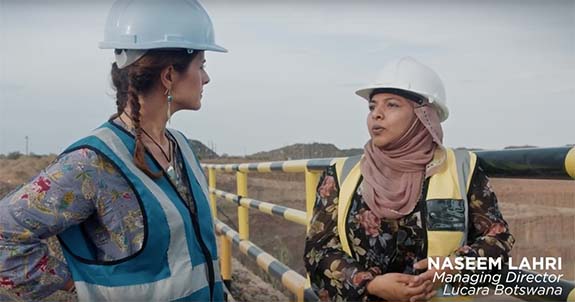
As the first-ever female managing director of the Korowe mine in Botswana, Naseem Lahri knows firsthand how diamonds have enriched the lives of her people.
"I was born in Botswana, I was schooled in Botswana, I've gone to university in Botswana and it's all because of the diamonds that have actually created the schools and the employment," she said.
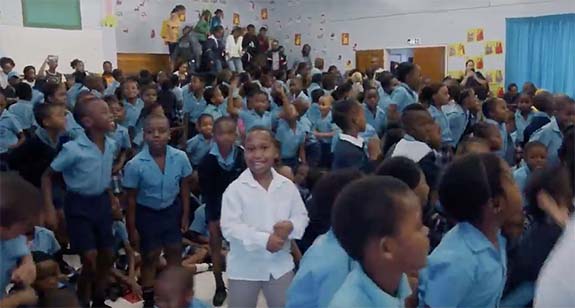
As Firth tours the country, she encounters an agricultural site that provides nutritious fresh food for poorer communities, a public school with enthusiastic students and teachers and an environmentalist who manages a wildlife preserve. All of these entities credit their success to the proceeds generated by the diamond industry.
“Fashionscapes: The Diamonds of Botswana” was produced with the support of the government of Botswana and key players in the country’s diamond industry, including the De Beers Group and mining company Lucara Botswana.
Check out the short film here...
Credits: Screen captures via YouTube.com.
Class Ring Lost in Maine 47 Years Ago Is Unearthed in Finland — 4,000 Miles Away
Forty-seven years ago, Debra McKenna lost her boyfriend's high school ring in the bathroom of a Portland, Maine, department store. Shawn's ring was adorned with an oval blue faceted stone and embellished with the tall mast symbol for Morse High School's athletic nickname — the Shipbuilders.

Ironically, the ring was discovered in early February by shipbuilder Marko Saarinen in a densely wooded area near the small town of Kaarina, Finland. The avid metal detectorist located the keepsake under eight inches of soil — about 4,000 miles from where it was originally misplaced.

The markings on the ring provided just enough clues for Saarinen to find the rightful owner. He had the name of the high school, the year of the graduating class and engraved initials inside the band — "S.M." The Finnish Good Samaritan posted a photo of the ring on the Facebook page of Morse High School's Class of 1973.

"Hello from Finland!" his message read. "I was metal detecting in the deep forest and found this high school ring."
Alert followers of the Class of 1973 Facebook page were able to determine that the S.M. initials belonged to Shawn McKenna. The graduating class of barely 200 students included only one male with those initials.
The classmates alerted Debra, who cried when the ring arrived just before Valentine's Day.
Debra and Shawn had met during his senior year and tied the knot in 1977. They were married for 40 years and had three children. In 2017, Shawn passed away after losing a six-year battle with cancer.
Debra said she was shocked by the unbelievable discovery and believes it might be a sign that her husband is still looking after her.
"I was feeling a little lost for a bit, and now I feel like, okay," she told CNN. "He's letting me know that things are good, that the decisions I'm making are right and he's behind me on it. Like he has been through my whole life."
When interviewed by Portland's CBS affiliate WGME-TV, McKenna recounted the day she lost the ring in the bathroom of a local department store. She had set it on the side of the sink while she washed her hands and then forgot to put it back on. Later, when she went back to retrieve it, it was gone.
How and why the ring found its way to a Finnish forest is a mystery that may never be solved.
"I wish it could talk," the 63-year-old McKenna said of the class ring. "I would love to hear the story of how it got from here to there, and if anyone ever knows what it is, I would love to hear what it is. No judgment, just interest."
“It’s very touching in this world of negativity to have decent people step forward and make an effort,” McKenna told the Bangor Daily News. “There are good people in the world, and we need more of them.”
Saarinen, who spends about two hours each week as a metal detector hobbyist, told CNN that he never considered keeping the ring for himself. He was thrilled to mail it back to McKenna.
"This has been an amazing discovery. Best yet," he said.
Credits: Screen captures via WGME-TV.
Alrosa Raises Profile in Color Market With Sale of 6-Carat Fancy Intense Pink-Purple Diamond
In a move that will surely raise its profile in the global market for polished colored diamonds, Russian mining giant Alrosa recently sold a 6.21-carat fancy intense pink-purple stunner to New York-based diamantaire Larry West.

Already the world’s leading diamond producer in terms of sheer output, Alrosa is looking to become a major player in a segment of the industry now dominated by Rio Tinto and Anglo American’s De Beers — gem-quality colored diamonds. Alrosa’s push is coming at a time when Rio Tinto’s Argyle Mine in Western Australia — the world’s primary source for pink, red and blue diamonds — is tapped out. The mine is scheduled to close some time this year.
“As global production declines, pink diamonds will become rarer and thus more valuable,” said West. “This is the first diamond from Russia that I have bought directly from Alrosa. It possesses excellent characteristics and will certainly take a worthy place in my collection.”
The cushion-cut stone, which was unearthed at Alrosa’s mine in Yakutia, Russia, was subsequently cut and polished by Alrosa's artisans. Alrosa did not disclose the purchase price, but industry insiders report that diamonds with similar characteristics can yield from $1 million to $3 million per carat. That would put the stone's value in the range of $6.2 million to $18.6 million.
“Alrosa deposits are known not only for their colorless diamonds, but also for a variety of rough colored diamonds," noted Rebecca Foerster, President of Alrosa USA. "Our cutter’s unique skills allow us to turn them into high-quality diamonds."
Through a new initiative, Alrosa provided West with the gem's digital passport. The document included a detailed visual history of the diamond’s extraction and production, as well as information about the cutter's background. What's more, Alrosa's digital platform automatically generated a short film based on information about the diamond.
“A closed production cycle guarantees the origin of each stone and allows us to track its path from its birth in Earth’s mantle," noted Foerster. "With these advantages, Alrosa may well become a world leader in the colored diamonds market."
In August of 2019, Alrosa unveiled “The Spirit of the Rose,” a 14.83-carat fancy vivid purple-pink diamond, which was also sourced at its mine in Yakutia. An advisory board member of the Fancy Color Research Foundation said the oval stone could sell for $60 million or more at auction. The date of the sale has yet to be announced.
For more than 30 years, the owner of L.J. West Diamonds has scoured the globe for the most extraordinary natural color diamonds in the world. His magnificent collection has been featured in museums, such as the Natural History Museum of Los Angeles County, and at worldwide auctions.
Back in October of 2019, L.J. West Diamonds granted CNBC unprecedented access to its New York City cutting facility to witness the re-polishing of a 5-carat pink diamond — a risky procedure that, if successful, would more than double the stone’s value from $3.2 million to $7 million.
The father-son team of Larry and Scott West were betting that the pink diamond they had purchased at auction could be elevated from a from a “fancy pink” to a “fancy intense pink.” In the end, their hunch was right.
Credit: Image courtesy of Alrosa.
Couples Spent an Average of $5,900 on Engagement Rings in 2019, Reports The Knot
Couples spent an average of $5,900 on their engagement rings in 2019, according to The Knot's 13th Annual Real Weddings Study. That amount reflected a budget increase of about 4% compared to 2018. The engagement ring continues to be the second-highest-priced item on the list of all wedding expenses (the venue is #1).

Overall, the average cost to host a wedding ceremony/reception in 2019 remained steady at $28,000, although expenditures varied widely by region. Couples in midwestern locales, such as Columbus ($23,500) and St. Louis ($24,000) reported wedding day costs below the $25,000 threshold, while their counterparts in large northeastern cities, such as Boston ($38,600), Washington, DC ($34,700) and Philadelphia ($34,300) reported day-of wedding costs that were significantly higher. The most expensive place in the U.S. to host a wedding in 2019 was Manhattan, where the average outlay was $83,000.
More than half (51%) of survey respondents said they married someone with a different background (race, religion, ethnicity or geographic location). Many of these couples embraced that diversity by asking their wedding planners, DJs or other wedding professionals to find interesting ways to fuse their respective traditions into the celebration.
From Guatemalan coffee to Chinese-crafted candy boxes, many couples selected wedding favors that reflected something unique about them (Nearly 6 in 10 said they distributed party favors).
While couples continued to embrace long-standing wedding traditions, such as the first dance (90%) and cutting the cake (82%), they also continued to break new ground. The concept of couples writing their own vows is now embraced by 44%.
Exactly 72% of those surveyed said their top priority was ensuring their guests were taken care of and had a good time. Besides the expected food, drink and music, nearly half of all couples provided fun entertainment and activities, such as photo booths, cigar-rolling stations and craft margarita bars, to name a few.
Here are some other highlights from The Knot's 2019 Real Wedding Study...
• Average length of an engagement: 15 months (up from 13.6 months in 2018)
• Average marrying age: 32 years (up from bride, 29.1, and groom, 30.5, in 2018)
• Most popular color: dark blue (this color was second to ivory/champagne in 2018)
• Average guest count: 131 (down from 136 in 2018)
• Percentage that have a destination wedding: 21% (down from 23% in 2018)
The Knot's 13th Annual Real Weddings Study reflects the experiences of nearly 27,000 couples married in 2019.
Credit: Image by Bigstockphoto.com.
Music Friday: Marty Raybon Tells the Story of a Young Couple's 'Cracker Jack Diamond'
Welcome to Music Friday when we bring you fun songs with jewelry, gemstones or precious metals in the title or lyrics. Today, country music artist Marty Raybon tells the story of how a trivial prize in a box of caramel corn became a powerful symbol of a couple's eternal love.

In "Cracker Jack Diamond," Raybon describes a summer scene in a rural town, where a 14-year-old boy is trying to earn a few bucks by mowing lawns. The young man happens upon a property where the weeds are tall, and on the porch is a young girl eating ice cream. Instantly smitten, the young man digs into the pocket of his grass-stained jeans and pulls out some week-old caramel corn and a plastic ring. He places the ring on her finger and she is delighted.
Raybon sings, "Just like a Cracker Jack Diamond / You never know when your gonna find one / They found love from that day on / The hand of fate put them together / Their hearts will stay forever young / Like a Cracker Jack Diamond."
Five years later, the young man — now 19 years old — has saved up enough money to pay for the preacher and a diamond ring. He takes his girlfriend to the same porch where they met and she accepts his marriage proposal.
Later in the song, the couple is now elderly, but the woman still has a fondness for the Cracker Jack Diamond.
Raybon sings, "Once a year she takes it out but it don't fit her hand / She wears it in her heart / That's where it all began."
(For more than a century, Cracker Jack fans, young and old, have been excited to find the prize buried in their box of caramel corn. Over time, these prizes have included plastic figurines, booklets, stickers, temporary tattoos and... rings.)
"Cracker Jack Diamond" was released in 2000 and appeared on the artist's solo album titled, Marty Raybon (2000). The song reached #63 on U.S. Billboard Country chart.
Raybon is best known as the frontman and lead singer for the country band Shenandoah, which he founded in Muscle Shoals, Ala., in 1984. In 1997, he left the band to pursue a solo career, but rejoined Shenandoah in 2014. Raybon, now 60, continues to tour actively. The band will be making appearances in Nashville, Tenn.; Milwaukee, Wisc.; Vero Beach, Fla.; Annapolis, Md.; Granger, Texas; Greenville, Texas; Indio, Calif.; Dunlap, Tenn.; Fort Myers, Fla.; and Fulton, Mo.
Billed as Shenandoah Featuring Marty Raybon, the band has released nine studio albums and charted 26 singles on the U.S. Billboard Hot Country Songs chart.
Trivia: Cracker Jack was introduced in 1896 with the slogan, "The More You Eat The More You Want."
Please check out the video of Raybon's performance of "Cracker Jack Diamond." The lyrics are below if you'd like to sing along...
"Cracker Jack Diamond"
Written by Ronny Scaife and Neil Thrasher. Performed by Marty Raybon.
Well he spent that summer walkin' door to door
With a can of gas and an ol' lawn mower
That's a sure fire way to make a buck when you're 14
Well he walked the block with no luck at all
Then he spotted a place where the weeds were tall
With a young girl sitting on the front porch eating' ice cream
Deep in the pocket of his grass stained jeans
Was some caramel corn and a plastic ring
Leftover from the week before
Momma didn't wash them thank the lord
Just like a Cracker Jack Diamond,
You never know when your gonna find one
They found love from that day on
The hand of fate put them together,
Their hearts will stay forever young
Like a Cracker Jack Diamond
Well it's been five years since he gave her his prize
Now the sparkle's gone, but not in their eyes
And he's wanting to tell her what's been on his mind lately
He said, girl I ain't rich but I've been saving up
A little ever day 'til I had enough
Before he could finished she said, you know I will baby
Deep in the pocket of his holey jeans
Was money for the preacher and a diamond ring
He took her back to that old front porch
Slipped it on her finger and he thanked the Lord
Just like a Cracker Jack Diamond,
You never know when your gonna find one
They found love from that day on
The hand of fate put them together,
Their hearts will stay forever young
Like a Cracker Jack Diamond
Once a year she takes it out but it don't fit her hand
She wears it in her heart
That's where it all began
Just like a Cracker Jack Diamond,
You never know when your gonna find one
They found love from that day on
The hand of fate put them together,
Their hearts will stay forever young
Like a Cracker Jack Diamond...
Credit: Screen capture via YouTube.com.
Icelandic Hotel Offers One Free Night to Ladies Who 'Take the Lead' on Leap Day
Ladies planning to pop the question on Leap Day, February 29, may want to check out this tempting offer from Iceland's Hotel Rangá, a luxury countryside resort about an hour's drive from the capital city of Reykjavik.
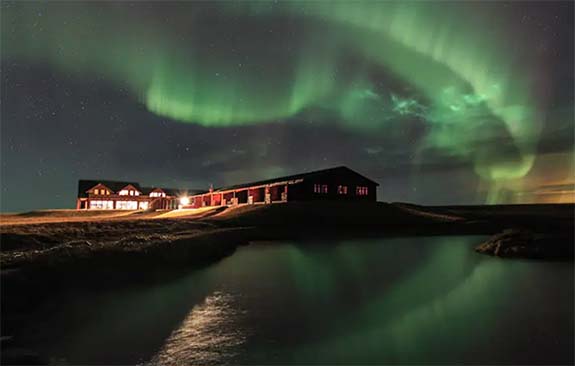
The hotel — which delivers breathtaking views of the northern lights — is giving away a free one-night stay to women who "take the lead" on Leap Day.
"Iceland, in general, is a big champion of women, and we love that Leap Year has this tradition where it's good luck for ladies to propose marriage on this day,” Eyrún Aníta Gylfadóttir, the hotel’s marketing manager, told Travel + Leisure.
“We wanted to empower women to have the courage to take the lead not only on Leap Day, but every day, and celebrate them for it! Plus, we're located in an especially beautiful location and are a romantic choice for couples looking to pop the question, celebrate a special occasion and enjoy an adventurous getaway."

The Hotel Rangá employs a wedding planner who can ensure that the proposal is extra special. One recommendation: How about popping the question under a crystallized waterfall?
The hotel will even throw in a complimentary breakfast, chocolate-covered strawberries and a bottle of Champagne.
Upon entering Hotel Rangá, visitors are greeted by a towering 10-foot tall polar bear named Hrammur that resides in the reception hall. Among the hotel's many amenities are three much-beloved outdoor hot tubs heated with geothermal water and an onsite astronomical observatory equipped with two high-quality 11-inch computerized telescopes.
The Leap Day offer is subject to availability, so those looking to book one of the venue's 52 rooms and suites should send an inquiry to hotelranga@hotelranga.is.
For more than 1,500 years, February 29 — which occurs once every four years — has been reserved for single ladies who have waited far too long for their guys to pop the question. Leap Day marriage proposals have their roots in 5th century Ireland, where St. Brigid of Kildare forged a deal with St. Patrick to permit women to propose to men every four years. In Ireland, Leap Day is also called Bachelor’s Day.
In a 2015 Glamour survey of 500 men, 70% said they would be “psyched” if their female partner popped the question.
Exactly 37% agreed that the woman should get down on one knee for the proposal, and 41% said they would expect to receive a ring.
Credits: Images courtesy of Hotel Rangá.
Soft Drink Giant Is Giving Away an Engagement Diamond Lab-Grown From Crystal Pepsi
The 1.53-carat diamond at the center of Pepsi's Engagement Ring Giveaway was formed in a lab with carbon derived from its short-lived spinoff, Crystal Pepsi.

Soft-drink fans may remember that Pepsi tested the crystal clear version of its ubiquitous carbonated beverage in 1992, and then pulled the plug on the nationwide rollout a year later. Crystal Pepsi (basically regular Pepsi without the caramel coloring) was revived in limited releases from 2015 through 2018.
For this promotion, the folks from Pepsi claim to have boiled down Crystal Pepsi "to its most basic carbon form," resulting in a powder that was used to create a lab-grown diamond.
Set in platinum, the truly one-of-a-kind round brilliant-cut diamond will soon adorn the left hand of the contest winner's significant other, just in time for National Proposal Day, which takes place on March 20. Pepsi says the ring is valued at $3,000.
On Pepsi's official Twitter page, the company wrote: "Propose how you’d propose for a chance to do it with The Pepsi Engagement Ring - the only ring made with real Crystal Pepsi. Really."
Contestants must tweet their proposal, along with up to four photos and one 30-second video, using the Twitter handle @Pepsi, and the hashtags #PepsiProposal and #Contest.
The winner will be chosen by a panel of judges based on originality, quality and marketability appeal.
“How do you make your passion clear to the one you love most?” the company stated in a 34-second promotional video that was posted to Twitter. “You could propose with the thing you love most: Pepsi.”
The romantic clip, which features newly engaged couples, ends with a closeup of the Crystal Pepsi rock and the tagline, “A ring with taste.”
The contest runs through March 6 and a winner will be selected during the week of March 16.
Credit: Image courtesy of Pepsi.
Air Force Pilot Launches Ring 17 Miles Into Space as Part of Stellar Marriage Proposal
A U.S. Air Force pilot attached an engagement ring to a weather balloon and sent it 17 miles into space as part of a spectacular surprise marriage proposal that included a wild hunt to retrieve the precious payload after it plummeted back to earth.

Stuart Shippee, a B-2 Spirit Stealth Bomber pilot from the 393rd Bomb Squadron at Whiteman Air Force Base in Missouri, worked with a bunch of friends and now-fiancée Marie Lisman to launch the balloon to a critical altitude of 90,000 feet. With the onboard video camera capturing every moment of the journey, the viewer is treated to spectacular images of the ring traveling three times as high as the cruising altitude of a 747. (Shippee used a faux ring just in case the mission went awry.)
Lisman didn't know an engagement ring was making the journey. She was under the impression that a medallion commemorating the 13th Bomb Squadron of the United States Air Force was secured in the clip. At the very last moment before launch, and out of Lisman's view, ShIppee replaced the medallion with the ring.

In Shippee's video, we see the team's preparation of the balloon, the clever switching of the medallion for the ring, and then a thrilling ascent that starts over a grassy field and ends at the edge of space, where the atmospheric pressure causes the balloon to burst and spin back down to earth.

Using a GPS tracking device, the team was able to find the remains of the balloon, as well as the camera and ring in a cornfield. We see Lisman grabbing the camera, but not realizing right away that the medallion has been replaced with an engagement ring.
In the next moment, Shippee is on bended knee, ring box in hand. With the real diamond ring, he proposes to his startled girlfriend. In the final scene, an ecstatic Lisman shows off her ring to the onboard camera.
"When I first picked up the balloon payload I did not see the imitation ring until I looked down and Stuart was on his knee," said Lisman. "I was speechless! After the long day and difficult search for the payload I was very happy to have the ending be so special."
Shippee told the Whiteman Air Force Base website that sending a ring into space was on his mind for a while, but he wasn't sure if he could pull it off. His window of opportunity was limited because Lisman was in town only for the weekend.
"If anything went wrong, the whole thing would fail," he said.
In the end, the mission — which took place in August — was a rousing success. The video was finally posted at the end of December and has been getting viral traction just recently.
You can check out the full video below...
Credits: Screen captures via YouTube.com/BloonStu.
172-Carat Parallelogram-Shaped Amethyst With 'Staircase Cut' Resides at Smithsonian
One of the world’s most unusual examples of February’s birthstone is this 172.23-carat parallelogram-shaped amethyst that boasts a fancy "staircase cut" on the pavilion. (That's the slanted lower portion of the gem just below the girdle).

Sourced at Hallelujah Junction, Nev., just 30 miles north of Reno, this impressive stone is the first from that locality to join the National Gem Collection at the Smithsonian’s National Museum of Natural History in Washington, D.C.
The Smithsonian's mineral and gem collection consists of approximately 350,000 mineral specimens and 10,000 gems, making it one of the largest of its kind in the world.
While amethysts traditionally have been sourced in Brazil, Uruguay, Zambia, Mexico, Italy and Germany, the U.S. and Canada are also credited with producing some of the finest-quality purple stones.
Amethyst is the most coveted variety of quartz, which is clear in its pure state. Amethyst gets is purple color from a few atoms of iron displacing some of the silicon in the gem’s molecular structure. These traces of iron can give amethyst a wide range of colors, from almost white to deep purple.
Coveted for thousands of years, Amethyst is one of the oldest recorded gemstones. They’ve been recovered from ancient Egyptian tombs and were prized by the Greeks, Romans, Babylonians and Hebrews.
Amethyst gets its name from the Greek word “amethystos,” which literally means “not to intoxicate.” Apparently, the Greeks believed amethyst could reverse the effects of drunkenness. Medieval soldiers wore amethyst to protect themselves in battle. Other cultures believed February’s birthstone would bring good fortune, inspire their intellect, heal their illnesses or bolster their immune systems.
The color rating of an amethyst is determined by its hue, tone and saturation. Hue is the color; tone is relative lightness or darkness of the color; and saturation relates to the color’s intensity, from dull to vivid.
Credit: Photo by Greg Polley / Smithsonian.