
Rio Tinto Reveals Six 'Heroes' From the 2020 Argyle Pink Diamonds Tender
Rio Tinto recently unveiled the six "hero" diamonds from its 2020 Argyle Pink Diamonds Tender, a collection of the rarest diamonds from a year’s worth of production at the Argyle mine in the remote east Kimberley region of Western Australia.

Among the heroes is the largest Fancy Vivid round brilliant diamond ever offered by Rio Tinto at the Tender, a 2.24-carat Fancy Vivid Purplish Pink diamond known as Argyle Eternity™.
With the Argyle Mine scheduled to close down at the end of this year, the current Tender is presumed to be the second-to-last offering of its kind. During its 35 years in operation, the mine famously produced between 90% and 95% of the world's pink and red diamonds.
“Rio Tinto’s Argyle mine is the first and only ongoing source of rare pink, red and violet diamonds in the world," said Arnaud Soirat, Rio Tinto's chief executive of Copper and Diamonds. "We have seen, and continue to see, strong demand for these highly coveted diamonds, which together with extremely limited global supply, supports the significant value appreciation for Argyle pink diamonds.”
Overall, the 2020 Argyle Pink Diamonds Tender — titled "One Lifetime, One Encounter" — includes 62 diamonds weighing a total of 57.23 carats.
According to Rio Tinto, the six hero diamonds were selected for their unique beauty and named to ensure there is a permanent record of their contribution to the history of the world’s most important diamonds:
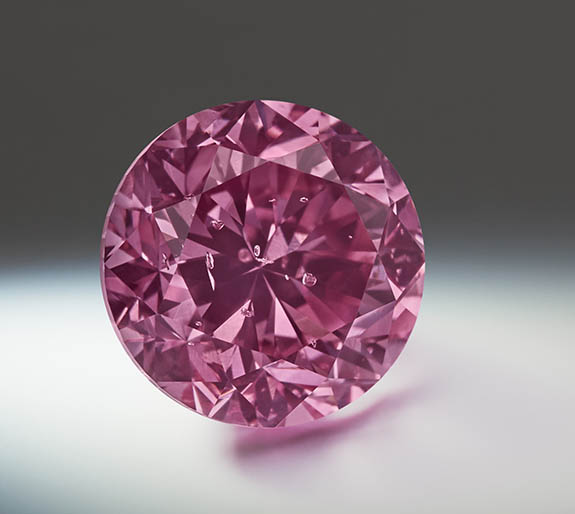
• Lot 1: Argyle Eternity™, 2.24-carat round brilliant Fancy Vivid Purplish Pink diamond.
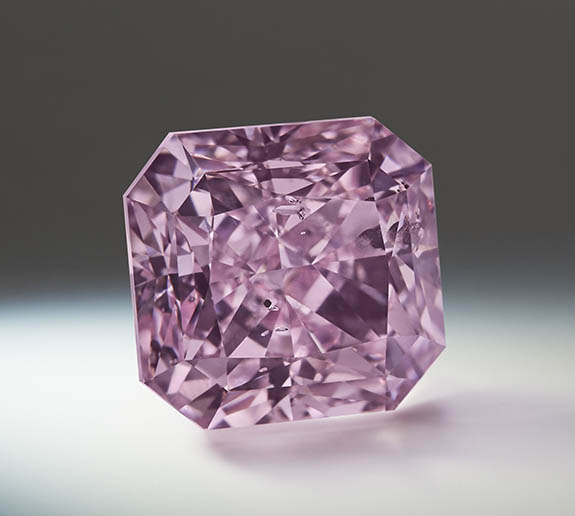
• Lot 2: Argyle Ethereal™, 2.45-carat square radiant-shaped Fancy Intense Purple-Pink diamond.
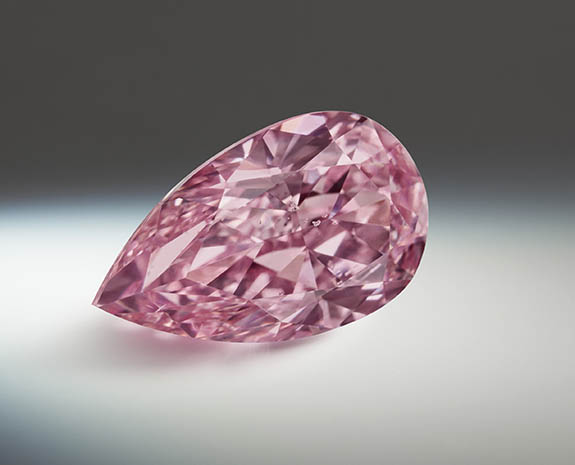
• Lot 3: Argyle Sakura™, 1.84-carat pear-shaped Fancy Vivid Purplish Pink diamond.

• Lot 4: Argyle Emrys™, 0.43-carat princess-shaped Fancy Deep Grayish Violet-Blue diamond.

• Lot 5: Argyle Skylar™, 0.33-carat heart-shaped Fancy Dark Gray-Violet diamond.
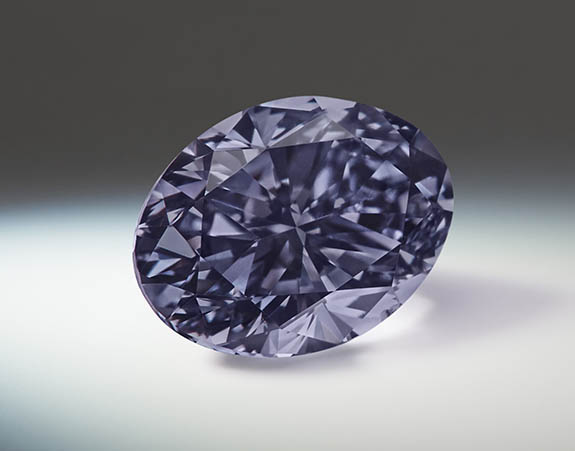
• Lot 6: Argyle Infinité™, 0.70-carat oval-shaped Fancy Dark Violet-Gray diamond.

Also included in the Tender 2020 are 12 lots of carefully curated pink, red, blue and violet diamonds weighing 13.90 carats in total. Called "The Petite Suites," these collectible diamonds were assembled over five years and represent a harmonious balance of size, shape, color and clarity.
Rio Tinto has provided a virtual preview of the rare Argyle pink, red, violet and blue diamonds to an exclusive group of collectors, diamond connoisseurs and luxury jewelry houses. In-person viewings will be offered later in the year at the Argyle mine, as well as Perth, Singapore and Antwerp. Bidding will close on December 2, 2020. Rio Tinto's final Argyle Pink Diamonds Tender is expected to take place in 2021, after the iconic mine's closure.
Credits: Images courtesy of Rio Tinto Diamonds.
Music Friday: Mama Rose Calls Mr. Goldstone 'a Gem' in Broadway Revival of 'Gypsy'
Welcome to Music Friday when we bring you fun songs with jewelry, gemstones or precious metals in the lyrics or title. Today, Tony Award winner Patti LuPone calls Mr. Goldstone "a gem" in a witty tune from the 2008 revival of the 1959 Broadway musical, Gypsy. In the song "Have an Eggroll, Mr. Goldstone," LuPone as Mama Rose tries secure a contract with the Orpheum Circuit executive by showering him with flattery and offering all kinds of leftovers from a take-out dinner.

With music by Jule Styne and lyrics by Stephen Sondheim, Gypsy follows the lives of Rose, the ultimate show business mother, and her two daughters, June and Louise, as they navigate the vaudeville circuit during the early 1920s. Jammed into a small apartment, Rose and her girls are caught off guard when Rose's boyfriend, Herbie, and Goldstone come by unannounced. Playwright Arthur Laurents cleverly uses the name Goldstone to convey the character's wealth and power.
LuPone and the cast of Gypsy sing, "There are good stones and bad stones / and curbstones and gladstones / and touchstones and such stones as them / There are big stones and small stones / and grindstones and gallstones / but Goldstone is a gem!"
Gypsy opened to rave reviews on Broadway in 1959 with Ethel Merman in the lead role. Rosalind Russell and Natalie Wood starred in the big screen version of Gypsy in 1963 and the stage show returned to Broadway in 1974, 1989, 2003 and 2008. LuPone's portrayal of Rose won her a Tony Award for Best Actress in a Musical. Critics have called Gypsy the greatest American musical.
Trivia: The Northport, NY-born LuPone played the part of Louise in a high school production of Gypsy when she was 13 years old.
More trivia: "Have an Eggroll, Mr. Goldstone" is the fifth song of Act I in the 2008 revival of Gypsy. The original name of the song was "Mr. Goldstone, I Love You."
Please check out the audio clip of LuPone and the 2008 Broadway cast of Gypsy singing "Have an Eggroll, Mr. Goldstone." The lyrics are below if you'd like to sing along...
"Have an Eggroll, Mr. Goldstone"
Written by Jule Styne and Stephen Sondheim. Performed by Patti LuPone and the Broadway cast of Gypsy.
Have an eggroll, Mr. Goldstone.
Have a napkin, have a chopstick, have a chair.
Have a spare rib, Mr. Goldstone.
Any spare that I can spare I'll be glad to share!
Have a dish, have a fork, have a fish, have a pork.
Put your feet up. Feel at home.
Have a smoke, have a Coke.
Would you like to hear a joke?
I'll have June recite a poem!
Have a lychee, Mr. Goldstone.
Tell me any little thing that I can do.
Ginger peachy, Mr. Goldstone.
Have a kumquat, have two!
Everybody give a cheer.
Santa Claus is sitting here.
Mr. Goldstone I love you!
Have a Goldstone, Mr. Eggroll.
Tell me any little thing that I can do.
Have some fried rice, Mr. Soy Sauce.
Have a cookie, have a few!
What's the matter, Mr. G?
Have another pot of tea.
Mr. Goldstone I love you!
There are good stones and bad stones
and curbstones and gladstones
and touchstones and such stones as them.
There are big stones and small stones
and grindstones and gallstones,
but Goldstone is a gem!
There are milestones, there are mill stones.
There's a cherry, there's a yellow, there's a blue.
But we don't want any old stone,
only Goldstone will do!
Moonstones, sunstones.
We all scream for one stone.
Mr. Goldstone we love you!
Goldstone!
Credit: Screen capture via YouTube.com.
KC Chiefs' Super Bowl Ring Gleams With 255 Diamonds and 36 Rubies
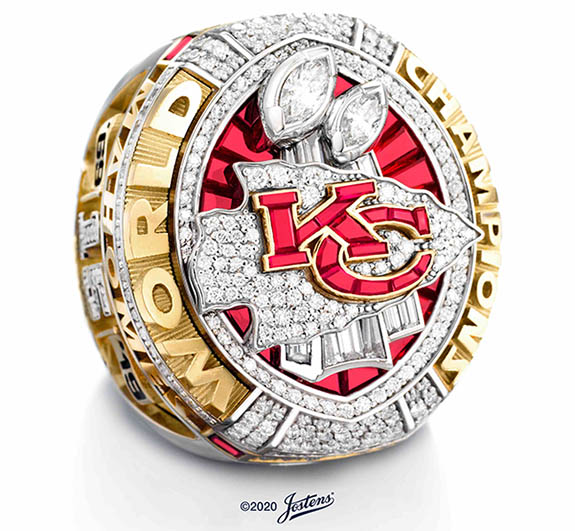
The Kansas City Chiefs received their championship rings on Tuesday during a socially distanced private celebration at Arrowhead Stadium. Each Super Bowl ring features 255 diamonds and 36 rubies for a total gem carat weight of 10.85 carats.
The surreal on-field ring ceremony saw masked players and coaches standing six feet apart behind small cocktail tables as team chairman/CEO Clark Hunt called up each recipient to collect his well-deserved symbol of a memorable season. The Chiefs' 12-4 regular season record was capped by three nail-biting, come-from-behind playoff victories.

The Chiefs' 31-20 win over the 49ers on February 2, 2020, marked the franchise's second Super Bowl victory and the first in 50 years. The photo, above, shows the 2019 and 1969 championship rings, both of which were designed by Jostens.
For 60 seasons, the Kansas City Chiefs have been proud defenders of the Chiefs Kingdom. The ring face pays tribute to this legacy with 60 diamonds set inside a stunning arrowhead-shaped adornment. The arrowhead is layered over two Lombardi Trophies, each of which is topped by a marquise-shaped diamond.
The letters KC are outlined in yellow gold and shimmer with 16 custom-cut rubies that represent the franchise’s 10 AFC division titles combined with six playoff appearances under Head Coach Andy Reid. The 50 diamonds that surround the rubies and logo signify the 50 years between the team's Super Bowl victories.
The four baguette rubies on the top and bottom edges of the ring symbolize four straight AFC West titles from 2016 to 2019. An additional 122 diamonds cascade along the ring top edges, calling to mind the 100th season of the NFL and the Chiefs' 22 playoff appearances. Wrapping it all up, the words WORLD CHAMPIONS crafted from contrasting yellow gold, appear on the ring’s outermost edges.

The right side of the ring pays tribute to the fanbase with the words CHIEFS KINGDOM in raised yellow gold lettering. Located directly in the center, the Super Bowl LIV logo is set in white gold surrounded by a banner displaying the championship game's final score, 31 to 20. The right side is completed with the championship year date, 2019.
On the left side of the ring, the ring recipient’s name is spelled out in raised yellow gold lettering. Below, flags that capture the ’69 and ’19 Super Bowl victories fly high alongside the player’s number set in diamonds. BE GREAT, the team’s championship season motto, is set in a banner beneath, followed by the numbers 142.2, the decibel rating that makes Arrowhead Stadium the loudest in the world, according to the Guinness Book of World Records. All of this is given definition by the stands seen at the very bottom, evoking a fan’s view from the stadium seats.
Etched inside the ring are the logos of the teams that were defeated by the Chiefs on their Super Bowl journey. Also shown are the scores of the games and the deficit overcome to secure the win. As an added touch of personalization, each player’s individual signature graces the interior. The final detail of the ring is a football located on the outer band, which features the initials LH, a tribute to franchise founder Lamar Hunt, who passed away in 2006.
Overall, the rings are highlighted by a total of nine baguette diamonds weighing 0.9 carats, two marquise-shaped diamonds weighing 0.7 carats and 244 round diamonds weighing 3.3 carats. The rings also boast four baguette rubies and 32 custom-cut rubies totaling 5.95 carats.
Credits: Images courtesy of Jostens.
Birthstone Feature: 'Blue Belle of Asia' Crushed the Sapphire World Record in 2014
In honor of September's official birthstone, we're revisiting a magnificent 392-carat blue sapphire that smashed an auction record when it sold for $17.3 million at Christie's Geneva in 2014. It remains the highest price paid at auction for a sapphire.

Named the "Blue Belle of Asia," the cushion-cut, cornflower blue Ceylon sapphire fetched nearly twice its pre-sale high estimate of $9.9 million.
When the tense bidding session was completed on November 11, 2014, Rahul Kadakia, International Head of Christie’s Jewelry Department, slammed down his gavel and proclaimed, "The private collector, seated in the room, is now the new owner of the most valuable sapphire in the world."
The stone has a provenance dating back 94 years. Blue Belle of Asia was discovered in 1926 at Pelmadula, Ratnapura (The City of Gems) in Ceylon (now known as Sri Lanka). It was originally owned by famous gem and jewelry dealers O.L.M. Macan Markar & Co., based in Colombo, Sri Lanka. According to Christie's, the Blue Belle of Asia was cut and polished to its current size and shape between 1926 and 1928.
British automobile magnate Lord Nuffield purchased the gem in 1937 with the rumored intentions of presenting it to Queen Elizabeth on her coronation day in May of that same year. The Queen never took possession of the stone and it subsequently “disappeared” into private hands. Its location remained a mystery for the next 35 years. In the 1970s, the stone curiously turned up in the notes and drawings of Swiss gem dealer Theodore Horovitz, although the owner remained anonymous.
After 40 more years in the shadows, the formidable gem finally returned to the limelight in 2014 as the headliner of the Christie's high-profile Geneva event.
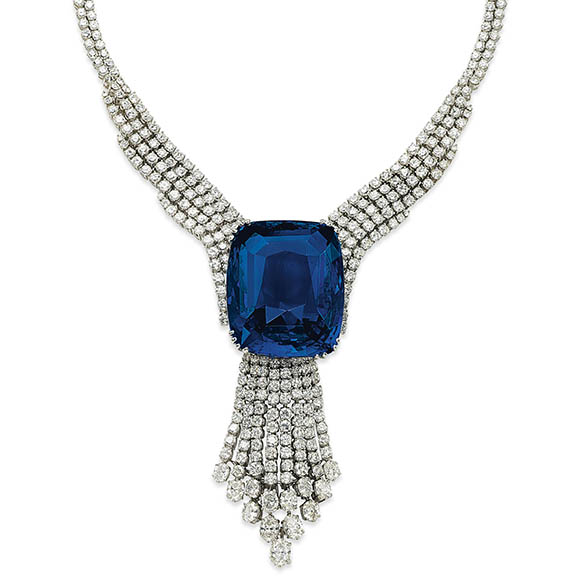
The Blue Belle of Asia is the centerpiece of a majestic diamond necklace featuring nine tassels adorned with brilliant-cut diamonds. Each tassel terminates in a larger oval-cut diamond.
All sapphires are made of the mineral corundum (crystalline aluminum oxide). In its pure state, the corundum is colorless, but when trace elements are naturally introduced to the chemical composition, the results are magical and colorful. Trace elements like iron, titanium, chromium, copper and magnesium give naturally colorless corundum a tint of blue, yellow, purple, orange or green, respectively, according to the American Gem Society. Ruby is the red variety of corundum.
Corundum has a hardness of 9 on the Mohs scale, compared to a diamond, which has a hardness of 10.
In additional to being the official September birthstone, sapphire is also the preferred gem for couples celebrating their 5th or 45th wedding anniversaries.
Credits: Images courtesy of Christie's.
Rough Diamond Oddities Are Chronicled on Alrosa's Instagram Page
As the world’s leading diamond producer, Russia's Alrosa Group gets to see a lot of rough stones — from the ordinary to the extraordinary.

Among the 40 million carats that are sorted in an average year, a handful of exceptional diamond oddities are extracted and preserved in the company's collection of rare finds. They are also photographed and chronicled on the company's Instagram page using the hashtag "uniquediamondsalrosa."
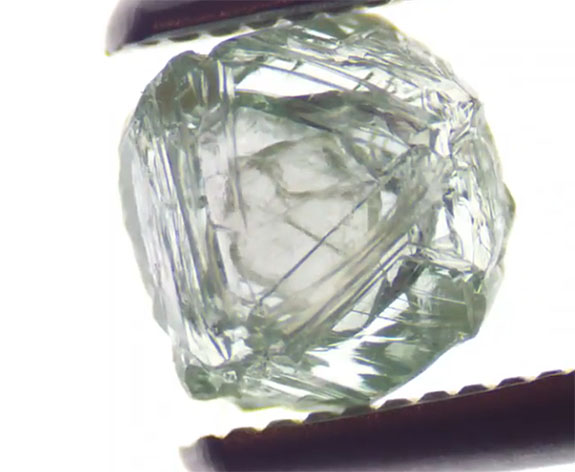
One of those oddities was revealed to the world exactly a year ago. Instagram followers were invited to view to a video that seemed to show a tiny rough diamond moving freely in the cavity of a larger one. The caption read, “A diamond in a diamond? We couldn’t help but share this very special find with you.”
At the time, Alrosa wasn’t quite sure what to make of the phenomenon. Nobody at the mining company had ever seen anything like it. Five weeks later, Alrosa scientists confirmed that both the host and smaller crystal were diamonds. They named the double-diamond “Matryoshka” because its strange configuration was reminiscent of the popular Russian nesting dolls.
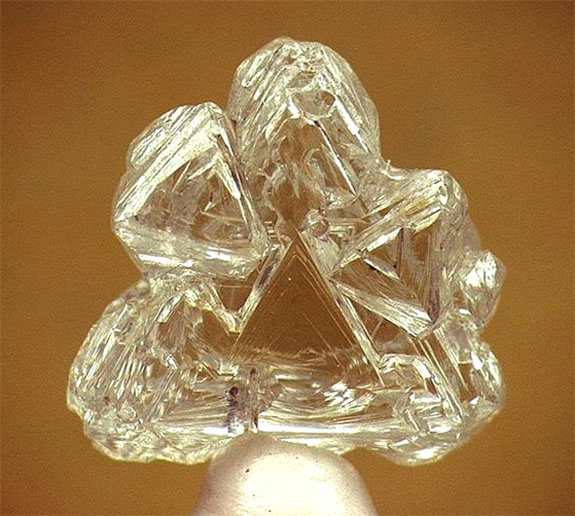
Just two weeks ago, Alrosa posted a pic and short video of its most recent oddity: a diamond composed of merged crystals.
Alrosa's asked its Instagram followers, "How many crystals do you see?" We see six, but there may be more.

Earlier in the year, during the onset of the COVID-19 virus, the mining company lifted the spirits of its followers with the post of a diamond with a pyrope inclusion.
Read the caption, "A pyrope heart of a diamond. During this hard time, we are strong while we are compassionate and caring."
The company explained that the unusual diamond was mined in the Arkhangelsk region by Alrosa's subsidiary, Severalmaz.
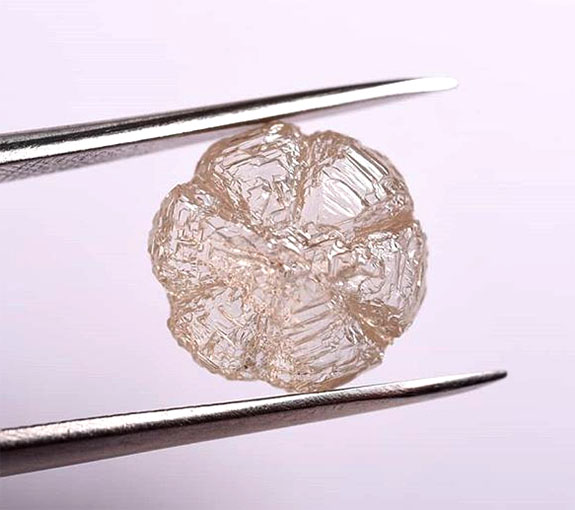
During holiday season, Alrosa showed off its snowflake diamond. In the caption, the company explained that the gemological name for the crystal formation is a cyclic twin. "But we prefer to call it a snowflake," the company wrote.
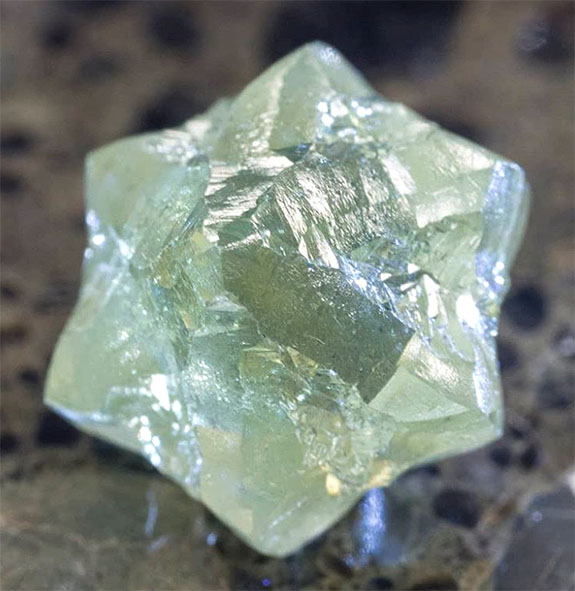
Also in December, in the lead-up to Hanukkah, Alrosa revealed a diamond that looked like the Star of David. Wrote Alrosa, "No filters! No cutting! Just creative nature. This greenish yellowish "Star of David" was mined in late 2018 by Alrosa's subsidiary Severalmaz in [the] Arkhangelsk region."
Also a cyclic twin, the diamond reflects the inter-growth of octahedral macles (triangular-shaped twinned crystals) that are oriented in opposite directions.

Just before Thanksgiving, the company had some fun with a strange rough diamond that resembled a galloping horse.
Alrosa's social media team penned, "Do we have a rich imagination or really crazy rough diamonds? Honestly, we expected to find a turkey-shape rough on the eve of Thanksgiving. But no. Instead, we are happy to have a pony diamond!"
Alrosa accounts for nearly one-third of global rough diamond production. The company manages mines in Russia’s Yakutia and Arkhangelsk regions, as well as Africa.
Credits: Images and video captures via Instagram.com/alrosadiamonds.
Next Stop on the National Gem Gallery Virtual Tour Is the 'Hall Sapphire Necklace'
Featuring 36 cushion-cut Sri Lankan sapphires totaling 195 carats, the spectacular "Hall Sapphire Necklace" is the next stop on our virtual tour of the Smithsonian’s National Gem Collection, which resides in the Janet Annenberg Hooker Hall of Geology, Gems, and Minerals in Washington, DC.
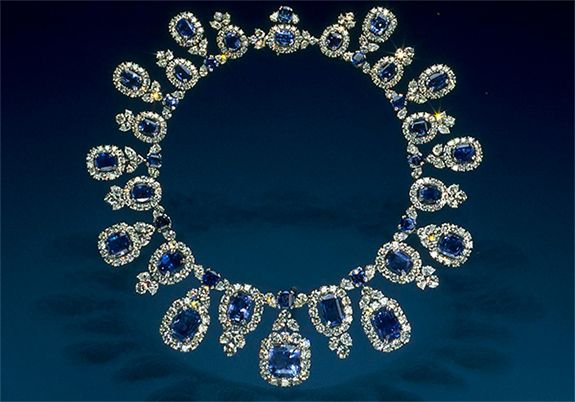
The platinum necklace — a gift to the Smithsonian in 1979 by philanthropist Evelyn Annenberg Hall — is accented with 435 pear-shaped and round brilliant-cut diamonds boasting a total weight of 83.75 carats.
(Evelyn Annenberg Hall is the younger sister of Janet Annenberg Hooker and, interestingly, both women have "Hall" connections. Evelyn's last name is Hall, while Janet has a "Hall" named in her honor. The sisters share a famous brother, Walter Annenberg, who owned and operated Triangle Publications, which included TV Guide, The Saturday Evening Post, The Atlantic Monthly, Essence and Seventeen magazine.)

Designed by luxury jeweler Harry Winston, the Hall Sapphire Necklace is arguably the most lavish of the three eye-popping sapphire pieces featured in a display called "Rubies and Sapphires." The other two are the 423-carat "Logan Sapphire" and the 98.57-carat "Bismarck Sapphire Necklace."
While the Smithsonian museums in Washington, DC, remain temporarily closed in an effort to contain the spread of COVID-19, we continue to present these virtual tours of the finest items in the National Gem Collection. Previous stops have included the “Victoria-Transvaal Diamond,” “Carmen Lúcia Ruby,“ “Chalk Emerald,“ “Gifts from Napoleon,“ “Stars and Cat’s Eyes,“ “Logan Sapphire,“ “Dom Pedro“ aquamarine, “Steamboat“ tourmaline and a grouping of enormous topaz.
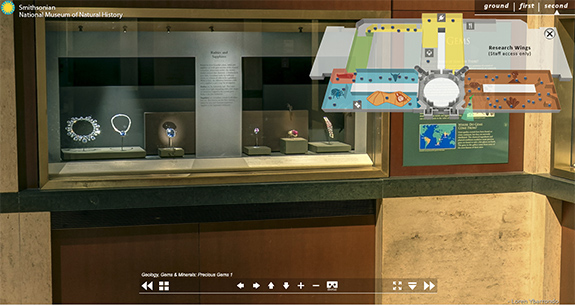
Here’s how to navigate to the exhibit called “Rubies and Sapphires.” The first item in the case is the Hall Sapphire Necklace.
— First, click on this link…
The resulting page will be a gallery called “Geology, Gems & Minerals: Precious Gems 1.”
When you arrive, the foreground in the center of the screen will show a four-sided glass case housing a topaz exhibit. Visible to the right of the topaz display, on the back wall, is a partitioned showcase called “Rubies and Sapphires.” The sapphire items are on the left and the ruby items are on the right.
– Click and drag the screen slightly from right to left and then touch the Plus Sign to zoom in. There you will see the Hall Sapphire Necklace.
(You may touch the “X” to remove the map. This will give you a better view of the jewelry. You may restore the map by clicking the “Second” floor navigation on the top-right of the screen.)
The Hall Sapphire Necklace displays three dozen well-matched sapphires of impressive size and quality. As the Smithsonian notes on its website, Sri Lanka has been an important source of sapphires, rubies and other gemstones for more than 2,000 years. The sapphires from this area are famous for their soft, sky-blue color.
The Smithsonian also explained that the precious stones from Sri Lanka have eroded from the country's central mountains and are picked by hand from alluvial ground deposits.
Evelyn Annenberg Hall passed away in 2005 at the age of 93.
Credits: Jewelry photos by Chip Clark / Smithsonian; Screen capture via naturalhistory2.si.edu.
Music Friday: The Kingston Trio Sings About a 'Priceless Gem of Perfection'
Welcome to Music Friday when we bring you throwback songs with jewelry, gemstones or precious metals in the title or lyrics. Today, we flip the 45 of The Kingston Trio's 1958 chart-topping hit, "Tom Dooley," to find a surprising gem of a song on the B-side, "Ruby Red."

Writers Lee Pockriss and Paul Vance employ rubies, diamonds, emeralds and sapphires in the lyrics to describe the one that got away.
Dave Guard, Bob Shane and Nick Reynolds of The Kingston Trio sing, "Ruby red were her lips. Diamond pure was her heart / Emerald green (emerald green) was the color of her eyes / A priceless gem of perfection, but I lost her 'neath the sapphire sky."
"Ruby Red" earned tremendous exposure on the B-side of a record that would sell more than three million copies and top the charts in five countries, including the U.S., Canada, Australia, Norway and Italy.
As the following songs attest, there is no shame in being on the B-side of a hit record...
• "Hound Dog," Elvis Presley (1953) / B-side of "Don't Be Cruel"
• "I Saw Her Standing There," The Beatles (1963) / B-side of "I Want To Hold Your Hand"
• "We Will Rock You," Queen (1977) / B-Side of "We Are the Champions"
• "You Can't Always Get What You Want," Rolling Stones (1969) / B-side of "Honky Tonk Women"
"Ruby Red" made its album debut as the 10th track of The Kingston Trio's second live album called Stereo Concert, which was released in 1959.
Only one year later, Pockriss and Vance would score their own #1 hit with "Itsy Bitsy Teenie Weenie Yellow Polka Dot Bikini." Recorded by Brian Hyland, the song became a worldwide smash and sparked the sales of two-piece bathing suits.
The Kingston Trio is credited with launching the folk revival of the late 1950s. The group started as a San Francisco lounge act, but quickly gained international fame. The Kingston Trio received an honorary Grammy in 2011.
Although Shane, the last surviving original member of The Kingston Trio, passed away in January at the age of 85, the band continues to tour with a new cast of musicians.
Please check out the audio track of "Ruby Red." The lyrics are below if you'd like to sing along...
"Ruby Red"
Written by Lee Pockriss and Paul Vance. Performed by The Kingston Trio.
Ruby red, Ruby red
Ruby red were her lips. Diamond pure was her heart
Emerald green (emerald green) was the color of her eyes
A priceless gem of perfection, but I lost her 'neath the sapphire sky
Ruby red, Ruby red, Ruby red
I'd cross the wide Pacific and swim the China Sea
To have those lips of ruby red back here again with me
Ruby red, Ruby red
To have those lips of Ruby red back here, again, with me
Ruby red were her lips. Diamond pure was her heart
Emerald green (emerald green) was the color of her eyes
A priceless gem of perfection, but I lost her 'neath the sapphire sky
Ruby red, Ruby red, Ruby red
I thought I could forget, and so I sailed away, but I lived to regret until this very day
Ruby red, Ruby red
To have those lips of Ruby red back here, again, with me
Ruby red were her lips. Diamond pure was her heart
Emerald green (emerald green) was the color of her eyes
A priceless gem of perfection, but I lost her 'neath the sapphire sky
Ruby red, Ruby red, Ruby red
Ruby red. Ruby red
Credit: Screen capture via YouTube.com.
Israeli Teenagers Unearth Hoard of 425 Gold Coins Dating Back 1,100 Years
Israeli teenagers unearthed a hoard of 425 ancient gold coins while volunteering at an archeological site during their summer vacations. The two youths were helping the Israel Antiquities Authority with an excavation in the central part of the country when they noticed something shimmering in the ground.
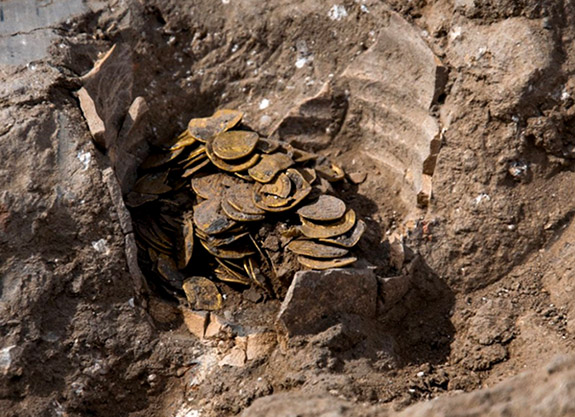
“It was amazing,” said Oz Cohen. “I dug in the ground, and when I excavated the soil, saw what looked like very thin leaves. When I looked again, I saw these were gold coins. It was really exciting to find such a special and ancient treasure.”
The coins, which date back to the Islamic Abbasid period about 1,100 years ago, had been buried in a clay jar. Their combined weight was 845 grams (about 30 ounces) and would have represented a small fortune for a family living at the end of the 9th century.

“The person who buried this treasure 1,100 years ago must have expected to retrieve it and even secured the vessel with a nail so that it would not move,” noted Israel Antiquities Authority directors Liat Nadav-Ziv and Dr. Elie Haddad. “We can only guess what prevented him from returning to collect this treasure.”
“With such a sum, a person could buy a luxurious house in one of the best neighborhoods in Fustat, the enormously wealthy capital of Egypt in those days," added Dr. Robert Kool, a coin expert at the Israel Antiquities Authority.
The pure gold coins were found in pristine condition due to the unique properties of the precious metal, which resists corrosion and does not oxidize when exposed to air.
The cache of gold coins included 270 small gold cuttings, which are fractional pieces of the original dinars that served during this period as “small change.“

Of particular interest to the directors was a cutting that depicted the Byzantine emperor Theophilos (829 – 842 CE). The fractional coin was minted in the empire’s capital of Constantinople. This was a surprising find since all the other coins in the vessel were minted by the Islamic Abbasid Caliphate, which stretched from Persia to North Africa and whose center of government was in Baghdad, Iraq. The mix of coinage presented some evidence that the rival empires had continuous connections — either via war or trade — during this period.
“This rare treasure will undoubtedly be a major contribution to research, as finds from the Abbasid period in Israel are relatively few,“ Kool added. “Hopefully, the study of the hoard will tell us more about a period of which we still know very little.“
Credits: Hoard photos by Yoli Schwartz/Israel Antiquities Authority. Photo of Byzantine coin fragment by Robert Kool/Israel Antiquities Authority.
Gal Gadot Becomes the 4th Woman to Ever Wear the 128-Carat 'Tiffany Diamond'
Actress Gal Gadot gets to wear the 128.54-carat "Tiffany Diamond" in the soon-to-be-released big screen adaptation of Agatha Christie's Death on the Nile. The famous — but rarely worn — gem dangles from a platinum necklace featuring an openwork motif of sun rays glistening with 481 diamonds totaling more than 100 carats.
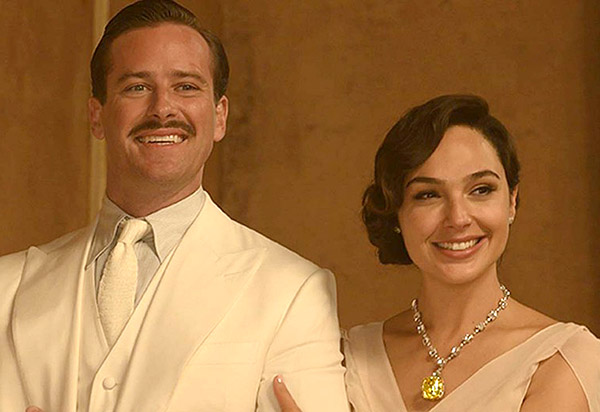
A Tiffany representative told the Hollywood Reporter that the necklace is showcased prominently in the murder mystery, starring Tom Bateman, Kenneth Branagh, Russell Brand, Dawn French, Armie Hammer, Annette Bening, Emma Mackey and Letitia Wright. Gadot plays a glamorous heiress who meets with foul play during her honeymoon aboard a cruise ship on the Nile River.
During its storied 143-year history, the cushion-cut yellow diamond has been worn by only four women. The gem made its first public appearance on the neck of Mrs. E. Sheldon Whitehouse at the 1957 Tiffany Ball. Actress Audrey Hepburn famously wore it in 1961 publicity posters for the motion picture Breakfast at Tiffany’s. And, in February of 2019, Lady Gaga turned heads when she wore it at the 91st Academy Awards.
Gaga revealed in June of this year how The Tiffany Diamond remained on her neck during a Madonna-hosted afterparty — and a late-night excursion to Taco Bell.
“When we were heading to Taco Bell, my car was pulled over, and Tiffany’s security politely removed [the necklace] from my neck,” Gaga said during a virtual appearance on The Graham Norton Show.
Promoted by Tiffany as one of the largest and finest fancy yellow diamonds in the world, the 128.54-carat gem was cut from a 287.42-carat rough stone discovered in the Kimberley diamond mines of South Africa in 1877. It was acquired the following year for $18,000 by Tiffany’s founder, Charles Lewis Tiffany. Today, it's estimated to be worth $30 million.
The rough stone was brought to Paris, where Tiffany’s chief gemologist, Dr. George Frederick Kunz, supervised the cutting of the diamond into a cushion-shape brilliant with an unprecedented 82 facets — 24 more facets than the traditional 58-facet brilliant cut. The stone is just over an inch wide and seven-eighths of an inch from top to bottom.
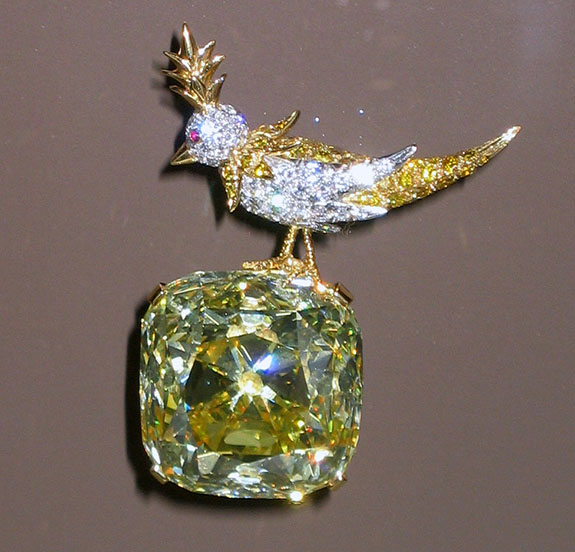
In 1961, the diamond was set in a ribbon rosette necklace to promote Breakfast at Tiffany’s. In 1995, it became part of a brooch called "Bird on a Rock," which was exhibited at the Musée des Arts Décoratifs in Paris.
The Tiffany Diamond necklace worn by Gadot was designed in 2012 to mark Tiffany’s 175th anniversary celebration. When the necklace is not attending the Academy Awards or on a movie set, it can be seen on the main floor of Tiffany's flagship store in New York City.
Death on the Nile is scheduled to hit theaters in October.
Credits: Promotional photo courtesy of 20th Century Studios. Tiffany Diamond image by Shipguy / CC BY-SA.

'Aussie Gold Hunters' Find a Pair of Gold Nuggets Weighing a Combined 7.7 Pounds
Within the span of just a few hours, a family of gold prospectors pulled two huge gold nuggets from the ground near Tarnagulla in the Australian state of Victoria. The dramatic scene played out during Thursday's episode of Aussie Gold Hunters on the Discovery Channel.

The nuggets weigh a combined 3.5 kilograms (7.7 pounds) and are valued at $336,000 AUD ($240,000 USD) based on today's spot gold price. According to a Discovery Channel press release, the nuggets could be worth 30% more if sold to a collector.

Brothers-in-law Brent Shannon and Ethan West discovered the nuggets with the assistance of West's dad, Paul, near the old gold mining town of Tarnagulla, which once boasted the world's deepest mine at 4,613 feet. The family had a hunch that there was still gold to be mined in this area and waited months for a permit.

The hunch paid off — big time.
The team, which calls itself the Poseidon Crew, used an excavator to move a large chunk of earth and then pushed it out thinly so they could use their metal detectors to find the gold.
"We can recover more gold that way, and it's a better way to do it and a safer way to mine," Shannon told News7.
Ethan West explained that he has encountered thousands of pieces of gold during the four years he's been mining, but none can compare with the latest discoveries.
"These are definitely one of the most significant finds," West said. "To have two large chunks in one day is quite amazing."
The area’s first Gold Rush period was in the 1850s and gold has been found continuously in Australia's "Golden Triangle" ever since.
While the two nuggets weighing 3.5 kilograms are impressive by most standards, they are just a fraction of the weight of “The Welcome Stranger,” which was discovered near Moliagul, Victoria, in 1869. That record-setting nugget weighed a staggering 2,300 ounces (143.75 pounds) and would have a precious metal value today of more than $4.4 million USD. Legend states that it had to be broken on an anvil before it could fit on a bank scale.
In 1981, the 256-ounce “Pride of Australia” was unearthed nearby in Mosquito Gully, just north of Wedderburn.
Credits: Gold photos courtesy of Discovery Channel. Map by GoogleMaps.