
Boston Red Sox World Series Ring Is a Fitting Tribute to 2018's 'Team for the Ages'
The Boston Red Sox received their bling-tastic 2018 World Series championship rings prior to the team's home opener on Tuesday afternoon at Fenway Park. Glistening with 185 gemstones weighing a total of 15 carats, the ring is a fitting tribute to what has been called a "team for the ages."
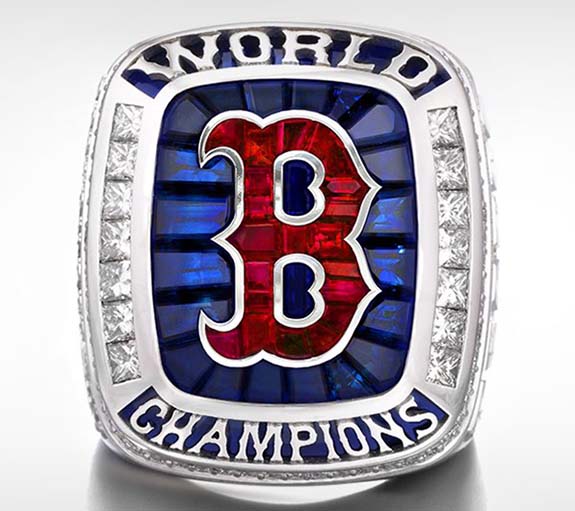
The dominant Red Sox of 2018 notched a franchise-record 108 wins during the regular season and then pummeled three postseason opponents — the Yankees, Astros and Dodgers — at an 11-3 clip to secure their fourth title since 2004.
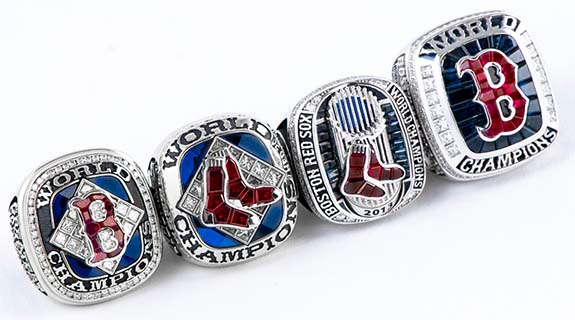
The Jostens-designed rings commemorating the historic season are flush with gem-themed symbolism. For instance, the 185 gems represent the 162 regular season games, 14 post-season games and nine World Series titles now held by the Red Sox.
The iconic Boston "B" logo on the face of the 14-karat white gold ring is formed by 21 custom-cut genuine rubies, which represent the four World Series titles won by the Red Sox during the 17 seasons of Fenway Sports Group ownership. The logo is framed by 22 intricately set custom-cut blue sapphires, which represent the Red Sox’ 14 post-season games and eight home runs hit during the World Series against the Dodgers.
The 14 channel-set diamonds accenting the top of the ring — seven on each side — symbolize the total number of American League pennants won by the Red Sox since the franchise was established in 1901.
A cascade of 128 diamonds in two rows add to the brilliance of the ring, but also represent the 119 franchise-record wins in 2018 and the nine World Series titles.
Overall, the ring features 4.5 carats of diamonds, 6.5 carats of blue sapphires and 4.0 carats of rubies for a total gem weight of 15 carats.
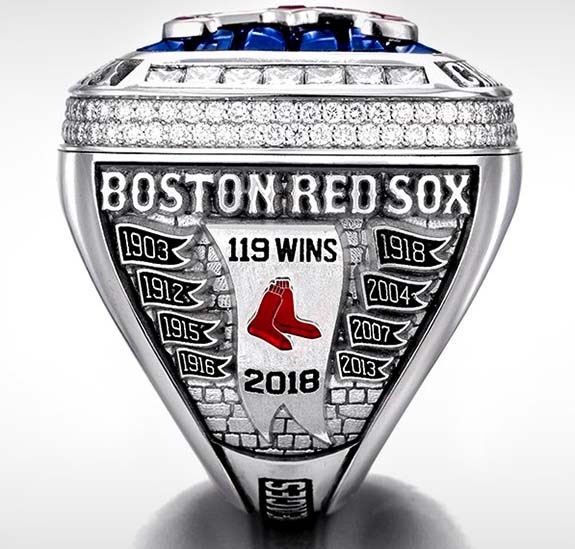
The left side of the ring displays eight pennants featuring the years of previous Red Sox World Series titles. The ninth and largest pennant pays tribute to 2018's franchise-record wins and is punctuated by the famous double Sox logo. In another nod to the team's championship history, the depiction of 100 individual weathered bricks of Fenway Park form the background of each side panel to celebrate the centennial of the famed 1918 World Series Championship.

The name of each recipient appears on the ring's right side, rendered in the Red Sox jersey font. The ring belonging to Steve Pearce, the 2018 World Series MVP, showcases his jersey number 25 rendered in pavé-set diamonds. Pearce's name and jersey number frame an intricately detailed façade of Fenway Park, the oldest ballpark in Major League Baseball.
Highlighted on the Fenway façade are two historically important years — 1912 and 2018. The smaller of the two dates displays the year Fenway Park opened. That year, the team won 105 regular-season games — a record that stood for 105 seasons until it was broken in 2018 by a team that captured 108 regular season wins.

Inscribed on the interior of the ring is "10-28-18," the date of the World Series victory and the date the team's post-season slogan of "Do Damage" was changed to "Damage Done." In recognition of the exceptional contributions of the players and the coaching staff, the declaration of DAMAGE DONE appears on the interior alongside each of their signatures and nicknames.
The finishing touch on this championship ring is an expression on the palm crest that captures the talent of the 2018 Red Sox and their place in baseball lore: TEAM FOR THE AGES.
Credits: Images by Jostens via Twitter/Boston Red Sox.
Let's Celebrate April's Birthstone With a Close-Up Look at the Oppenheimer Diamond
In honor of April's official birthstone, let's take a close-up look at one of the largest uncut yellow diamonds in the world. At 253.7 carats, the Oppenheimer Diamond is a nearly perfectly formed octahedron, a shape that's essentially an eight-sided double pyramid connected at the base.
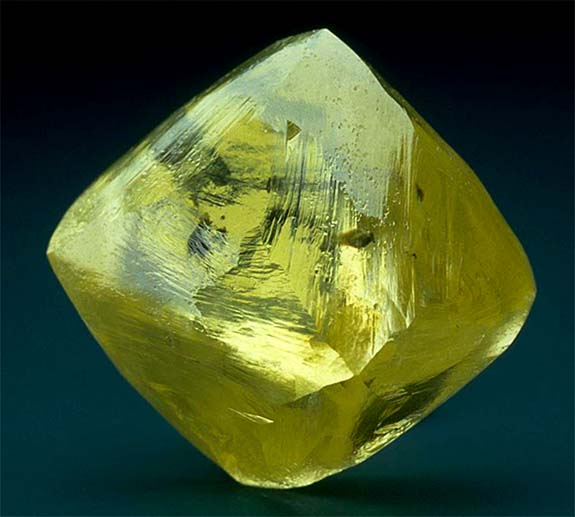
Named in honor of Sir Ernest Oppenheimer, former chairman of the Board of Directors of DeBeers Consolidated Mines, the 20mm x 20mm gem was discovered at the Dutoitspan Mine near Kimberley, South Africa, in 1964, and acquired that same year by luxury jeweler Harry Winston.
Instead of cutting the rough gem into a hero stone and a series of smaller finished diamonds, Winston decided to leave it in its natural state and donate it to the Smithsonian in memory of Oppenheimer, who passed away in 1957 at the age of 77. The surface of the gem is reminiscent of an icy pond.

Vivid yellow diamonds are extraordinarily valuable. In May 2014, for example, the 100.09-carat Graff Vivid Yellow was sold for $16.3 million at Sotheby's.
The Oppenheimer Diamond is now on display near the Hope Diamond in the Janet Annenberg Hooker Hall of Geology, Gems and Minerals in Washington, D.C.
The gem owes its vivid yellow color to nitrogen impurities that were substituted for carbon atoms as the crystal formed. Similarly, the presence of boron in the chemical composition of a diamond will yield a vivid blue color.
Unlike their yellow and blue brethren, pink and red diamonds get their rich color not from chemical impurities, but from a molecular structure distortion that occurs as the diamond crystal forms in the earth’s crust.
Credits: Images by Chip Clark/Smithsonian.
Document Paving the Way for the Cutting of World's Largest Diamond Is Up for Sale
The original legal document that set the wheels in motion for the cutting of the 3,106-carat Cullinan — the world's largest rough diamond — will be offered to the highest bidder at Bonhams London on April 30. The auction house is estimating that the historic document will sell in the modest price range of $2,606 to $3,910.

Signed on January 29, 1908, the nine-page agreement between the representatives of King Edward VII and M.J. Levy & Nephews mapped out the company's responsibilities during the cutting process. London-based broker M.J Levy & Nephews arranged for the diamond to be cut and polished by the renowned Asscher Company in Amsterdam, which had successfully cut the previously largest known diamond, the 995.2-carat Excelsior, five years earlier.
Included within the M.J. Levy & Nephews' document is a "principal agreement" between the Crown Nominees and the Asscher Company. That agreement outlined the cutting process and detailed how the Asscher Company would be compensated. Interestingly, the company was to be paid in "chippings" (diamond remnants) or the cash equivalent.
In 1905, the astonishing discovery of the Cullinan diamond was made at the Premier Mine No. 2 near Pretoria, South Africa. The massive stone was named after the chairman of the mine, Thomas (later Sir Thomas) Cullinan.
Having initially failed to find a buyer, the mine owners eventually sold the Cullinan to the South African Transvaal Colony government in 1907 for £150,000, which then presented it to King Edward VII on his 66th birthday as a symbol of South Africa's loyalty to the Crown.
The King was advised that the Cullinan needed to be cleaved into smaller stones before it could be cut and polished. This was enormously complex and involved significant risk for a stone valued in 1908 at £250,000, more than £25 million ($32.6 million) today. The King hired M.J. Levy & Nephews to oversee the operation. At the time, insurance was taken out "against loss, theft and damage of every kind, excepting damage caused by cutting."
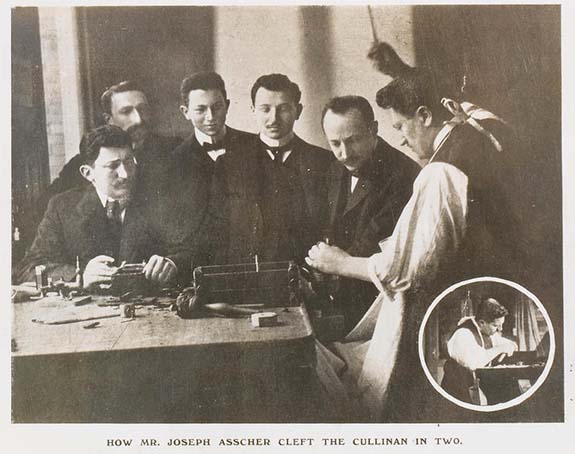
After an extensive period of studying the stone, Joseph Asscher started the cutting process by creating an incision in the diamond of approximately 6.5mm deep. It has been reported that Asscher broke his tool when he initially struck the stone. A week later, after developing stronger tools, Asscher successfully cleaved the the Cullinan into two principal parts, weighing 1,977 carats and 1,040 carats.
It's been reported that the failed first attempt was done under the watch of a notable audience, while the second attempt was accomplished with nobody in the room, except for a Notary Public. Legend has it that Asscher struck the diamond so hard that he fainted after it split.
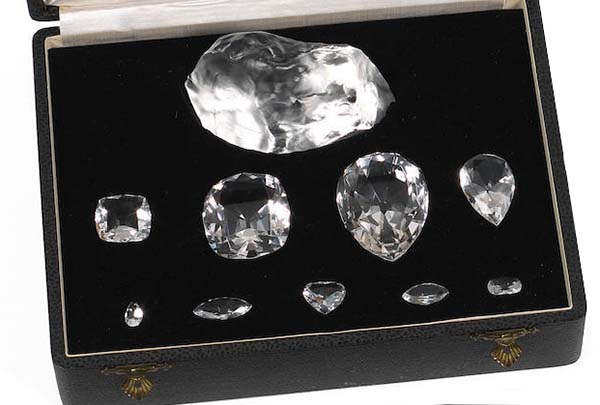
Over the following months, these diamonds were further polished and cut to create nine principal stones, 96 smaller diamonds and a quantity of polished "ends."
Cullinan I and II are part of the collection of Crown Jewels and the remaining seven principal diamonds are in the collection of Queen Elizabeth II, after Her Majesty inherited them from her grandmother, Queen Mary, in 1953.
The Bonhams lot includes the M.J. Levy & Nephews agreement as well as a replica of the Cullinan in its original rough crystal form and two replica sets of the nine principal diamonds from the uncut diamond.
Credits: Images courtesy of Bonhams.
Researchers Find World-Class Blue Spinel on Baffin Island in the Canadian Arctic
On Baffin Island in the Canadian Arctic, University of British Columbia researchers discovered deposits of cobalt-blue spinel in qualities that rival the finest in the world.
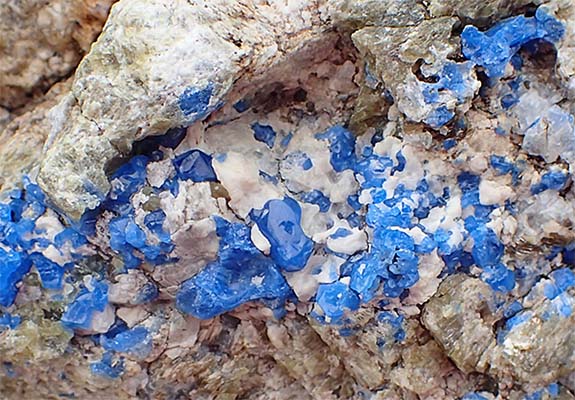
Researchers Philippe Belley and Lee Groat attributed the surprising find to the high levels of a "magic" ingredient present in the area — cobalt.
Pure spinel is colorless, but impurities in its chemical structure give rise to a range of colors, from pink and red to purple and blue. Baffin Island spinel, the researchers found, contains up to 500 parts-per-million of cobalt, which gives it a vivid blue color — a color comparable to the highly coveted material found in Vietnam and the Himalayas.
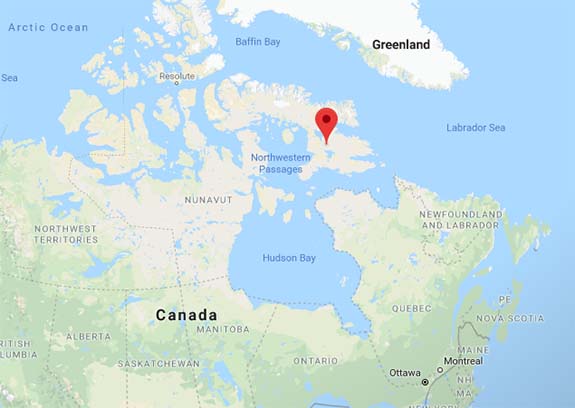
“Baffin Island is geologically similar to the Himalayas, where some of the world’s finest gems have been found,” said Belley, a recent PhD graduate of the department of earth, ocean and atmospheric science. “Canada hasn’t been widely recognized as a source for fine, colored gemstones, but our research suggests that we have all the right ingredients.”
Belley added, "There’s considerable interest in cobalt-blue spinel for gems and jewelry. There are few stones that match its intense blue color.”
Spinel formed on Baffin Island from sedimentary deposits of dolomite-bearing limestones. These sedimentary rocks metamorphosed at temperatures of about 800º C (1,472º F) under immense pressure.
“We found that cobalt was added at some point during sediment deposition or up to early metamorphism,” said Groat, a UBC mineralogist.
The researchers noted that even small spinel crystals with good transparency and fine cobalt-blue color can sell for about 10 times the price of comparable sapphires. But supply is an issue, and even production from the most significant source, Vietnam, is limited and sporadic.
The researchers explained that, despite the prevalence of hungry polar bears on Baffin Island, finding blue spinel there might be easier than exploring for the gem in the thick jungles of Vietnam or the challenging terrain of the Himalayas.
"[In those areas] most new deposits are found by accident,” said Belley. “But there’s excellent rock exposure on Baffin Island, which facilitates exploration and the use of more advanced techniques like imaging using drones or satellites.”
Spinel, which in 2016 joined the official list of birthstones for the month of August, is famous for being the jewelry-industry's "great imposter." Before modern testing became available, deep red spinel was often mistaken for ruby.
Credit: Image courtesy of Philippe Belley, UBC. Map via Google.
Music Friday: This Old Chunk of Coal Is Gonna Be a Diamond Someday
Welcome to Music Friday when we bring you awesome songs with jewelry, gemstones or precious metals in the title or lyrics. Today, country star John Anderson has fun with a well-worn gemstone myth in his Grammy-nominated 1981 hit, "I'm Just an Old Chunk of Coal (But I'm Gonna Be a Diamond Someday)."
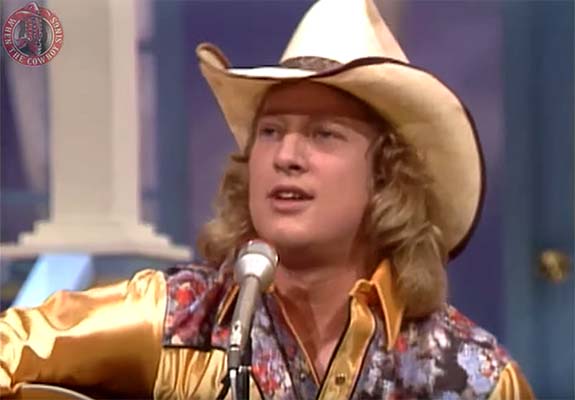
In this song written by Billy Joe Shaver, Anderson likens himself to a common chunk of coal, but promises to work hard to rid himself of flaws until he's "blue pure perfect." We're guessing he aspires to be a blue diamond.
He sings, "Now I'm just an old chunk of coal / But I'm gonna be a diamond someday / I'm gonna grow and glow till I'm so blue pure perfect / I'm gonna put a smile on everybody's face."
"I'm Just an Old Chunk of Coal (But I'm Gonna Be a Diamond Someday)" was released as the first single from the singer's self-titled album, John Anderson 2. The song zoomed to #4 on the Billboard U.S. Hot Country Songs chart and #2 on the Canadian RPM Country Tracks chart. The song also earned Anderson a Grammy nomination for Best Male Country Vocal Performance.
While we've all heard about Superman having the power to squeeze a lump of coal into a diamond, and many of us are familiar with the phrase, "a diamond is a chunk of coal that did well under pressure," the concept that coal has the capacity to be turned into a diamond is just a myth.
A piece of coal and a diamond are both primarily composed of carbon, but that's largely where the similarity ends. A diamond is made up of pure carbon that was subjected to intense heat and pressure about 100 miles below the earth's surface. Coal, on the other hand, is hardly pure. It is a mix of carbon and organic plant matter. It also contains hydrogen, nitrogen, oxygen, sulfur, arsenic, selenium and mercury. Thereby, no matter how hard Superman squeezed the chunk of coal, there's no way a material with that many impurities would yield a diamond.
Trivia: "I'm Just an Old Chunk of Coal (But I'm Gonna Be a Diamond Someday)" is briefly sung by the title character in the 2001 animated film, Jimmy Neutron: Boy Genius.
Born in Apopka, Fla., in 1954, John David Anderson grew up admiring rock musicians, but then switched over to country music as a teenager. He moved to Nashville as a 17-year-old and took odd jobs during the day while playing in clubs during the evening. One of his odd jobs was as a roofer at the Grand Ole Opry House.
After six years of perseverance, he earned a record deal with Warner Bros. Anderson's career that has spanned more than 30 years, during which he's scored more than 40 singles on the Billboard country charts and five number ones. Anderson was inducted into the Nashville Songwriters Hall of Fame in 2014.
Please check out the video of Anderson's performance of "I'm Just An Old Chunk Of Coal (But I'm Gonna Be A Diamond Someday)." The lyrics are below if you'd like to sing along...
"I'm Just An Old Chunk Of Coal (But I'm Gonna Be A Diamond Someday)"
Written by Billy Shaver. Performed by John Anderson.
Hey, I'm just an old chunk of coal
But I'm gonna be a diamond someday
I'm gonna grow and glow till I'm so blue pure perfect
I'm gonna put a smile on everybody's face
I'm gonna kneel and pray every day
Lest I should become vain along the way
I'm just an old chunk of coal, now Lord
But I'm gonna be a diamond someday
I'm gonna learn the best way to walk
I'm gonna search and find a better way to talk
I'm gonna spit and polish my old rough edged self
Till I get rid of every single flaw
I'm gonna be the world's best friend
I'm gonna go 'round shaking everybody's hand
Hey, I'm gonna be the cotton pickin' rage of the age
I'm gonna be a diamond someday
Now I'm just an old chunk of coal
But I'm gonna be a diamond someday
I'm gonna grow and glow till I'm so blue pure perfect
I'm gonna put a smile on everybody's face
I'm gonna kneel and pray every day
Lest I should become vain along the way
I'm just an old chunk of coal, now Lord
But I'm gonna be a diamond someday
Credit: Screen capture via YouTube.com.
Canadian Man Inherits 61-Pound 'Giga Pearl' — One of the Largest in the World
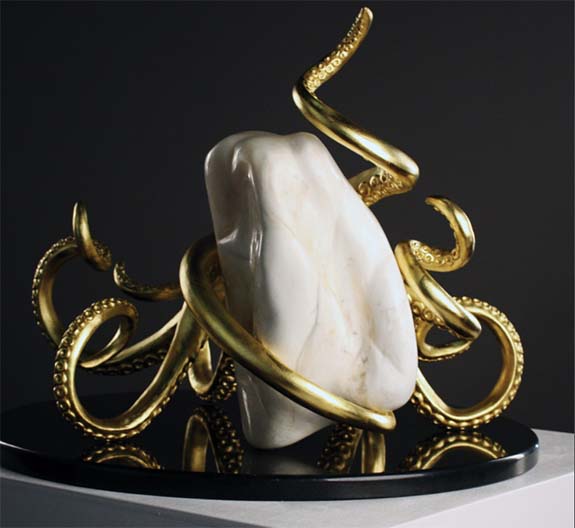
Resembling a dinosaur's tooth and weighing an astonishing 61 pounds, the Philippine-sourced "Giga Pearl" is one of the largest in the world and could be worth upwards of $90 million.
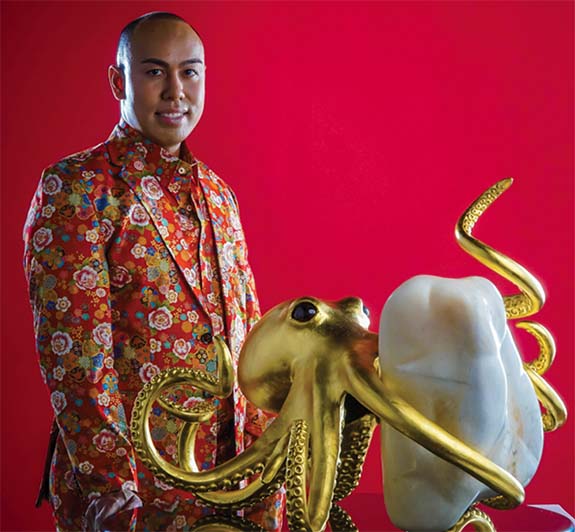
Currently owned by Ontario native Abraham Reyes, The Giga Pearl had been a family heirloom for 60 years. The natural pearl was hidden within a giant clam his grandfather had purchased from a Filipino fisherman as a gift for Reyes' aunt. It was 1959.
Even when the cream-colored mass was discovered inside, family members didn't think it had much value. In fact, some weren't convinced it was a pearl. Reyes and his aunt, however, always had an affection for the odd collectible, which she displayed along with her artwork and antiquities.
In 2016, when Reyes' aunt began divvying up her estate, the mollusk-born treasure and 15,000 Oriental and Philippine antiques were passed on to him.
Reyes, who is a mineral broker, kept the pearl in a safety deposit box until he could have it evaluated by gemologists. The 34-year-old from Mississauga soon learned that his aunt's collectible was certified by the Gemological Institute of America (GIA) as the largest natural blister pearl in the world. Blister pearls are different than conventional pearls because they grow attached to the inside surface of a shell.
The waters of the Philippines are home to one of the most fascinating mollusks on earth — the Tridactna Gigas. They are the largest mollusks in the fossil record, measuring more than a meter wide and weighing more than 200 kilograms.
Insurance appraisers have placed the value of The Giga Pearl at somewhere between $60 million and $90 million, according to Reyes.
"It's priceless to me," Reyes told CBC Toronto. “I believe the world should know that it does exist. To me, I feel very honored to have it. I feel a great responsibility.”
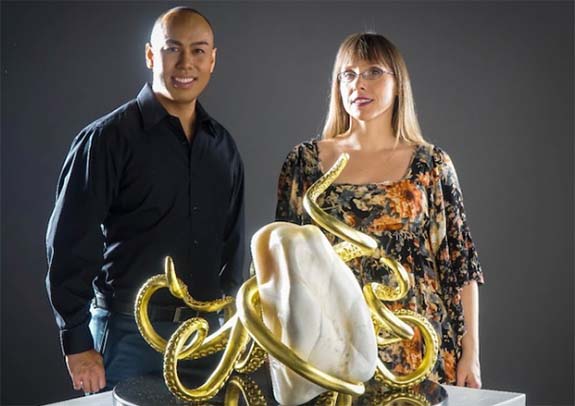
Ideally, Reyes would love to display The Giga Pearl in museums and galleries around the world. The pearl is currently paired with a 22-karat gold leaf octopus conceived by New York-based sculptor Bethany Krull.
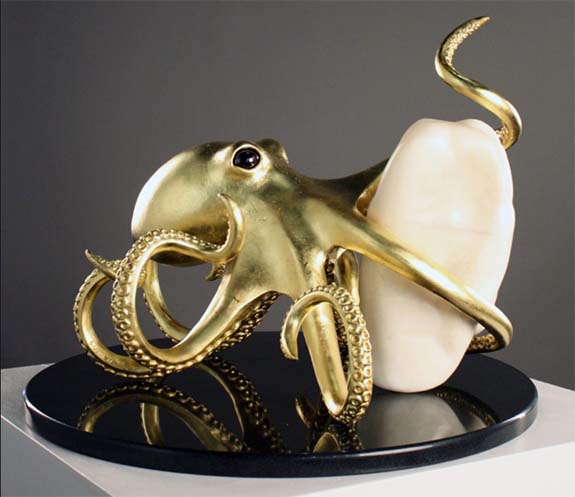
"Seeing this incredible natural pearl and learning of its origins in the Philippine Seas... inspired me to create a sculpture that not only displays the pearl's magnificence but also reiterates the idea that the biodiversity and uniqueness of the waters to which it was born need to be respected and preserved," Krull said.
Back in 2016, we reported on the 75-pound Puerto Princesa pearl, which was found by a Filipino fisherman when his anchor got snagged on a giant clam. He had kept the pearl under his bed as a good luck charm for 10 years, and every time he would head out to sea, he would touch the pearl to ensure his safety and good fortune.
The fisherman entrusted the amazing pearl to Aileen Cynthia Maggay-Amurao, a relative who was affiliated with the Puerto Princesa tourism office. He asked her to take custody of the good luck charm because he was about to move outside the province and couldn’t take it with him.
Recognizing the pearl’s star power, she asked the fisherman if he would approve of the pearl going on display as the city’s newest tourist attraction. He agreed, and the “Pearl of Puerto” was moved into the Atrium of the New Green City Hall.
Credits: Images courtesy of The Giga Pearl.
Dad Buys 88-Carat Diamond for Daughter and Names It 'Manami Star' in Her Honor
Outbidding two challengers, a Japanese private collector plunked down $13.7 million for a D-flawless 88.22-carat oval diamond at Sotheby's Hong Kong yesterday. He gifted it to his eldest daughter and named it "Manami Star" in her honor.
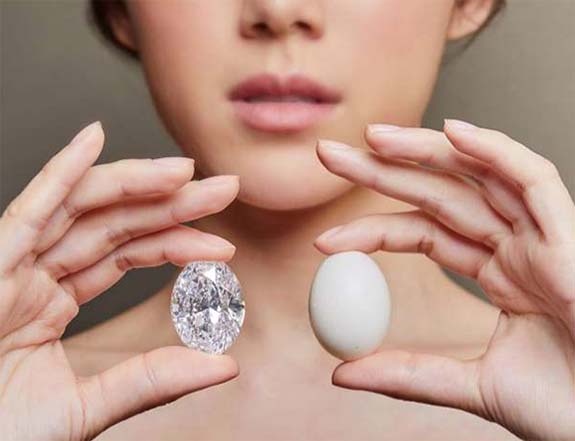
The diamond had been described by the auction house as "perfect according to every critical criterion." The collector, who remains anonymous, told Sotheby's that the gem first caught his eye while it was on exhibit in Japan during a pre-auction promotional tour.
Given the great interest in the "perfect" diamond, the hammer price easily surpassed the pre-show high estimate of $12.7 million, making the Manami Star the top lot at the Magnificent Jewels and Jadeite auction.
About the size of a small egg, the 88.22-carat faceted diamond was cut from an elongated 242-carat rough stone discovered at the Jwaneng mine in Botswana. The oval shape was chosen to maximize the carat weight.
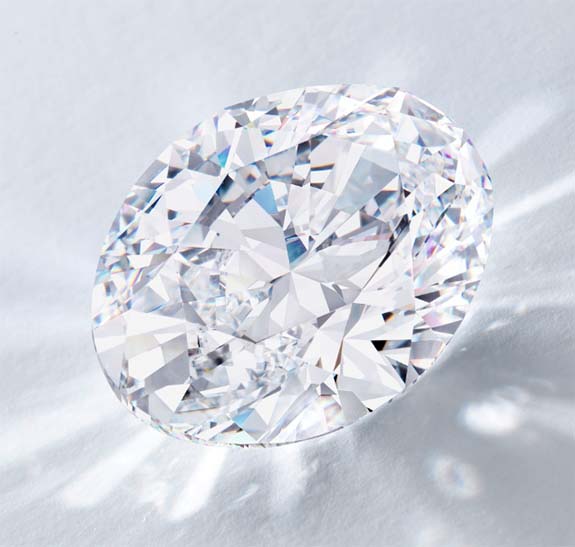
Sotheby’s noted that the gem is one of only three oval diamonds larger than 50 carats to have appeared at auction over the past few decades. It's also the largest perfect oval seen at auction in the past five years.
The diamond is rated Type IIa, the most chemically pure classification. Diamonds of this quality display exceptional optical transparency and make up less than 2% of all gem-quality diamonds.
The Japanese buyer may have been influenced by the double-eights in the carat weight of the stone. Eight is considered a lucky number in Asian culture and “88” is believed to bring good fortune in abundance.
“We were thrilled to handle a diamond of such rarity, which now takes its place in the roster of top white diamonds to have come to the market here at Sotheby’s Asia," said Patti Wong, Sotheby’s Chairman in Asia. "At 88.22 carats, this lucky stone now carries the name of the fortunate child whose father has chosen to give it her name. A happy moment in the journey of one of the earth’s greatest, oldest treasures."
Credits: Images courtesy of Sotheby’s.
South Africa's 117-Year-Old Cullinan Mine Yields 425-Carat Gem-Quality Diamond
The historic Cullinan Mine, which famously produced the 3,106-carat Cullinan in 1905, added another enormous diamond to its roster of legendary finds. London-based Petra Diamonds announced late last week that it had unearthed a 425.10-carat, D-color, ultra-pure, Type II diamond at the South African mine.
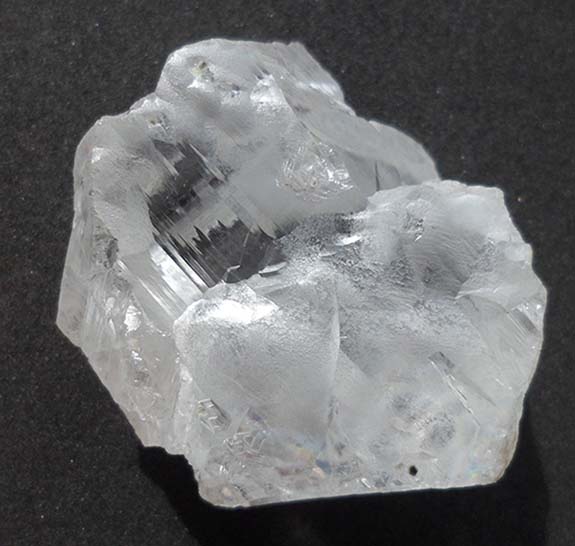
Analysts placed the stone's value somewhere between a high of $35 million and a low of $8 million. A three-dimensional mapping of the rough stone still needs to be conducted to determine the size and number of polished stones it may yield. Petra expects to sell the gem before June 30.
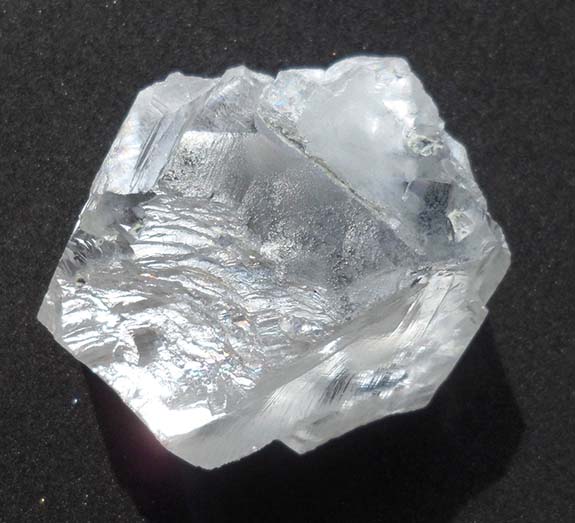
The yet-to-be named diamond is the sixth-largest ever discovered at the mine, which has been operational since 1902.
The diamond ranks 38th on Wikipedia's list of the Largest Rough Diamonds of All Time, just behind The De Beers (428.5 carats, South Africa, discovered 1888) and just ahead of The Regent (410 carats, India, 1698).
The Premier Mine, which was renamed the Cullinan Diamond Mine in celebration of its 100th anniversary, is responsible for producing seven of the world's largest 50 diamonds based on carat weight. These include the Cullinan Heritage (#27, 507 carats, 2009), Centenary (#23, 599 carats, 1986), The Golden Jubilee (#11, 755 carats, 1985) and the granddaddy of them all — the Cullinan Diamond (#1).
The 3,106-carat Cullinan diamond was eventually segmented into nine major stones, each of which was given the name Cullinan and a Roman numeral. Two of the gems are part of the the British Crown Jewels — the Great Star of Africa (Cullinan I) at 530.4 carats and the Second Star of Africa (Cullinan II) at 317.4 carats.
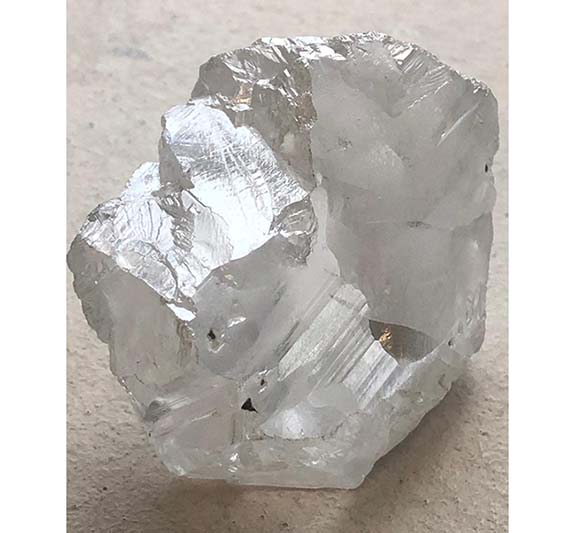
Petra's newest find boasts Type II clarity, the purest of all diamonds because they are composed solely of carbon with virtually no trace elements in the crystal lattice. A spokesperson for Petra said the newest discovery "further demonstrates the prevalence of these types of stones in the Cullinan orebody, as well as the ability of the mine’s plant to recover the full spectrum of diamonds.”
Credits: Images courtesy of Petra Diamonds.
Boyfriend Surprises 'American Idol' Contestant With On-Stage Proposal, Tears Flow
In the lead-up to her performance on Monday night's edition of American Idol, contestant Johanna Jones said she wished her boyfriend, Matt Zavoral, could have been there. He was buried in final exams at Brigham Young University, and couldn't get from Provo, Utah, to Hollywood in time for the taping — or so she thought.
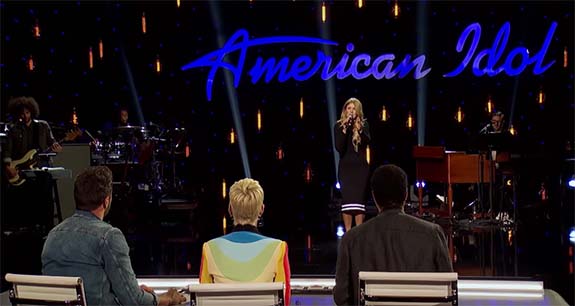
"I don't want to get ahead myself, but he's probably the one," she said in a wonderful foreshadowing of what happened next.
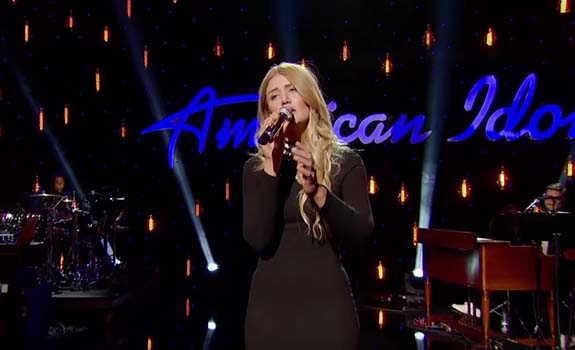
Jones, a 23-year-old fast food cook from Las Vegas, earned a standing ovation for her unique and soulful interpretation of Chris Isaak’s “Wicked Game."

While judges Katy Perry, Lionel Richie and Luke Bryan applauded the young singer, Zavoral emerged from backstage and joined his girlfriend in the spotlight.
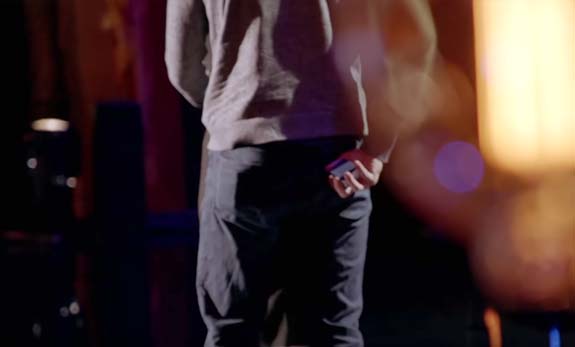
With his hands gripping a ring box hidden behind his back, Zavoral said, "I couldn't be here this week because of exams, but I couldn't wait another day."
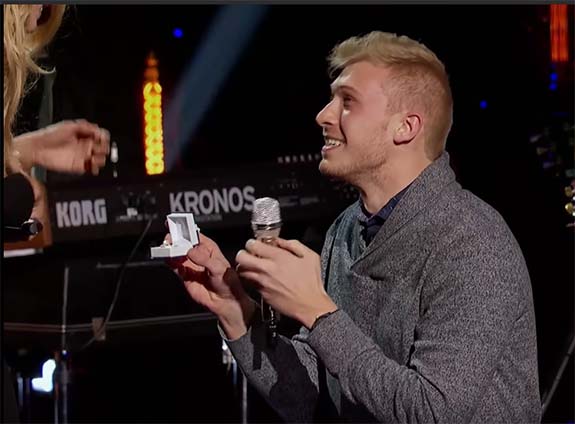
Then he went down on one knee and said, "Johanna, you are the love of my life. Will you marry me?"
Johanna said, "Yes," and Zavoral placed a halo-style diamond ring on his girlfriend's finger.
Jones' dad, who was watching with his wife from the audience, shouted, "He did ask me first. He got the thumbs up!"
Meanwhile, Perry was crying buckets of happy tears, collapsing to the floor behind the judge's table.
"Why won't someone love me like that," she weeped.
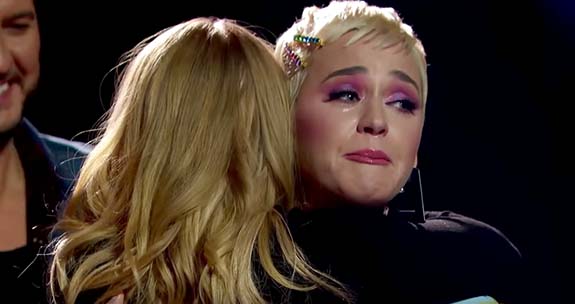
The comment seemed odd because Perry accepted an equally romantic proposal from actor Orlando Bloom on Valentine's Day. What we didn't realize is that the taping of the show predated her proposal. Perry cleared up the details in a Twitter post.
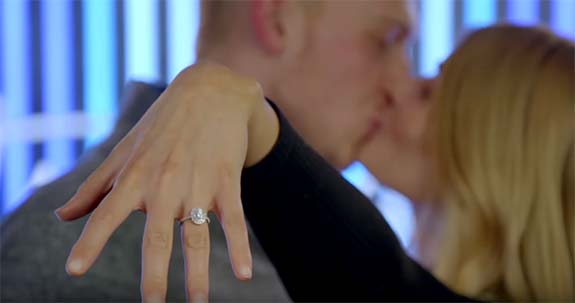
The cameras followed Jones and Zavoral backstage where the couple continued their celebration.
Zavoral explained that he had taken six exams the day before and then traveled 11 hours starting at the crack of dawn to make it to Hollywood just in time for his girlfriend's performance.
"Matt is the most amazing man I've ever met," said Jones. "No matter what happens, I'm going to go home smiling."
Jones certainly has a few busy months ahead of her and she advances to the next round of Idol, while preparing for a June 2019 wedding.
Check out Jones' performance and the romantic aftermath in the video below. The proposal starts at the 2:15 mark.
Credits: Screen captures via YouTube.com/American Idol.
Exceptional Pink and White Diamonds Put Letšeng Mine Back in the News
The Letšeng Mine in the tiny African country of Lesotho is back in the news after luxury jeweler Laurence Graff paid $8.8 million, or $656,933 per carat, for a 13.33-carat pink diamond sourced there. The per-carat price was a record for any Letšeng diamond.
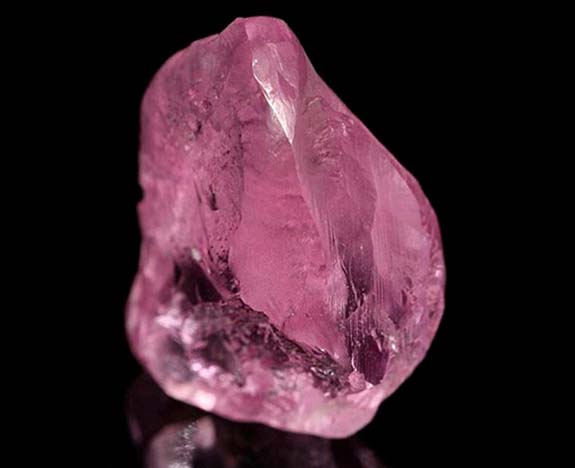
“This is the most vivid pink rough diamond I have ever seen, and it is an exceptionally rare treasure,” said Graff. “I am sure the polished diamond that comes from this rough will be an auspicious addition to our roll call of famous gems. It is an enormous privilege to own this natural miracle. We may never see anything like it again.”
Hot on the heels of that first announcement, Gem Diamonds — a 70% stakeholder in Letšeng — disclosed that the prolific mine had yielded a 161-carat, white color, Type IIa gem.

If you're a fan of fabulous diamonds, you may already know that the Letšeng Mine is famous for producing large, exceptional diamonds and generating more dollars per carat than any other kimberlite diamond mine in the world.
In fact, a little over a year ago, Letšeng made headlines when it revealed an amazing 910-carat D-color, Type IIa diamond. As the fifth-largest gem-quality diamond ever recovered, the Lesotho Legend was eventually sold for a whopping $40 million.
(Type IIa represents the most chemically pure classification of diamonds. They display exceptional optical transparency and make up less than 2% of all gem-quality diamonds.)
Gem Diamonds reported that Letšeng in 2018 yielded 15 stones weighing more than 100 carats, a record for the company. By comparison, it produced seven diamonds larger than 100 carats in 2017. And while the mine is best known for its flawless white diamonds, Letšeng is starting to make its mark in the world of fancy-colored diamonds, as well.
Despite its diminutive size (it's about the size of Maryland), the landlocked country of Lesotho at the southern tip of Africa is a powerhouse in the diamond world. Miners at Letšeng recovered 126,875 carats in 2018, up from 11,811 in 2017. The average per-carat value of the rough material rose over that same period from $1,930 to $2,131.
Letšeng has the distinction of being one of the world's highest diamond mines. Its average elevation is 10,000 feet (nearly two miles) above sea level.
Images: Courtesy of Gem Diamonds..