
Survey: Shoppers to Spend More on Jewelry Than Any Other Valentine's Day Gift Category
For the third consecutive year, U.S. consumers are expected to spend more on jewelry than any other Valentine’s Day gift category, according to an annual report released by the National Retail Federation.

Spending for jewelry-related Valentine's Day gifts is likely to reach $3.9 billion, outpacing "an evening out" ($3.5 billion, given by 34%), clothing ($2.1 billion, 18%), flowers ($1.9 billion, 35%), candy ($1.8 billion, 52%), gift cards ($1.3 billion, 15%) and greeting cards ($933 million, 44%).
Of those surveyed, 26% of men and 9% of women said they would be gifting a special piece of jewelry on February 14.
The NRF reports that overall spending on Valentine’s Day gifts will reach an all-time record of $20.7 billion in 2019, up from $19.6 billion in 2018. Those surveyed said they would spend an average of $161.96. That’s an increase of 13% from last year’s $143.56 and easily tops the previous record of $146.84 set in 2016.
“Those who are participating are spending more than ever and that could be the result of the strong economy," commented NRF President and CEO Matthew Shay.
Valentine gift givers will spend an average of $93.24 on their significant other/spouse; $29.87 on other family members, such as children or parents, $9.78 on friends, $8.63 on children’s classmates or teachers, $7.78 on co-workers, $6.94 on pets, and $5.72 on others.
On the average, men are budgeting $229.54 for Valentine's Day gifts, an increase of 20% over last year. Women will be spending $97.77, about 1% lower than last year. Among age groups, those 35-44 are the biggest Valentine's Day spenders at $279.14, followed by those 25-34 at $239.07. Both groups typically have more people on their gift lists, including children and children’s classmates or teachers.
Despite the record spending numbers, the portion of Americans celebrating Valentine's Day is expected to decline to 51% in 2019, a drop of 4 percentage points compared to 2018 and more than 12 points down from 2007.
The NRF’s 2019 Valentine’s Day spending survey was designed to gauge consumer behavior and shopping trends related to Valentine’s Day. The survey was conducted for NRF by Prosper Insights & Analytics. The poll of 7,384 consumers took place from January 2-9, 2019, and has a margin of error of plus or minus 1.2 percentage points.
Credit: Image by BigStockPhoto.com.
Birthstone Feature: Stunning 78.3-Carat Gem Is Smithsonian's First Amethyst From Rwanda
Billed as the first amethyst from Rwanda to join the National Gem Collection, this stunning 78.3-carat Super Trillion™ Cut was faceted by award-winning cutter John Dyer and is a first-rate example of February's birthstone.
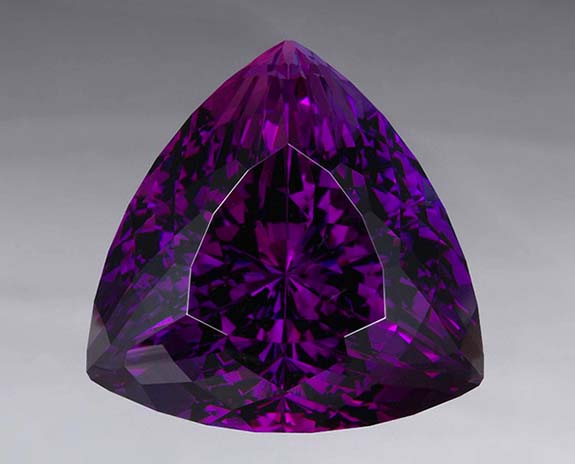
Dyer told us yesterday that the original rough amethyst, which weighed 465.5 carats, yielded four finished stones, the largest of which was purchased by the Smithsonian in 2017. The second-largest weighed about 10 carats. The painstaking faceting process took more than three days to complete.
Smithsonian representatives were impressed by the stone's size, unusual origin, unique cut and deep rich purple color with flashes of red.
Based in Edina, Minn., Dyer has notched 54 cutting awards and is famous for his artistic ability and passion for precision. His Super Trillion™ Cut reflects an optimized pattern that adds more facets and other variations to the traditional trillion cut.
Dyer noted that he purchased the rough amethyst through a dealer who had access to a brand new find in Rwanda. Amethysts traditionally have been sourced in Brazil, Uruguay, Zambia, Mexico, Italy, Germany, Canada and the U.S.
Amethyst is the most coveted variety of quartz, which is clear in its pure state. Amethyst gets its purple color from a few atoms of iron displacing some of the silicon in the gem’s molecular structure. These traces of iron can give amethyst a wide range of colors, from almost white to deep purple.
The ancient Greeks believed amethyst could prevent drunkenness. Medieval soldiers wore amethyst to protect themselves in battle. Other cultures believed February’s birthstone would bring good fortune, inspire their intellect, heal their illnesses, or bolster their immune systems.
Amethyst gets its name from the Greek word “amethystos,” which literally means “not to intoxicate.” Apparently, the Greeks believed amethyst could reverse the effects of drunkenness. Other characteristics attributed to amethyst include peace, balance, courage, stability and inner strength.
The color rating of an amethyst is determined by its hue, tone and saturation. Hue is the color; tone is relative lightness or darkness of the color; and saturation relates to the color’s intensity, from dull to vivid.
Credit: Photo by John Dyer & Co, courtesy of the Smithsonian.
North America's Largest Rough Diamond Makes Final Public Appearance — And We Were There
The largest rough diamond ever mined in North America — the fancy yellow "552" — made its final public appearance at Phillips auction house in New York City on Sunday. And we were there.
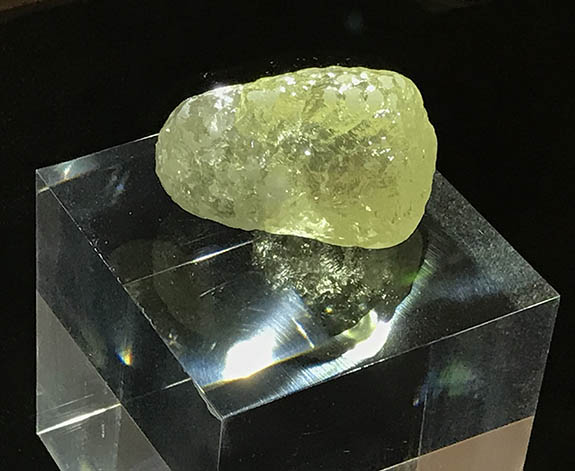
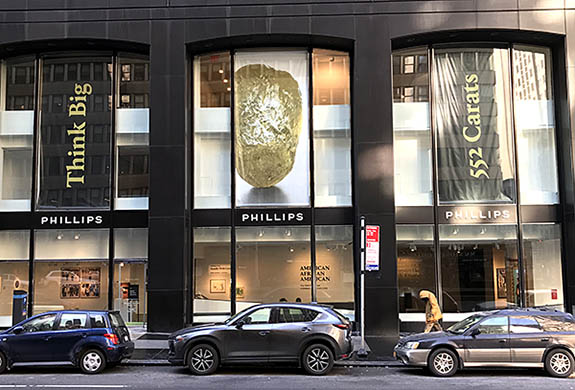
Exhibiting a frosty surface and distinctive bi-color transition from intense yellow to nearly white, the 552-carat diamond seemed surreal in its glass case at the street-level exhibit hall of the famous auction house on Park Avenue and 57th. Giant vertical banners in the Phillips windows delivered a bold and simple message, "Think Big — 552 Carats." It was the public's final opportunity to see one of nature's true wonders — before it gets transformed into faceted stones.
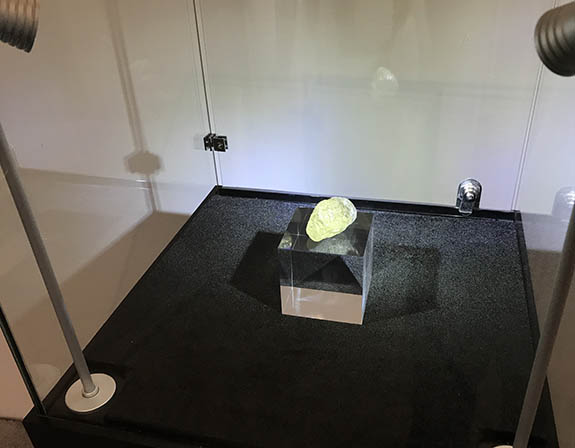
Inside, a solitary glass case illuminated by two spotlights and watched over carefully by two armed guards provided the temporary home to the "552." The spectacular diamond had been found at the Diavik mine in Canada's Northwest Territories back in October, and Phillips' executives pitched Dominion Diamond Mines with the idea of putting the diamond on display in New York City before it went through the cutting process.
Dominion Diamond Mines Director of Marketing Rachel Aaron told us that there are two likely outcomes for the egg-sized "552." In scenario one, the rough diamond would yield a primary faceted stone of 150 to 200 carats, as well as a number of residual faceted diamonds. In scenario two, cutters would opt for a pair of primary diamonds in the 70- to-100-carat range, plus the residual stones. The pair of smaller diamonds, she said, would be considered more wearable.

Aaron said that only four or five cutters in the world are capable of handling a fancy yellow diamond of this magnitude. Dominion has yet to select a cutting partner.
She also noted that once the diamond is cut, all the finished stones will return to Phillips for a special exhibition. She said the mapping and cutting process should take about nine months and the Phillips exhibition will likely be a year from now.

There are a number of characteristics that make the "552" unique. On close inspection, one can see a clear transition in color about two thirds of the way across the diamond. It goes from a clear, vibrant yellow to a cloudy white. Aaron said that gemologist believe that the transition point could reflect an internal fracture.
There are also obvious scars on the surface of the stone. These represent the beating the rough diamond took during the sorting and screening process. The Diavik processing plant is optimized to recover smaller diamonds, but Aaron believes the shape of the stone saved it. The stone turned vertically during the screening process and was just the right size to fit through. Had it stayed horizontal, it would have been crushed.

Aaron said the mine is not planning to change it's recovery methods to secure more super-large diamonds. The mine has been specializing in smaller, fine-quality diamonds since 2003 and there's no indication from their geological surveys that other super-large diamonds are likely to be found.
The gem's yellow color is also an anomaly at the Diavik mine. Diamonds from the mine typically rate in the D, E and F color range (colorless to near colorless) and usually boast a clarity rating of VS or better. Dominion reports, however, that a small portion of Diavik's production exhibits varying shades of brown, orangey-brown, light pink and light purple.
Despite its impressive dimensions, the "552" rates only 25th on the all-time list of the world’s largest rough diamonds, just ahead of the Lesotho’s Letseng Star (550 carats) and just behind the Central African Republic’s Spirit of de Grisogono (587 carats). The top seven diamonds on the list are all from the continent of Africa, including the granddaddy of them all, the 3,106-carat Cullinan, which was discovered near Pretoria, South Africa, in 1905.
Credits: Phillips exhibition images by The Jeweler Blog; Mine image courtesy of Dominion Diamond Mines.
Music Friday: February's Birthstone Makes Curious Appearance in Wang Chung's 'Dance Hall Days'
Welcome to Music Friday when we bring you fun songs with jewelry, gemstones or precious metals in the title or lyrics. In 1984, British band Wang Chung helped define a generation with its international hit “Dance Hall Days.” The song put a New Wave timestamp on a slew of popular movies and is memorable for lead singer/composer Jack Hues' "hallucinogenic" reference to amethyst in the final verse.

The purple gem is, of course, the official birthstone for February.
Hues sings: “So take your baby by the wrist, and in her mouth an amethyst. And in her eyes two sapphires blue, and you need her and she needs you.”
During an interview with “Just My Show” podcast host Eric Greenberg, Hues explained that the song about finding love in an old-fashioned dance hall begins innocently with the line, “Take your baby by the hand.” But, by the last verse, the tone has escalated to “Take your baby by the wrist, and in her mouth an amethyst.”
“It’s all a bit more hallucinogenic in a way, how things that start off simple get complex,” he said.
“Dance Hall Days,” which charted in 12 countries and peaked in the U.S. at #16 on the Billboard Hot 100 chart, was featured in a slew of popular movies, including Bachelor Party, Pretty in Pink, Gotti, Romy and Michele’s High School Reunion, To Live And Die In LA, Adventureland, The Informers and The Fighter.
Founded in 1980 by Nick Feldman, Jack Hues and Darren Costin, Wang Chung's unusual name translates to “yellow bell” in Mandarin Chinese. Wang Chung is also the first note in the Chinese classical music scale.
The band scored five Top-40 hits from 1983 through 1987, including "Let's Go!" and "Everybody Have Fun Tonight." The band actively toured from 1980 to 1990, and then again from 1997 to the present.
Don’t miss Wang Chung's performance of “Dance Hall Days” at the end of this post. The lyrics are below if you’d like to sing along.
“Dance Hall Days”
Written by Jack Hues. Performed by Wang Chung.
Take your baby by the hand
And make her do a high hand stand
And take your baby by the heel
And do the next thing that you feel
We were so in phase
In our dance hall days
We were cool on craze
When I, you, and everyone we knew
Could believe, do, and share in what was true
I said
Dance hall days, love
Take your baby by the hair
And pull her close and there, there, there
And take your baby by the ears
And play upon her darkest fears
We were so in phase
In our dance hall days
We were cool on craze
When I, you, and everyone we knew
Could believe, do, and share in what was true
I said
Dance hall days, love
Dance hall days
Dance hall days, love
Take your baby by the wrist
And in her mouth, an amethyst
And in her eyes, two sapphires blue
And you need her and she needs you
And you need her and she needs you
And you need her and she needs you
And you need her and she needs you
And you need her
And she needs you
We were so in phase
In our dance hall days
We were cool on craze
When I, you, and everyone we knew
Could believe, do, and share in what was true
I said
Dance hall days, love
Dance hall days, love
Dance hall days
Dance hall days, love
Dance hall days
Dance hall days, love
Dance hall days
Dance hall days, love
Credit: Screen capture via YouTube.com.
Limited-Edition Super Bowl LIII Caps Are Embellished With Rubies and Sapphires
When the New England Patriots take on the Los Angeles Rams in Super Bowl LIII this Sunday, at least a handful of fans will be wearing a limited-edition, gemstone-adorned cap that might be worth thousands more than their ticket to the game.

Carrying a price tag of $5,300, the New Era x Swarovski 9TWENTY hats feature an NFL shield logo embellished with genuine rubies and sapphires.
Rows of rubies spell out the "NFL," while blue sapphires provide the ground against which a stylized football and eight stars rise up in white metal. The stars represent the eight NFL divisions.
The luxurious ladies' caps — which are covered in crushed blue velvet and lined in satin — went on sale yesterday on a first-come, first-served basis at the NFL Shop in the Super Bowl Experience in Atlanta.
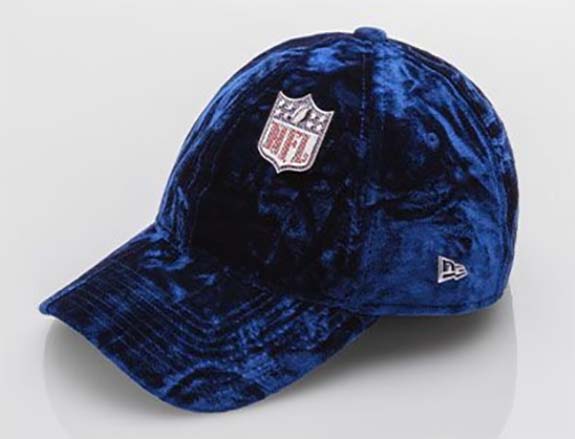
At $5,300, the price of one bejeweled cap is slightly less than a pair of nosebleed tickets, which are currently selling for about $2,700.
The caps were designed in coordination with Swarovski, which was credited with cutting the gemstones.
This was not the first time the NFL has worked with well known brands to create special items in honor of the Super Bowl.
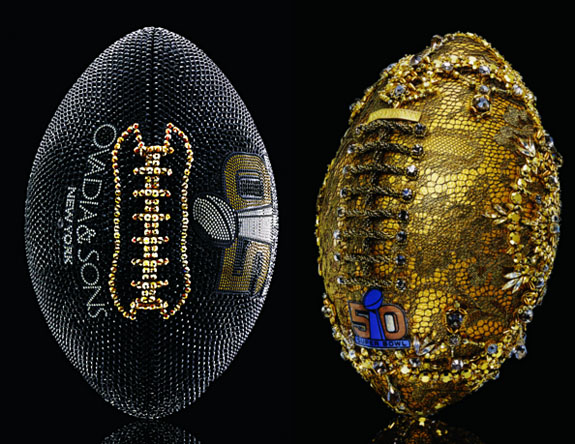
To commemorate Super Bowl 50 in 2016, the NFL and members of the Council of Fashion Designers of America (CFDA) teamed up to create 50 lavish footballs that shared a “gold” theme. The NFL required the designers to use a “gold” theme to align with the precious metal’s traditional connection with 50th anniversaries.
But, how they used the gold was totally up to them. While some positioned gold as the central motif, others used it as a glittering accent.
Our favorites were the designers who took it up a notch by mixing precious metals and gemstones to make their footballs into treasures suitable for a jeweler’s showcase.
Credit: Cap images courtesy of New Era. Ovadia & Sons, Marchesa footballs courtesy of CFDA.
Ice Ice Baby! Frosty Gem Is the 54th 200+ Carat Diamond Discovered at Karowe Mine
Ice ice baby! No, we're not referring to the 1990 song or the mammoth Arctic blast that's breaking wind-chill records from the Dakotas to Long Island. What's got our attention is this 240-carat frosty white gem-quality diamond that was just unearthed at the red-hot Karowe mine in Botswana, where the mercury topped out at 91 degrees yesterday.

Yes, Lucara's diamond mine in the tiny landlocked country in Southern Africa is arguably the world's most prolific. The recent recovery was the mine's 54th diamond in excess of 200 carats.
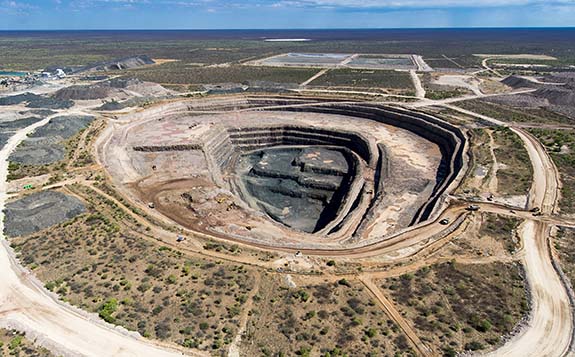
The mine that brought you the 1,109-carat Lesedi la Rona and the 813-carat Constellation, has yielded a dozen diamonds exceeding 300 carats.
Impressively, 180 diamonds from the mine have sold for $1 million or more and 10 diamonds yielded $10 million or more.
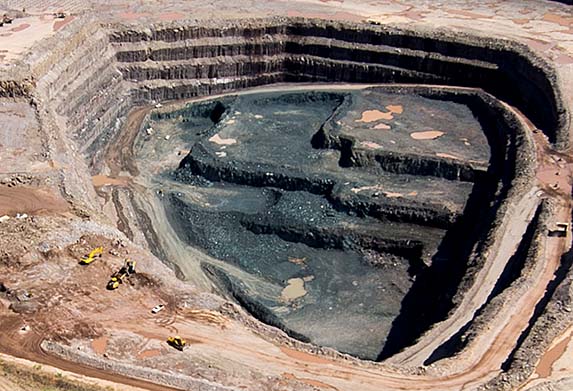
Lucara CEO Eira Thomas said 2018 was a banner year and that mining operations in 2019 will be largely focused on Karowe's higher-value lobes, the ones from which Lesedi la Rona and the Constellation were extracted.
“As Karowe enters its seventh full year of production, the regular recovery of specials (diamonds larger than 10.8 carats) continued unabated and in line with expectations,” she said. Lucara expects to extract 300,000 to 330,000 carats in 2019.
The mine has been so successful that Lucara Diamond Corp. is looking at ways to extend its lifespan.
The mine currently boasts open pit reserves of 2.6 million carats extending out to 2026 and is in the process of completing a feasibility study that could expand mining underground to 2036 and beyond, according to Thomas.
Credits: Images courtesy of Lucara Diamond Corp.
Wow! GIA Gemologist Finds Fossilized Insect Trapped Within Indonesian Opal
On a trip to Indonesia last year, GIA Graduate Gemologist Brian Berger purchased an unusually striking opal originating from the island of Java. Boasting an exciting “play of color” throughout the stone ranging from pale yellow to dark blue, the gemstone was remarkable on its own. But now it has become a potentially significant scientific discovery. Fully encased within the gemstone is an insect. While insects trapped in amber are a more common find, it is almost unheard of in a slow-forming gemstone like opal.
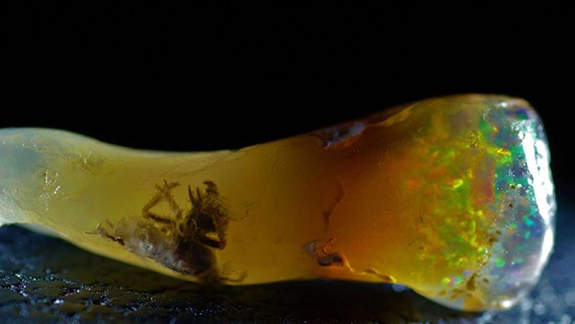
“You can see what appears to be a complete insect encased beautifully inside,” Berger noted in a blog post for Entomology Today. “The insect appears to have an open mouth and to be very well preserved, with even fibrous structures extending from the appendages."
Berger told Gizmodo: "Some researchers weren’t sure it was possible. Now we know it’s possible. Is it likely? Extremely unlikely.”
According to Ryan F. Mandelbaum at Gizmodo, most scientists believed that high-quality fossil specimens were unique to amber.

“It’s possible the bug was trapped in amber that then underwent a process known as opalization," he wrote. "Much like fossilization turns bone into stone, opalization can render organic specimens into opal’s hapless prisoners.”
Entomologist Ryan McKellar, curator of invertebrate paleontology at the Royal Saskatchewan Museum in Canada, told Gizmodo, “It is a pretty neat find, and a bit puzzling.”
Amber is cherished for its contributions to fossil records. Researchers have recovered extraordinary amber fossils featuring spiders, wasps, ants, and even a lizard. According to Vasika Udurawane at Earth Archives, petrified tree resin starts out as a viscous liquid, slowly hardening... and preserving the entrapped remains of creatures that find themselves caught up in the process.
Berger’s find supports the theory that opal can also preserve ancient remains. It has been reported, for instance, that paleontologists in Australia have found an opalized dinosaur fossil.
Michelle Starr of Science Alert noted that researchers still have a limited understanding of opal formation. The dominant theory states that silica-laden water fills cracks and cavities in its path. When it evaporates, it leaves behind silica deposits, starting the slow opal forming process. Starr notes that opalization needs a hollow cavity. Amber does not fit these parameters, leaving scientists wondering how this opal, if it did start out as amber, came to be.
Berger intends to work with an entomologist or paleontologist who can study the opal and its insect inclusion. He had submitted the stone to the Gemological Institute of America, which subsequently issued a report authenticating the specimen as an “unaltered, untampered precious opal, with a genuine insect inclusion.”
"If the process of formation is correct, from tree sap with an insect through a sedimentary process, to copal (resin), to amber, to opal, it could mean the insect has the possibility to be one of the oldest ever discovered,” Berger said.
He plans to donate the specimen to a museum after the analysis.
Credits: Images courtesy of Brian Berger, @velvetboxsociety.
Music Friday: 'I'd Make You a Chain Out of Diamonds and Pearls,' Sings Jim Croce
Welcome to Music Friday when we bring you classic songs with jewelry, gemstones or precious metals in the title or lyrics. Today, music legend Jim Croce tells his sad and lonely wife how things are going to change in the 1972 classic, "Tomorrow's Gonna Be A Brighter Day."

He'd love to give her diamonds and pearls to express how much he wants to make things right, but the hardscrabble musician can only offer a kiss and an apology.
He sings, "Well, I'm sorry for the things that I told you / But words only go so far / And if I had my way / I would reach into heaven / And I'd pull down a star for a present / And I'd make you a chain out of diamonds / And pearls from a summer sea / But all I can give you is a kiss in the morning / And a sweet apology."
Released as the second track from his chart-topping studio album, You Don't Mess Around with Jim, "Tomorrow's Gonna Be a Brighter Day" seems to reflect Croce's personal struggle with balancing a life on the road with the needs of his family.
Only 17 months after the release of this song — at the peak of his fame — the 30-year-old Croce lost his life in a plane crash near Natchitoches, La. He had just wrapped a performance at the campus of Northwestern State University.
In a letter to his 26-year-old wife, Ingrid — a letter that arrived after his death — Croce told her that he was homesick and couldn’t bear the pain of being away from her and their infant son. He was planning to stop touring and to concentrate, instead, on writing short stories. It was never to be.
Born in South Philadelphia in 1943, Croce struggled early in his music career, appearing at large coffee houses, on college campuses and at folk festivals. In 1972, he scored a three-record deal with ABC Records.
Later that year, he made his national debut on American Bandstand, which spawned appearances on The Tonight Show, The Dick Cavett Show, The Helen Reddy Show and The Midnight Special.
He was on his way and the possibilities were boundless. Sadly, his life ended much too soon.
Please check out the audio track of Croce performing "Tomorrow's Gonna Be A Brighter Day." The lyrics are below if you’d like to sing along…
"Tomorrow's Gonna Be A Brighter Day"
Written and performed by Jim Croce.
Well, I'm sorry for the things that I told you
But words only go so far
And if I had my way
I would reach into heaven
And I'd pull down a star for a present
And I'd make you a chain out of diamonds
And pearls from a summer sea
But all I can give you is a kiss in the morning
And a sweet apology
Well, I know that it hasn't been easy
And I haven't always been around
To say the right words
Or to hold you in the mornin'
Or to help you when you're down
I know I never showed you much of a good time
But baby things are gonna change
I'm gonna make up for all of the hurt I brought
I'm gonna love away all your pain
And tomorrow's gonna be a brighter day
There's gonna be some changes
Tomorrow's gonna be a brighter day
This time you can believe me
No more cryin' in your lonely room
And no more empty nights
'Cause tomorrow mornin' everything will turn out right
Well, there's something that I've got to tell you
Yes I've got something on my mind
But words come hard
When your lying in my arms
And when I'm looking deep into your eyes
But there's truth and consolation
And what I'm trying to say
Is that nobody ever had a rainbow baby
Until he had the rain
It's gonna, it's gonna, it's gonna be a brighter day
It's gonna, it's gonna, it's gonna be a brighter day
It's gonna, it's gonna, it's gonna be a brighter day
It's gonna be, it's gonna be, it's gonna be a brighter day
It's gonna be, it's gonna be, it's gonna be a brighter day
Come on tomorrow
Come on tomorrow
It's gonna be a brighter day
Credit: Image by ABC Television [Public domain], via Wikimedia Commons

Blue Cabochon Gem Still Shines in 2,000-Year-Old Ring Unearthed at City of David Site
A blue gemstone ring that was lost in a ritual bath 2,000 years ago was recently unearthed by archaeologists at the City of David National Park in Jerusalem. The site is believed to be the original urban core of the ancient city. The wonderfully preserved, but still unidentified solitaire stone, appears to be an aquamarine, turquoise or beryl.
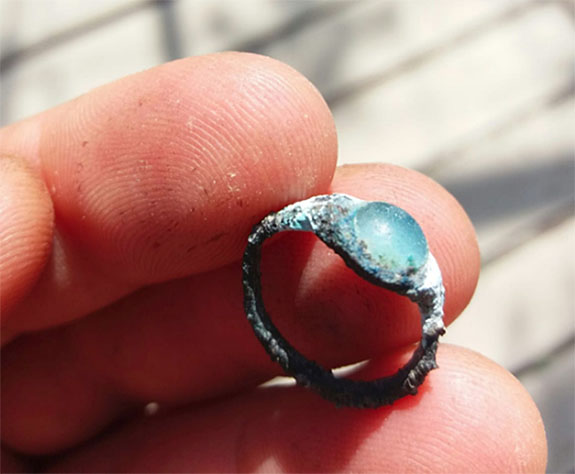
The Israel Antiquities Authority reported that archaeologists recovered the bronze ring from the remains of a ritual bath (mikveh) at the side of Pilgrimage Road, the 600-meter-long thoroughfare that leads to the Temple Mount.
On their way to the holy site, Jewish pilgrims would commonly immerse themselves in the bath to achieve ritual purity.
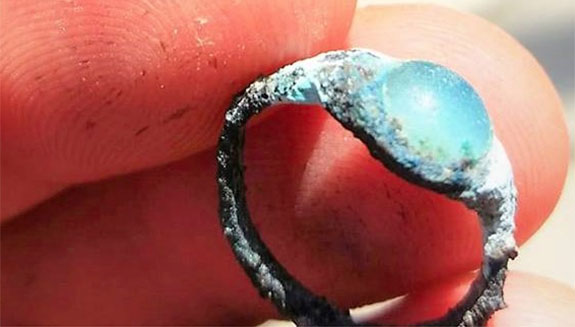
"Just like today, it would appear that in the past, rings and jewelry were removed before bathing, and sometimes forgotten," noted archaeologists Nachshon Zenton, Moran Hajabi, Ari Levy and Dr. Joe Uziel in a statement. "This phenomenon, perhaps, is behind the discovery of the ring in what appears to be a ritual bath. This ring allows us to personally connect with an individual’s personal story from 2,000 years ago. The ring, along with other finds, can shed light and expose the lives of people during the Second Temple period."

Added Doron Speilman, vice president of the City of David Foundation, “It’s incredible to think that this beautiful ring sat at the bottom of a mikveh on the ancient Pilgrimage Road for 2,000 years, until it was uncovered by archaeologists in the City of David. It is yet another piece in the puzzle that is ancient Jerusalem."
While the gemstone maintains much of it original luster, the bronze ring is showing its age. This is due to the fact that bronze is an alloy of copper and tin, both of which can corrode over time. Had the 2,000-year-old ring been crafted in gold, it would probably look pristine today.
The City of David is Israel's largest active archeological site and draws more than a half million visitors annually.
Credits: Ring photos provided by City of David. Archaeological site by Ariely [CC BY 3.0], from Wikimedia Commons.

Canadian High Schooler Discovers Kinder, Gentler Way of Liberating Diamonds From Rock
A 17-year-old Canadian high school student participating in a research program at the University of Alberta surprised her mentors by discovering a new high-yield, less destructive way of electronically separating diamonds from rock.

Using the new SELFRAG lab system, Hamdi Ali learned that pulsing diamond-rich ore with 200,000 volts of electricity effectively destroyed the rock while leaving the diamonds intact.
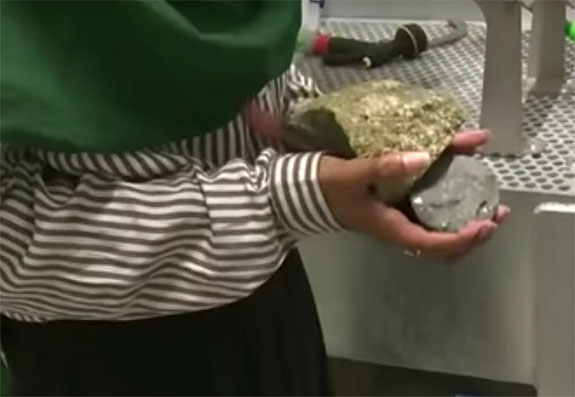
Under the supervision of graduate student Margo Regier, Ali experimented by taking a diamond-bearing rock and cutting it in half. One portion was processed using the diamond industry's standard of crushing the material between vibrating plates. The diamonds in that sample were completely destroyed. For the other half, Ali used the Swiss-made SELFRAG device to break down the rock using high voltage. This technique yielded 10 undamaged diamonds.

Ali was given the opportunity to present her findings at the Yellowknife Geoscience Forum, an experience she characterized as both "intimidated and exhilarating."

“This was my first foray into research," Ali told thegatewayonline.ca, the online publication of the University of Alberta's Student Journalism Society. "And while my results seemed promising, I didn’t know just how relatively extraordinary they were. It was only later on, as I was presenting my results to representatives from De Beers and saw their excitement firsthand, that I fully realized that my work had real-life applications.”
The SELFRAG machine at the university's Department of Earth and Atmospheric Sciences had been donated to the program so researchers could test the range of its capabilities.
The Edmonton high school student's participation in cutting-edge research was made possible by the Women in Scholarship, Engineering, Science, and Technology (WISEST) Summer Research Program. Ali hopes to continue to pursue science as a field of study.
Credits: Image of Hamdi Ali and the SELFRAG lab system, supplied. Screen captures via CTV.