
Young Couple Finds $18K in Diamond Rings Hidden in $2 Thrift Shop Board Game
A young couple visiting Prince Edward Island for the Labour Day weekend thought they struck it rich when a $2 board game purchased at a second-hand store yielded $18,000 worth of diamond jewelry. Chris Lightfoot and Mandy Flack could hardly believe their eyes when they discovered a trove of diamond rings hidden under the box's false bottom.
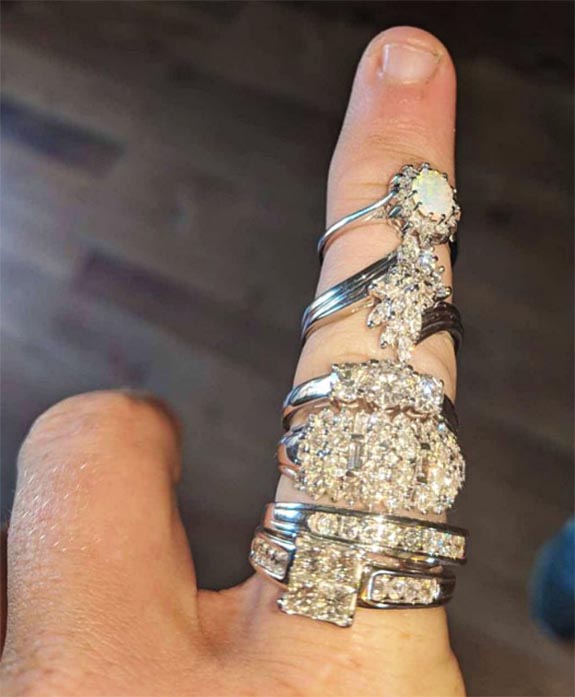
After the story went viral, a forgetful widow came forward as the rightful owner. Orlanda Drebit had recently donated the MindTrap game to a Charlottetown thrift store, just before she moved out of her home in Bonshaw, P.E.I.
She hadn't seen her diamond rings since the summer of 2015 and was not sure where she lost them. She had rushed out of town to attend the Cavendish Beach Festival and didn't have time to get to them into a safety deposit box.
The next best plan of attack was to hide her precious rings — all gifts from her late husband — where a burglar wouldn't find them. In a housecoat pocket? In a mitten shoved in a tote bag in a closet? Under cardboard in the false bottom of a 1990s board game?
When she returned from the festival, Drebit had no recollection of where she hid her rings. For months, she looked in every possible hiding place. She even checked with the hotel in Cavendish. No luck.
By December 2015, she had given up hope. She made an insurance claim and accepted the fact that she'd never see her beloved rings again.
In additional to their intrinsic value, each of the rings held a special connection to her late husband, Donald, who passed away in a car accident nine years ago. Donald appreciated Orlanda's love for fine jewelry and often lavished her with beautiful gifts — earrings, necklaces and rings.
“I have a big personality. And the jewelry matches that,” the widow told the National Post. “He took a lot of care to choose things that were different. He was a wonderful, wonderful man. He was just the other half of me.”
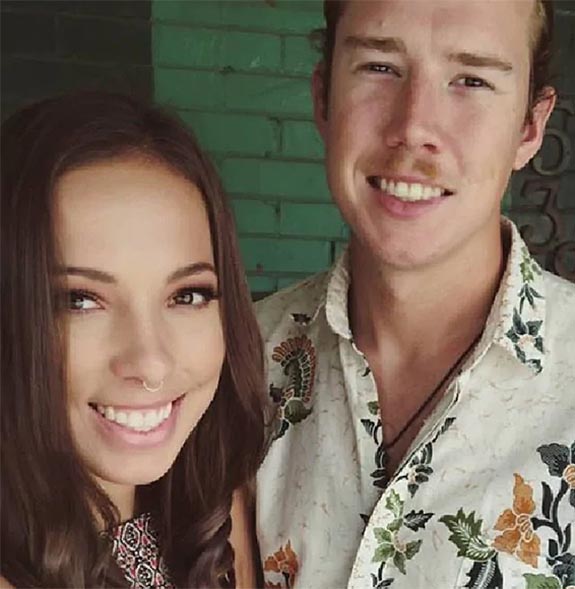
Lightfoot and Flack, who are originally from Sydney, Australia, traveled halfway around the world to establish new roots in Toronto. When Lightfoot's parents came to visit for the Labour Day holiday, the young couple chose a picturesque fishing village on Prince Edward Island as the perfect destination. In preparation for the visit, the young couple stopped in at a thrift store to pick up a board game. They ended up settling on the 1990s lateral-thinking puzzle game, MindTrap.
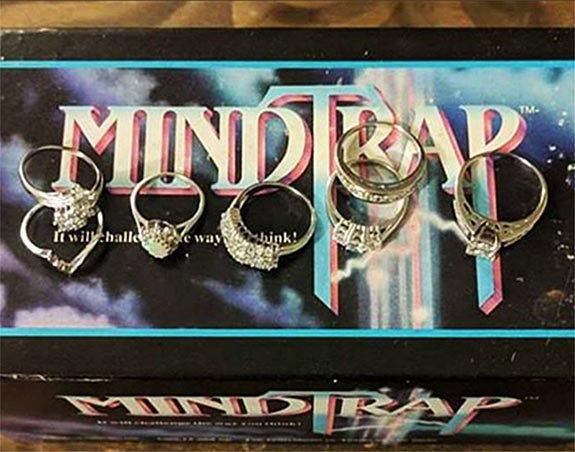
“We bring it back and start playing, and mum starts asking the questions. She goes to put the cards back in [the box] and she’s like, ‘What’s going on? They don’t fit,’” Lightfoot told Yahoo7 News. “She puts her hand in and finds a false bottom. She reaches in and pulls out a diamond ring and then another, and another and another. We are just standing there looking at each other. Is this for real?”
Lightfoot and Flack recently connected with the widow and are working out a plan to safely return the jewelry to her.
“I’ll never get him back,” Drebit said of her husband. “But getting back my engagement ring would mean a lot.”
Credits: Images via Facebook/mandy.flack1; Facebook.com/chris.lightfoot.148.
Music Friday: Don Williams Is in Love With the Girl Who Wears a Diamond Ring
Welcome to Music Friday when we bring you throwback tunes with jewelry, gemstones or precious metals in the title or lyrics. In 1977, Don Williams topped the Billboard U.S. Hot Country Songs chart with "I'm Just a Country Boy," a sweet ballad about a young man who is in love with the prettiest girl in town.
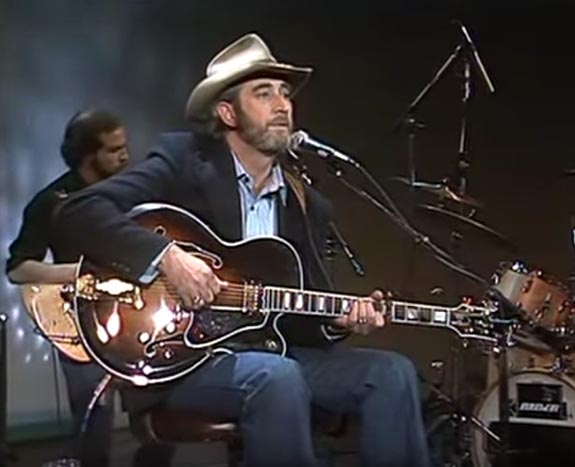
She wears a bit of bling and he fears that she'll turn down his marriage proposal because he can't afford a "store-bought ring with a sparkling diamond stone." What he can give her is a loving heart and a country boy's deep appreciation of nature's treasures.
He sings, "I ain't gonna marry in the fall / I ain't gonna marry in the spring / 'Cause I'm in love with a pretty little girl / Who wears a diamond ring. / And I'm just a country boy / Money have I none / But I've got silver in the stars / Gold in the mornin' sun / Gold in the mornin' sun."
"I'm Just a Country Boy," which appeared as the first track on Williams' album, Country Boy, was originally recorded by Harry Belafonte in 1954. It was also covered by George McCurn, Ronnie Laine, Jimmie Rodgers, Jim Croce, Jimmy Witherspoon, Roger Whittaker, David Ball, John Holt, The Brothers Four and Bobby Vinton.
The song was written by Fred Hellerman and Marshall Barer. Hellerman, who passed away in 2016 at the age of 89, was best known as an original member of the American folk group The Weavers. He also produced Alice's Restaurant (1967) for Arlo Guthrie. Barer was a lyricist, librettist, singer, songwriter and director, but was most famous for composing the "Mighty Mouse" theme song. He died in 1998 at the age of 75.
Williams amassed 17 #1 country hits during his illustrious career. The singer's imposing stature, paired with a soft, smooth bass-baritone voice earned him the nickname the "Gentle Giant" of country music. In 2010, he was inducted into the Country Music Hall of Fame.
Trivia: Williams appeared as himself and played a number of songs in Smokey and the Bandit II (1980).
The popular country star from Floydada, Texas, stopped touring in 2016 and passed away a year later at the age of 78.
Please check out the video of Williams performing "I'm Just A Country Boy." The lyrics are below if you'd like to sing along...
"I'm Just A Country Boy"
Written by Marshall Barer and Fred Kellerman. Performed by Don Williams.
I ain't gonna marry in the fall
I ain't gonna marry in the spring
'Cause I'm in love with a pretty little girl
Who wears a diamond ring.
And I'm just a country boy
Money have I none
But I've got silver in the stars
Gold in the mornin' sun
Gold in the mornin' sun.
Never gonna kiss
The ruby red lips
Of the prettiest girl in town
Never gonna ask her if she'd
Marry me
I know she'd turn me down.
'Cause I'm just a country boy
Money have I none
But I've got silver in the stars
And gold in the mornin' sun
Gold in the mornin' sun.
I never could afford
A store-bought ring
With a sparkling diamond stone
All I could afford
Is a loving heart
The only one I own.
'Cause I'm just a country boy
Money have I none
But I've got silver in the stars
And gold in the mornin' sun
Gold in the mornin' sun...
Credit: Screen capture via YouTube.com.
Three Minuscule Moon Rocks Expected to Sell for $1 Million at Sotheby's Auction
Three tiny moon rocks brought to the Earth by Soviet cosmonauts in 1970 are expected to fetch upwards of $1 million when they hit the auction block at Sotheby's New York on November 29. The specimens weigh approximately .07 carats combined, so their per-carat tally could reach a staggering $14.3 million.

By comparison, the highest price ever paid per-carat for a gemstone is $4.03 million. That record is held by the 12.03-carat Blue Moon of Josephine, a diamond that sold for $48.5 million at Sotheby’s Geneva in November of 2015.
So, why are these minuscule moon rocks pegged to sell for seven figures? Because moon specimens available for private ownership are virtually nonexistent.
While NASA reportedly owns 842 pounds of lunar material retrieved from six Apollo missions dating between 1969 and 1972, the three moon rocks offered by Sotheby's — two measuring 2 mm, and the third just 1 mm — are the only samples on the planet currently possessed by a private individual.
The moon rocks were retrieved during the Soviet Luna-16 mission and subsequently gifted to the widow of Sergei Pavlovich Korolev, the former “chief designer” and director of the Soviet space program. He is credited with heading up two monumental achievements — the launch of Sputnik, the first artificial satellite, and the flight of Yuri Gagarin, the first man in space.
Nina Ivanovna Korolev first offered the moon rocks for sale at a Sotheby's auction in 1993. The pre-sale estimate was $30,000 to $50,000, but aggressive bidding pushed the final price to $442,500. Now, 25 years later, the samples are owned by an anonymous U.S. collector and Sotheby's has reset the pre-sale estimate to $700,000 to $1 million.
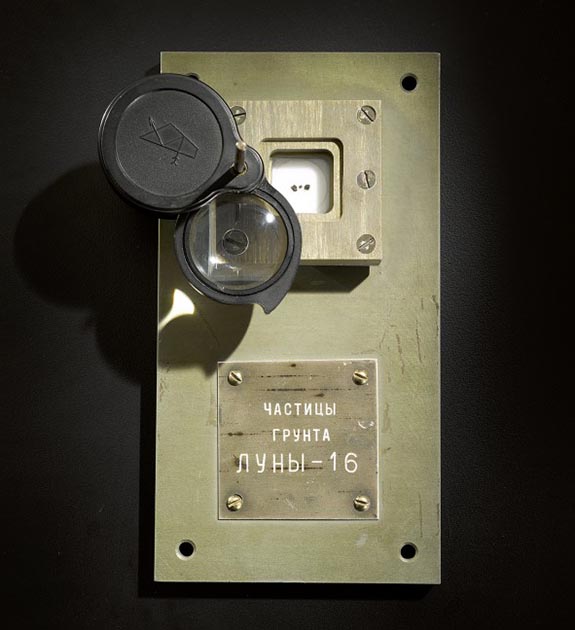
The lunar rocks are encased under glass below an adjustable viewing lens. The plaque is labeled in Russian and translates to "Soil Particles from Luna-16."
CNN reported that space objects have been a hot ticket at Sotheby's recently. A bag used by astronaut Neil Armstrong to collect lunar samples during the Apollo 11 mission fetched $1.8 million in 2017.
The moon rocks are part of a larger "Space Exploration" auction, which will include a NASA Gemini spacesuit and a Soviet LK-3 lunar lander model. Sotheby's New York will offer a public exhibition of the items, starting November 25.
Credit: Images courtesy of Sotheby's.
Gemfields Unveils 'Inkalamu,' a 5,655-Carat Zambian Emerald Crystal With Remarkable Color and Clarity
On Monday, Gemfields unveiled "Inkalamu," a 5,655-carat Zambian emerald crystal with remarkable clarity and a perfectly balanced golden green hue. The carat weight is equivalent to 1.1 kg or 2.5 lbs.
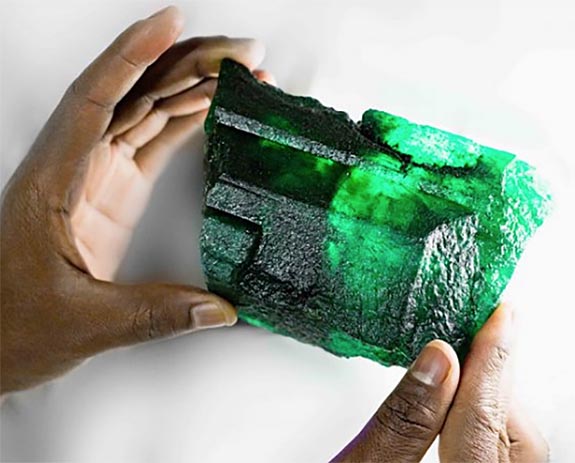
Inkalamu, which means the "Lion Emerald" in the regional Bemba language, was discovered at the Kagem mine on October 2 by geologist Debapriya Rakshit and veteran emerald miner Richard Kapeta. It will be offered for sale at Gemfields' next auction, which will take place in Singapore in November. Forty-five approved auction partners will be vying for the extraordinary find.
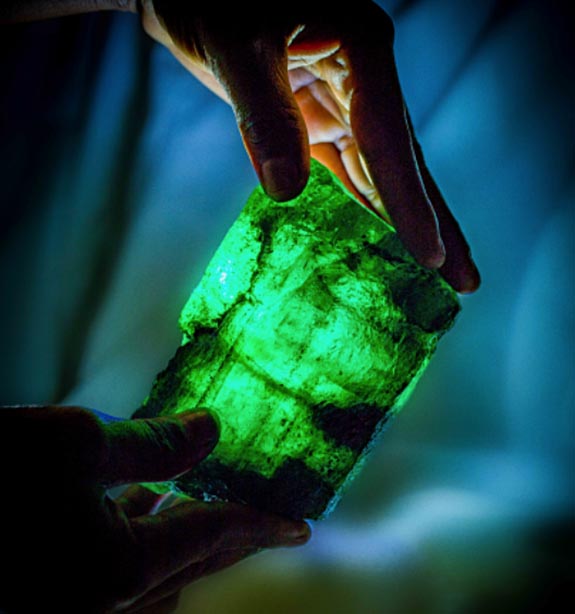
“We expect a number of large, fine-quality cut emeralds to be borne of the Inkalamu crystal,” said Adrian Banks, Gemfields’ Managing Director for Product and Sales. “There might be hundreds of offcuts that are fashioned into smaller gems, cabochons and beads, but the key lies in recovering the fine-quality pieces. Given this emerald is such a rare find, it is also perfectly conceivable that the buyer will choose to purchase it as an investment.”
Gemfields noted that it is extremely difficult to predict what the selling price might be.
Despite its massive size, Inkalamu is not the largest crystal to be unearthed at the Kagem mine. In 2010, it yielded a 6,225-carat emerald that would take the name "Insofu," which is the Bemba word for "elephant."
Gemfields believes that Inkalamu will take its place among the world's most exceptional gemstones of all time, and if the crystal is divided into smaller stones, the "The Pride of Inkalamu," so to speak, will continue the legacy for generations to come.
The name Inkalamu honors the work carried out by two of Gemfields’ conservation partners, the Zambian Carnivore Programme and the Niassa Carnivore Project in Mozambique. Gemfields will divide 10% of Inkalamu’s auction proceeds equally between the two carnivore initiatives.
Kagem, the world's largest emerald mine, is 75% owned by Gemfields and 25% owned by the Government of the Republic of Zambia.
Credits: Images courtesy of Gemfields.
600 Akoya Cultured Pearls Adorn the $400,000 Tournament of Roses Crown
Adorned with 600 cultured pearls and valued at $400,000, the bejeweled Tournament of Roses crown was placed on the head of 17-year-old Louise Deser Siskel during a coronation ceremony last Tuesday evening at the Pasadena Playhouse in Southern California.
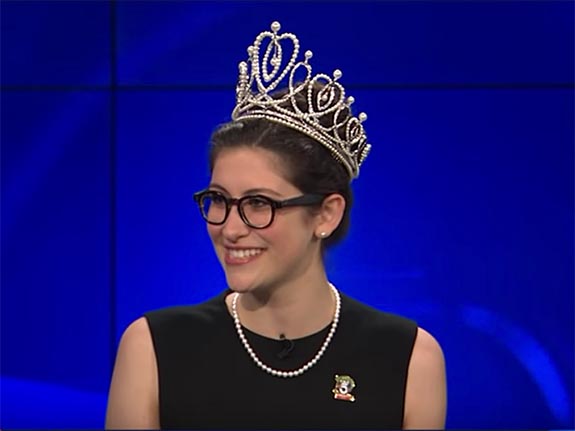
The newly crowned Rose Queen will lead the 130th edition of the Tournament of Roses Parade on New Year's Day in Pasadena. The parade, which features floral floats, spirited marching bands and high-stepping equestrian units along the 5 1/2 mile route, will be followed by the 105th Rose Bowl game.
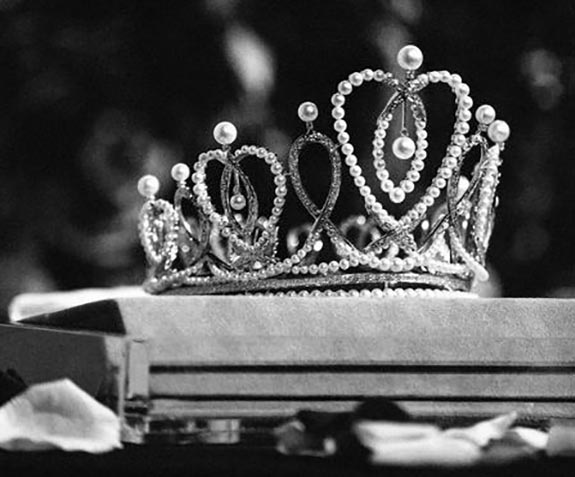
The crown designed by Mikimoto glistens with hundreds of Akoya cultured pearls, 10 white South Sea cultured pearls from Australia and six carats of diamonds. Mikimoto spokesperson John Cotter told pasadenanow.com that it took about a year to fabricate the crown.
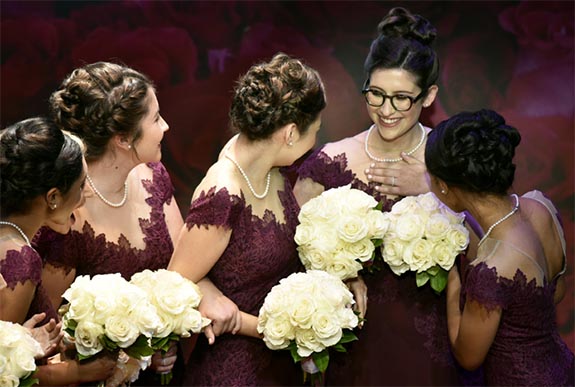
Siskel, a senior at Sequoyah High School in Pasadena, will don the impressive three-pound crown, while her six princesses will be wearing simpler cultured pearl tiaras valued at $90,000 each. The new Rose Queen plans to study cellular and molecular biology and would like to attend Johns Hopkins University.
Once the Rose Parade celebrations have concluded, the crown and tiaras will head back to Mikimoto headquarters in Japan for refurbishing. Mikimoto Kōkichi is credited with creating the first cultured pearl in the late 1800s and subsequently starting the cultured pearl industry.
Historically, the Rose Queen's head adornments have not always been so lavish, according to the Associated Press. In fact, in the early 1900s, the Rose Queens had no crowns. They simply wore hats or garland.
In 1939, a special crown was created for Rose Queen Barbara Dougall to mark the Tournament of Roses’ 50th anniversary. It was reportedly made of crystal rhinestones and featured the tournament's rose logo. Eventually, tournament officials nixed that version in favor of a more traditional design.
Credits: Louise Deser Siskel screen capture via YouTube.com/KTLA 5; Crown photo courtesy of Mikimoto. Queen and her court image via tournamentofroses.com.
Vancouver Man Spells Out Halloween-Themed Marriage Proposal Using 640 Pumpkins
Justine Aichelberger and Jesse Seads met at a Halloween party seven years ago, so when the young man was plotting a surprise marriage proposal recently, he was determined to include pumpkins — many pumpkins — in his plan.

Seads had arranged for his girlfriend to "win" an aerial tour for two over Vancouver Island. Once airborne, Aichelberger could have hardly predicted that the flight would take her and her boyfriend directly over Gobind Farms, where 640 pumpkins neatly spelled out the question "Justine - Will You Marry Me?"
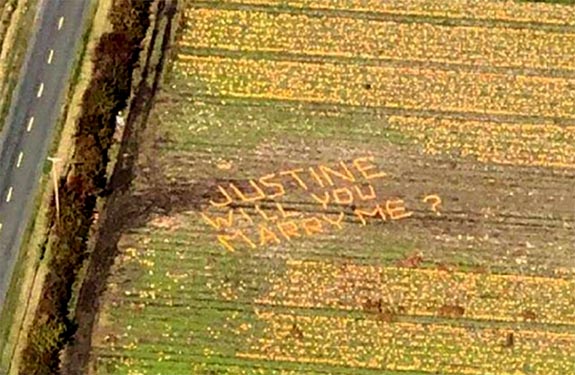
The romantic groom-to-be pulled out a diamond engagement ring when the pumpkin message came into view. A stunned Aichelberger said, "Yes," and the couple celebrated their engagement with some high-flying selfies and a glass of champagne.
“It kind of read ‘Justine will you marry me’ and it took me a minute for me to take it all in. I was really shocked,” Aichelberger told cheknews.ca. "I’m so happy, he will do anything for me. He would move the world if he could for me. It’s just an amazing feeling.”
Seads had enlisted the help of his parents, Douglas and Julie, friend Andreas Bokelman and 95-year-old neighbor Jim Squire for the tricky task of rolling hundreds of pumpkins precisely into place.
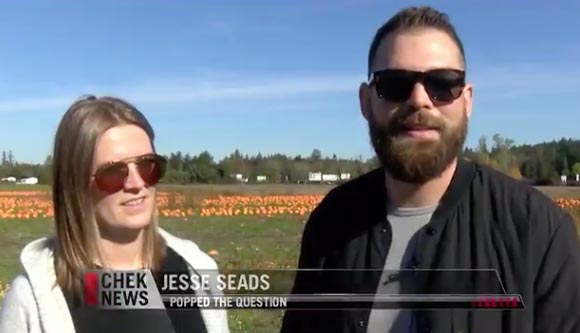
"We got really lucky I think it just turned out really well,” Seads told vancouverislandfreedaily.com.
The flight continued from Saanichton northwest to scenic Courtenay, where the couple gathered with friends and family at a cabin on the beach.
Seads said the pumpkin proposal was well worth the effort.
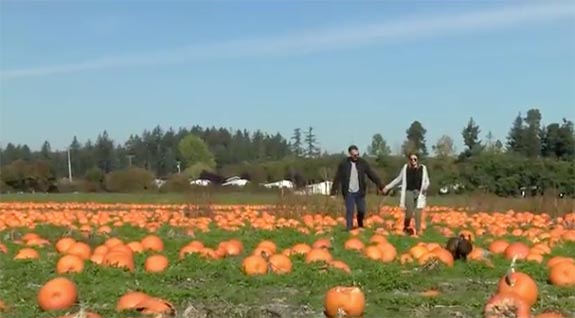
“Any time she thinks of pumpkins in the future or sees pumpkins, pumpkin pies or whatever, she will think of our engagement day,” Seads told cheknews.ca.
The couple has yet to announce a wedding date.
Credits: Flight images by Justine Aichelberger. Screen captures via cheknews.ca.
Music Friday: Learn From Mistakes and 'Make Them Gold,' Urges Chvrches' Lauren Mayberry
Welcome to Music Friday when we bring you new tunes with jewelry, gemstones or precious metals in the title or lyrics. Today, Lauren Mayberry of the Scottish synthpop band Chvrches (pronounced churches) implores her young fans to embrace their mistakes and "make them gold."
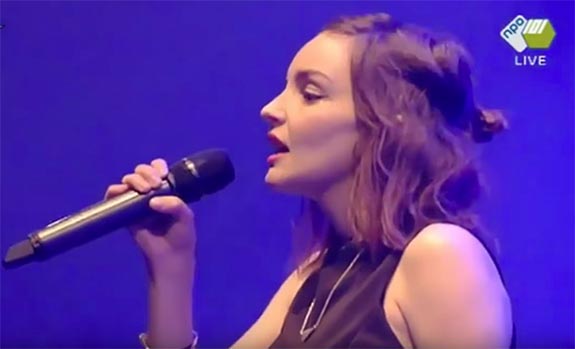
Written by band members Iain Andrew Cook, Martin Clifford Doherty and Mayberry, "Make Them Gold" is an empowerment anthem that reinforces the notion that nobody is perfect and mistakes are actually a blessing in disguise. They're an essential part of the process of building skills, confidence and attaining one's goals.
She sings, "We are made up of our mistakes / We are falling but not alone / We will take the best parts of ourselves / And make them gold."
Gold, in this case, symbolizes perfection, success and something of great value.
"Make Them Gold" appeared as the fourth track of the group's second studio album, Every Open Eye. Released in 2015, the album went to #1 on both the U.S. Billboard Top Alternative Albums and U.S. Billboard Top Rock Albums charts. It was also an international success, charting in 16 countries, including Scotland, Sweden, Australia and the UK.
Gathering their inspiration from Madonna, Eurythmics, Prince, Depeche Mode, Kate Bush, Death Cab for Cutie and Cyndi Lauper, among others, the band members write, record, mix and master their songs in Glasgow, Scotland.
The odd spelling of Chvrches is attributed to a general concern about how the band may — or may not be — found on the internet. When the band was formed in 2011, the three members had chosen Churches as the name, but changed it to Chvrches with a Roman letter "v" instant of a "u" because they didn't think they'd have a chance to come up at the top of a "churches" search result.
"After we decided on [the name], we realized it was more or less impossible to Google," Doherty told Interview magazine. "There's a girl called Amy who's designed all of our artwork. She'd already stylized the logo with the "V" in it. It kind of felt natural just to go with that. Now, we don't have to compete with anyone, which is cool."
Trivia: Just a few weeks ago, the band appeared in the heart of Texas at the Austin City Limits Music Festival.
Please check out the video of Chvrches' live performance of "Make Them Gold." The lyrics are below if you'd like to sing along...
"Make Them Gold"
Written by Iain Andrew Cook, Lauren Eve Mayberry and Martin Clifford Doherty. Performed by Chvrches.
Can you tell me what to have
And what to hold
If you never take the way
On your own
No one tells us what is hard
And what is fair
We will deliver once we know
Where to fall
We are made up of our mistakes
We are falling but not alone
We will take the best parts of ourselves
And make them gold
We are made of the smallest stars
We are breathing and letting go
We will take the best parts of ourselves
And make them gold
Can you steady all the hands
That you hold
If you never look away
From the drum
If you push yourself then I
Will pull you up
And we will deliver once we know
Where to fall
We are made up of our mistakes
We are falling but not alone
We will take the best parts of ourselves
And make them gold
We are made of the smallest stars
We are breathing and letting go
We will take the best parts of ourselves
And make them gold
I will wait to see if you come at all
To stop us falling out of phase
Let's see if we can keep
Track of losing days
You'd smile so wide i can see the stars
To stop us falling out of phase
I will be with you in the fray
With those second thoughts
You asked for all you asked for
We are made up of our mistakes
We are falling but not alone
We will take the best parts of ourselves
And make them gold
We are made of the smallest stars
We are breathing and letting go
We will take the best parts of ourselves
And make them gold
And make them gold
Credit: Image capture via YouTube.com.
Artist Trevor Paglen Is About to Launch a ‘Diamond’ the Size of Two School Buses Into Low Earth Orbit
A diamond-shaped reflective balloon the size of two school buses will be delivered into low-Earth orbit by a SpaceX Falcon 9 rocket in mid-November. Visible from the Earth without the aid of a telescope, the "The Orbital Reflector" by artist Trevor Paglen will appear as bright as a star in the Big Dipper.
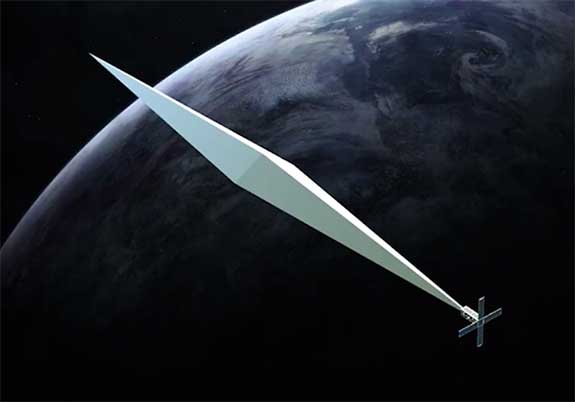
The diamond will orbit the Earth for three months, after which it will fall through the Earth’s atmosphere and burn up harmlessly. The high-flying diamond could go down in history as the most widely viewed artwork of all time.
Paglen collaborated with the Nevada Museum of Art on the $1.3 million project that encourages all of us to look up at the night sky with a renewed sense of wonder, to consider our place in the universe and to re-imagine how we live together on this planet.
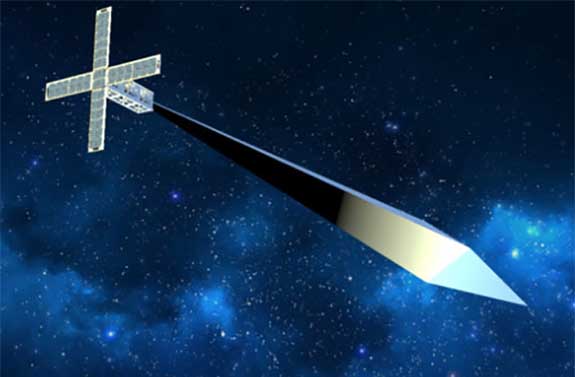
The rocket's main mission is to place 70 communication satellites into orbit about 350 miles from the Earth. But one of those satellites will be "The Orbital Reflector." The package will start its mission the size of a shoebox, but when it reaches the proper altitude, it will unfurl and then self-inflate into a 100-foot-long diamond in the sky.
It's actually constructed of a lightweight polyethylene material that looks like thin plastic. Reflective titanium dioxide powder coats the sculpture, making it visible from Earth with the naked eye.
The artist and engineers behind the project debated whether the reflector should be a sphere or a diamond. They finally settled on the diamond shape because it could deliver “bigger, brighter and better in flight than a sphere.”
Skywatchers will be able to track the diamond's path using a free app that can post alerts when the high-flying, slow-moving attraction is about to pass over a particular area.
Credits: Images courtesy of Trevor Paglen/Nevada Museum of Art.
Made Famous by Marilyn Monroe, 'Moon of Baroda' Diamond to Hit the Auction Block in Hong Kong
Hollywood starlet Marilyn Monroe sang "Diamonds Are a Girl’s Best Friend" and wore the 24-carat Moon of Baroda diamond while promoting the Howard Hawks film Gentlemen Prefer Blondes in 1953.
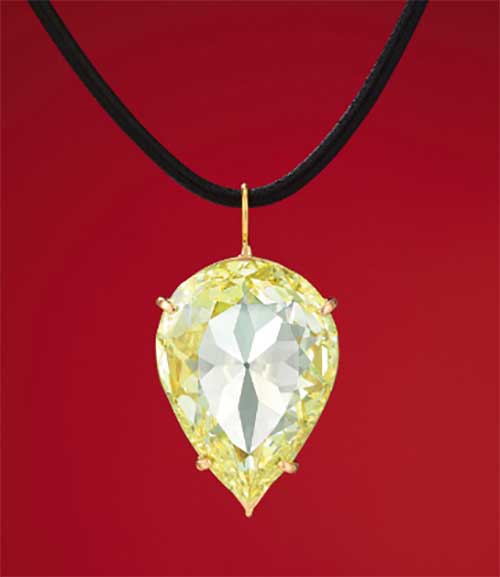
"It’s gorgeous!" Monroe gasped when she first set eyes on the pear-shaped, VS2, canary yellow stone. It was the largest diamond she ever wore in her lifetime.
Despite its historical ties to the Maharajas of India and the legendary Golconda mines near Hyderabad, it was an adoring Monroe who helped catapult the Moon of Baroda to international fame.
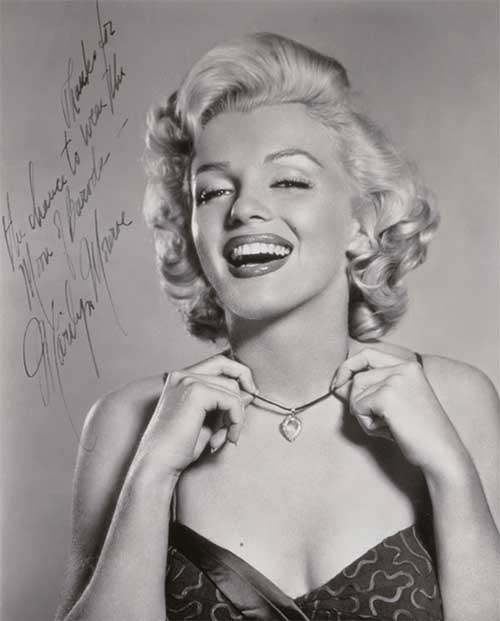
On November 27, after 18 years in a private collection, the Moon of Baroda will regain the spotlight at Christie's Magnificent Jewels Sale in Hong Kong. The pre-sale estimate is $510,300 to $765,450. When the same stone hit the auction block at Christie's New York in 1990, it fetched $297,000.
This time around, the winning bidder will get a bonus — an autographed publicity shot of the glamorous Monroe wearing the Moon of Baroda. On the photo she wrote, "Thanks for the chance to wear the Moon of Baroda — Marilyn Monroe."
“It’s really hard to give an estimate to such a legendary and historical stone," Christie’s Connie Luk told The Hollywood Reporter. "We give the estimate based on the market price of a 24-carat yellow diamond. We believe that the historical value will add to the price.”
According to Christie's, the Moon of Baroda was likely discovered between the 15th and 17th centuries and owned by the Gaekwads of Baroda, one of India’s wealthiest and most powerful ruling families.
It was later sent by the Gaekwad family to Empress Maria Theresa of Austria, the only female monarch of the Habsburg dynasty. The diamond was returned to the Gaekwad family and set into a necklace in the mid-1800s. The Maharaja Sayajirao Gaekwad sold it to an unknown buyer in the early 1920s.
The stone was acquired by Cleveland diamond cutter Samuel H. Deutsch in 1944 and sold to Meyer Rosenbaum, president of Detroit-based Meyer Jewelry Company, in 1953. It was Rosenbaum who loaned the diamond to Monroe for her publicity tour.
Luk told The Hollywood Reporter that the anonymous current buyer had a hard time parting with the famous stone.
“We paid him a visit almost every year to ask him if he’s interested in selling, and we were quite persistent," she said. "And finally, this year he said yes to us.”
Credits: Images courtesy of Christie's.
Golden State Warriors Unveil the First-Ever Reversible Championship Rings
The Golden State Warriors kicked off a new season with a ring ceremony last Tuesday to commemorate their 2017-18 championship run, and as expected, they’re opulent.
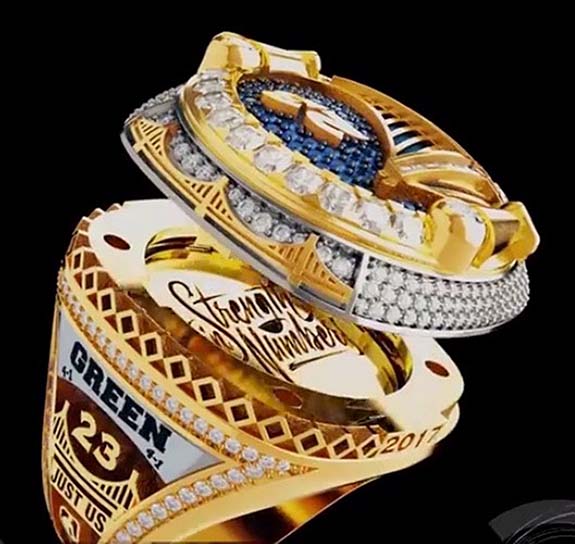
The rings’ most interesting feature is the reversible top, the first-of-its-kind for a championship ring. The head of the ring, which can be completely detached from its band, has a centerpiece that can be flipped from blue to white, the Warriors' primary colors. Twisting off the top of the ring reveals the slogan ‘Strength in Numbers’ etched in gold.
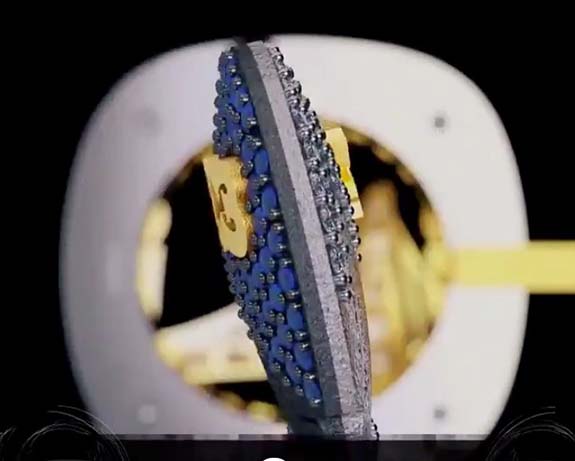
There are 56 diamonds set on the right side of the ring to commemorate the number of years the team has been in the San Francisco Bay area. The left side features the player’s name and number, Bay Bridge and “Just Us” slogan. There is an interesting bristly texture (as though it were swept with a broom), celebrating the four-game sweep of the Cavaliers in the 2018 final. The top is a perfect circle to match the footprint of Oracle Arena, the Warriors' current home. And that's just for starters.
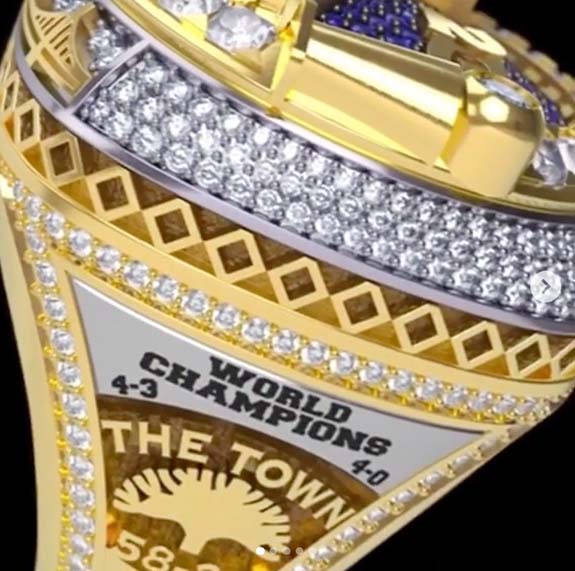
There are two trophies on top of the ring, signifying the team’s back-to-back championships in 2017 and 2018. The 2017 trophy is 17-karat gold and has .17 carats of white diamonds; the 2018 trophy is 18-karat gold and has .18 carats of white diamonds. Each side has 74 sapphires and diamonds to represent the combined number of wins in the regular season and the playoffs.
When you've won three NBA championships in the past four years (only the 13th team ever to complete such a feat), your championship ring needs some extra bling. Designer Jason Arasheben, aka Jason of Beverly Hills, created the technically challenging rings composed of nearly 20 pieces.
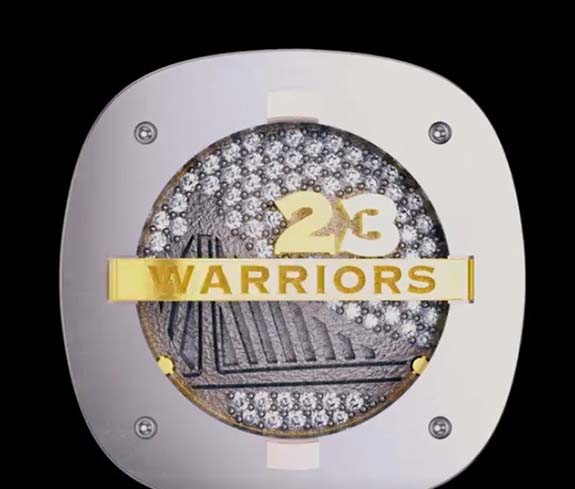
“The highlight of the ring is clearly the reversible feature from the top of the ring. Jason of Beverly Hills really brought something new to the ring design game, and executed his vision beautifully,” stated a Warriors’ spokesperson.
On Tuesday night, as the Warriors headed to the floor in white jackets with “The Champions” inscribed in gold, the team’s accomplishments were announced over the public-address system — dominance practically unheard of in NBA history.
Credits: Images via Twitter/Golden State Warriors; Instagram/Jason of Beverly Hills.