
'The Constellation' Sets Rough Diamond Price Record; 813-Carat Stablemate of 'Lesedi la Rona' Sells for $63M
Back in November of 2015, Canada-based Lucara enjoyed an uncanny stroke of good luck when its workers discovered two enormous gem-quality rough diamonds at its Karowe Mine in Botswana. The pair tipped the scales at a combined 1,922 carats — or just shy of a 14 ounces.
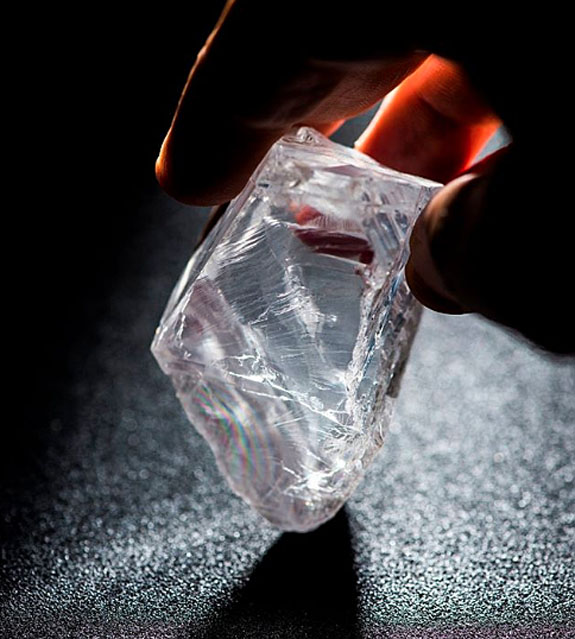
The larger of the two — the 1,109-carat Lesedi la Rona — will be offered for sale at Sotheby's London on June 29. The smaller of the two — The Constellation — just set a record when the 813-carat gem was purchased by Dubai-based Nemesis International for $63.1 million. It was the highest price ever paid for a rough diamond.

The record is likely to be short lived because the Lesedi la Rona is expected to fetch at least $70 million in London. If Lesedi la Rona earns the same $77,649 per-carat as its Lucara stablemate, it is likely to garner upwards of $86 million.
Both diamonds have been rated Type IIa by the Gemological Institute of America. Diamonds in this rare and coveted subgroup are chemically pure and often show extraordinary optical transparency.

As part of the deal with Nemesis International, Lucara retained a 10% interest in the net profit from the sale of the faceted diamond (or diamonds) The Constellation will yield after cutting and polishing.
Lesedi la Rona is being billed by Sotheby's as "The Diamond of a Lifetime" because it's the biggest rough diamond to be unearthed in more than a century. Only the 3,016-carat Cullinan Diamond, discovered in 1905, was larger. The Constellation, at 813 carats, is the sixth largest gem-quality rough diamond ever found, according to NationalJeweler.com.
It's hard to imagine how improbable it was for Lucara to secure two such extraordinary diamonds within days of each other in the same area of a single diamond mine — in this case, the south lobe of the Karowe Mine.
Credits: Facebook/Lucara Diamond Corporation.
Utah Man's Romantic Proposal Takes Unexpected Turn When Girlfriend Opens an Empty Ring Box
They say, "The best laid plans of mice and men often go awry” and that's certainly the case for Greg Nottingham, whose perfectly planned marriage proposal took an unexpected turn of epic proportions.

The Provo, Utah, resident had picked a glorious day, the perfect diamond engagement ring and a scenic riverside setting for a romanic picnic with his girlfriend of five years, Sax Brinkley, and their dog, Bella. What's more, he also arranged for some friends to secretly photograph the exact moment Nottingham would pop the question to the love of his life.
At first, everything seemed to be going swimmingly.
When the timing was just right, Nottingham smoothly pulled a ring box from his jacket pocket and went down on one knee. As he opened the box, it became frighteningly clear that something very important was missing.
"There's nothing in it," exclaimed Brinkley as her mortified boyfriend froze in horror.
Fortunately for Nottingham, Brinkley has a wonderful sense of humor. All she could do was chuckle at the classic blunder.
Trying to make the best of a bad situation, Nottingham joked, "This is the part where I get down on one knee and show you a really pretty ring."
Nottingham had picked up the wrong box on his way to the picnic and left the actual engagement ring at home.
Despite the epic goof, Nottingham was undaunted as he continued with the marriage proposal — ring or no ring.
"Will you be mine forever and always, and for the rest of your life?" he asked.
"Yes, yes," she answered.
Then he lifted her into his arms.
As their friends filmed the couple, Brinkley wore a wide grin and repeated, "He forgot the ring! He forgot the ring!"
Later, Nottingham explained the circumstance that led to the embarrassing situation...
"I got the wrong box," he said. "Before I left the house, I put this coat on and just felt the pocket, which had a box in it. I didn't think to check it. The box I picked up was the gift box. The box with the ring [was] in another jacket."
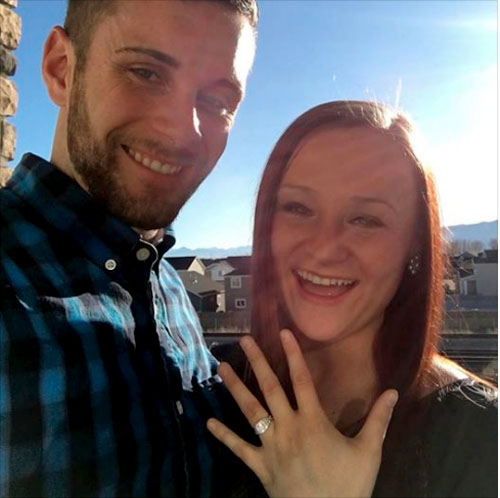
After the picnic, the couple dashed home so Nottingham could give Brinkley her engagement ring. From the photo posted on Brinkley's Facebook page, it was clear the bride-to-be loved her new bling.
Despite the happy ending, Nottingham realized that his embarrassing story is now part of marriage proposal folklore.
"I'll have to live with that moment for the rest of my life," he said. Check out the video at The Daily Mail...
Credits: Video screen capture via Mail Online; Facebook/Saxanie Brinkley.
1,109-Carat 'Lesedi la Rona' Diamond Expected to Fetch $70M+ at Sotheby's London on June 29
The greatest diamond find in more than a century — the 1,109-carat gem-quality "Lesedi la Rona" — is expected to fetch at least $70 million when it goes under the hammer at what promises to be an electrifying stand-alone sale at Sotheby's London on June 29.
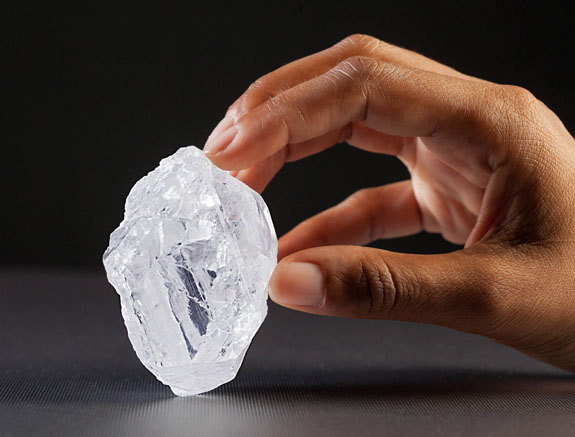
The $70 million figure would set a record for the highest price ever paid for a gemstone at auction, surpassing the $48.5 million achieved by the 12.03-carat Blue Moon of Josephine diamond at Sotheby's in November of 2015.
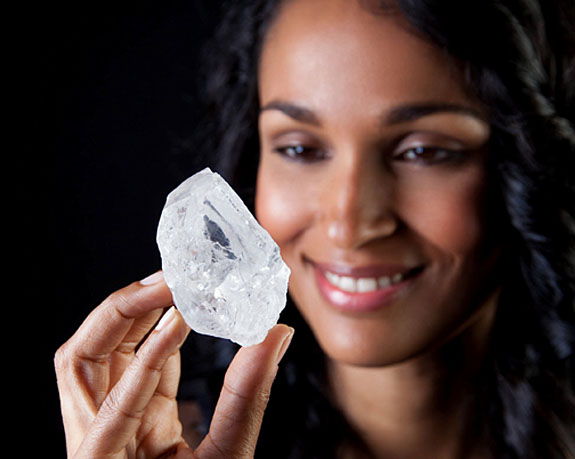
In its current rough state, Lesedi La Rona is the size of a tennis ball. When cut and polished, it could yield a D-color diamond weighing more than 400 carats. The current record for the largest top-quality faceted diamond in existence is held by the 530.20-carat Great Star of Africa, which was the largest of nine diamonds carved from the legendary 3,016-carat Cullinan Diamond more than a century ago. The Great Star of Africa is now part of the British Crown Jewels.
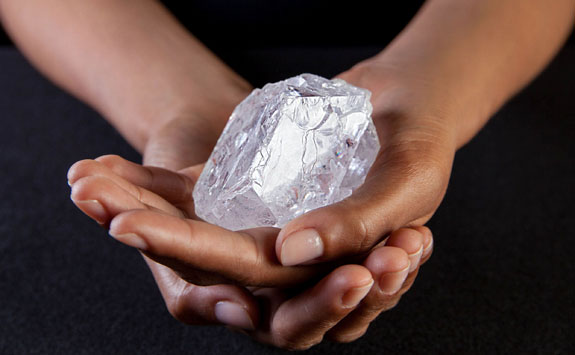
Unearthed by Lucara Diamond Corp. at its Karowe mine in Botswana in 2015, Lesedi la Rona means "Our Light" in the Tswana language spoken by the Botswana people. Sotheby's is calling Lesedi la Rona "The Diamond of a Lifetime."
When we first wrote about Lesedi la Rona in November 2015, Lucara had reported its weight to be 1,111 carats. The new weight of 1,109 reflects a loss of 2 carats during the cleaning process, which is normal, a Sotheby's spokesperson told NationalJeweler.com.
According to the Gemological Institute of America, the Lesedi la Rona’s “top color and transparency exemplify the 'limpid' appearance commonly associated with Type IIa diamonds” – a rare and coveted subgroup which comprises less than 2% of all gem diamonds. Stones in this group are “the most chemically pure and often show extraordinary optical transparency."
Independent reports on the potential yield of the rough have stated that the Lesedi la Rona may have the potential to yield the largest top-quality diamond that has ever been cut and polished.
“The Lesedi la Rona is simply outstanding and its discovery is the find of a lifetime," commented David Bennett, Worldwide Chairman of Sotheby’s Jewelry Division. "It is a huge honor for Sotheby’s to have been entrusted with its sale. Every aspect of this auction is unprecedented. Not only is the rough superlative in size and quality, but no rough even remotely of this scale has ever been offered before at public auction.”
The Lesedi la Rona will be on view at Sotheby’s London from June 18-28, ahead of its auction in the evening of June 29.
Credits: Donald Bowers/Getty Images for Sotheby's.
Music Friday: Teardrops Turn Into Precious Gems in Kelita's Inspirational Song of Inner Healing, 'Tears'
Welcome to Music Friday when we often bring you uplifting songs with jewelry, gemstones or precious metals in the title or lyrics. Today, Canadian recording artist Kelita performs "Tears," an inspirational song about inner healing and overcoming adversity.
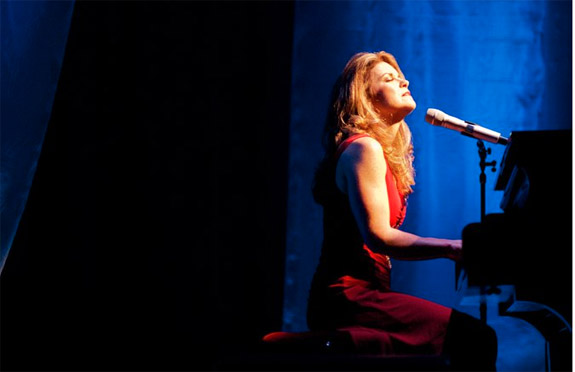
In this song, Kelita compares herself to a sparrow with broken wings. But, instead of accepting her fate of never being able to "fly," she describes how the Holy One will take away the pain by cradling her teardrops and transforming them into precious stones.
She sings, "Shimmering diamonds, rubies of red / Bright as the blood that my dear Savior shed / Emeralds of green, sapphires of blue / He’ll take away your teardrops / Turn them into jewels."
"Tears" first appeared in 2000 on Kelita's Naked Soul album, a work that earned a nomination for a Juno Award (Canada's version of a Grammy) for Best Gospel Album. Kelita also included the song as the final track of her Heart of a Woman album in 2010.
Born Kelita Haverland in Alberta, Canada, the singer/songwriter/actress/comedian draws her strength from having overcome a series of seemingly insurmountable life challenges. As a child, she suffered sexual abuse at the hands of her sibling. Her alcoholic father committed suicide and then her mother died from cancer. Her abusive sibling later died from a heroin overdose, and Kelita nearly lost her own life in a terrible auto accident.
Kelita's official website explains that the artist writes, sings and speaks what is gleaned from her own life experiences. From a relentless life of tragedy to triumph, the lessons are shared with a transparency and honesty that engages, encourages and inspires. Her ability to touch and penetrate the hearts of audiences is what drives her success.
Kelita is credited with giving the first break to an aspiring 19-year-old singer name Eileen Twain. The teenager from Timmins, Ontario, sang backup on Kelita's hit song, "Too Hot to Handle." Today, that up-and-coming young singer is known as Shania Twain.
We know you will enjoy the audio clip of Kelita singing "Tears." The lyrics are below if you'd like to sing along...
"Tears"
Written and performed by Kelita Haverland.
Tiny little sparrow fell from the tree
Sometimes I feel that little wounded sparrow is me
Tiny broken wings that never will fly
I wonder does her little heart know how to cry
Chorus:
Does her heart know how to cry
Are her tears gently falling inside
Crying tears she’s been trying to hide
Does her heart know how to cry like mine
Warm velvet words poured like sweet honey from his tongue
Until tonight I’d never heard the Holy one
He said that he would cradle every teardrop in His hand
He’d take away their pain and turn them into precious gems
Jesus knows the tears that you've cried
And he has seen them falling inside
Crying tears you've been trying to hide
Jesus knows the tears that you've cried like mine
Bridge:
Shimmering diamonds, rubies of red
Bright as the blood that my dear Savior shed
Emeralds of green, sapphires of blue
He’ll take away your teardrops
Turn them into jewels
Jesus knows the tears that you've cried
And he has seen them falling inside
Crying tears you've been trying to hide
Jesus knows, Jesus knows, Jesus knows the tears that you've cried like mine
Credit: Promotional image via www.kelita.com.
Smithsonian's 75-Carat Hooker Emerald Was Once Mounted Into a Sultan's Belt Buckle
One of the world's most spectacular examples of May's official birthstone is the 75.47-carat Hooker Emerald, an historic gem that was once mounted into the belt buckle of an Ottoman sultan.
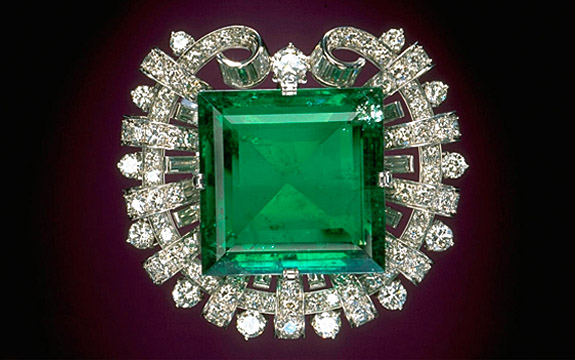
Today, it is beautifully displayed in a platinum brooch adorned with 109 brilliant-cut diamonds weighing approximately 13 carats. When Janet Annenberg Hooker donated the piece in 1977 to the Smithsonian in Washington, D.C., it was valued at $500,000. Based on inflation alone, today it would be worth $2.03 million.
If the name Janet Annenberg Hooker sounds a bit familiar, it may be because the renowned philanthropist and publishing heiress was the principal benefactor of the Smithsonian's National Museum of Natural History. Her cash donation to the museum of $5 million allowed for the construction of a fabulous gallery, which was named the Janet Annenberg Hooker Hall of Geology, Gems and Minerals.
The emerald brooch designed by Tiffany & Co. is an open-ended circular band of platinum. The two ends of the band curl outward into scrolls and are connected by a large round brilliant-cut diamond. Spokes cross the band and converge in the center, forming the setting for the Hooker Emerald.
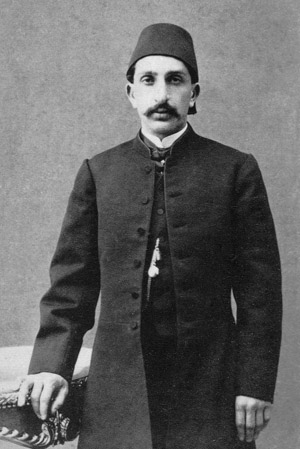
The emerald was mined in Colombia in the 16th or 17th century and was sent to Europe by Spanish conquistadors to be cut and polished. The gem was sold to the ruling family of the Ottoman Empire and became part of the crown jewels during the reign of Sultan Abdul Hamid II (1876-1909). The sultan reportedly wore the emerald mounted into his belt buckle.
In 1908, the emerald was smuggled to Paris on behalf of the sultan, who hoped the proceeds from its sale would ensure him a comfortable life in exile should he be dethroned by a revolution. The sultan never received the anticipated windfall. The money raised by the sale of the gem went to the succeeding government.
The massive emerald had been auctioned to Tiffany & Co, which initially set it in a tiara. Despite its beauty, the tiara remained unsold for decades. In 1950, the emerald was re-set into a brooch that included matching earrings. Five years later, the brooch was purchased by Hooker. In 1977, she donated it to the Smithsonian.
The Hall of Geology, Gems and Minerals that was named in her honor was officially opened in September of 1997, just three months before she passed away at the age of 93.
Lush green emeralds have excited legions of gem admirers for thousands of years. The first emerald mines were in Egypt, and Cleopatra was known to favor this, the most famous member of the beryl family. The name "emerald" comes indirectly from the ancient Greek word for green, “smaragdos.” Ancient Romans believed emerald could relieve eyestrain, and the grass-green emerald was said to be one of the four precious stones given by God to King Solomon.
Besides being the birthstone for the month of May, it's also the official gemstone for 20th and 35th wedding anniversaries.
Credit: Hooker Emerald by Chip Clark, courtesy Smithsonian Institution, National Museum of Natural History; Sultan Abdul Hamid II (public domain).
'Impossibly Rare' Violet Diamond Could Fetch $5 Million or More
Described as "impossibly rare" and "a complete fluke of nature," the largest violet diamond ever found at Australia's Argyle mine could sell for $5 million or more.

The 2.83-carat polished oval-shaped diamond, known as The Argyle Violet, will headline the 2016 Argyle Pink Diamonds Tender, the annual showcase of the rarest diamonds from the Argyle mine in Western Australia.
The Rio Tinto-owned mine generates more than 90% of the world's pink diamonds, and on rare occasion will yield a violet stone. In the past 32 years, Argyle has produced only 12 carats of polished violet diamonds for its annual tender. In fact, before the discovery of The Argyle Violet, the mine had delivered just one other 1-carat-plus violet-colored diamond — and that was in 2008.
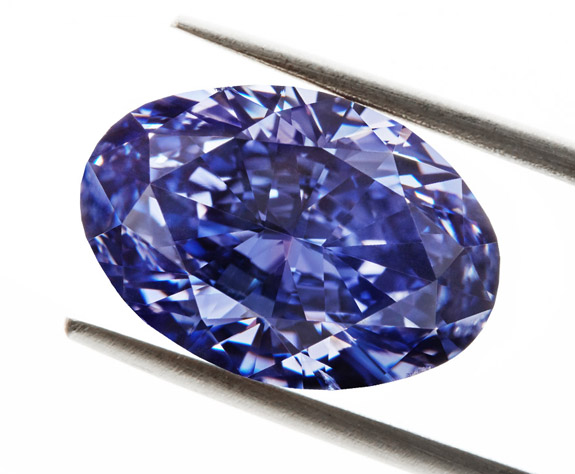
The Argyle Violet is "a complete fluke of nature," Josephine Archer from Argyle Pink Diamonds told Yahoo7 News.
Rio Tinto’s general manager of sales Patrick Coppens added, “Impossibly rare and limited by nature, The Argyle Violet will be highly sought after for its beauty, size and provenance.”

Argyle’s master polisher Richard How Kim Kam worked for more than 80 hours cutting the 9.17-carat oddly-shaped rough diamond into its perfectly symmetrical final form. More than 69% of the diamond's weight was lost during the cutting process.
The Argyle Violet was assessed a color grade of "Fancy Deep Greyish Bluish Violet" by the Gemological Institute of America. Violet diamonds owe their unique color to the presence of hydrogen atoms in the chemical composition of the stone.
Experts believe The Argyle Violet is sure to attract offers of $1 million to $2 million per carat at Argyle's annual tender. That would put its selling price somewhere between $2.8 million and $5.6 million.
Argyle Pink Diamonds manager Josephine Johnson said, “We are very excited to announce this historic diamond ahead of our Tender launch. This stunning violet diamond will capture the imagination of the world’s leading collectors and connoisseurs.”
Credits: Images courtesy of Rio Tinto.
Jewelry Remains the Top Gift-Giving Category for Mother's Day; Spending to Exceed $4.2 Billion
Americans will be spending more than $4.2 billion on jewelry gifts for their moms this Mother's Day, according to survey results just released by the National Retail Federation. That dollar amount places "jewelry" at the top of all gift categories — a place it has occupied for four of the past five years.

The survey revealed that 35.4% of adults have jewelry on their Mother's Day shopping lists this year, up from 34.2% in 2015 and 31.7% in 2014. Nearly four in 10 men (39.2%) plan to purchase a jewelry item for the special moms in their world, while 31.7% of woman plan to do the same.
The average cost of a Mother's Day jewelry gift will be $95.71, with men expecting to spend $117.79 and women $69.82.
Total Mother's Day gift spending is expected to reach $21.4 billion in 2016, up slightly from $21.2 billion in 2015. Overall, men will spend $197.77 on Mother's Day gifts this year, while women will spend $147.99.
While jewelry remains to top category in terms of dollars spent, other strong categories include "special outings" ($4.1 billion), flowers ($2.4 billion), gift cards ($2.2 billion), consumer electronics ($1.9 billion), apparel ($1.9 billion) and personal services, such as spa treatments ($1.6 billion).
Mother’s Day greeting cards are still a gifting staple, with 78% of consumers reporting that they will buy a card for their moms. Total spending on cards will reach $792 million in 2016, according to the NRF.
The biggest spenders this Mother’s Day are expected to be 25- to 34-year-olds ($248.88). Their 18- to 24-year-old counterparts plan to spend an average of $188.87.
Mother's Day continues to draw wide interest and participation across all demographic groups. Overall, 84.4% of adults surveyed said they would be celebrating Mother's Day in 2016. That participation rate grows to about 95% for adults 18 to 34.
“Mother’s Day is the time when millions of Americans find special ways to express their love and gratitude for Mom,” said analyst Pam Goodfellow of Prosper Insights & Analytics, which conducted the survey of 7,000 consumers for the NRF. “While many will spend a little more than usual to pamper her, some consumers will provide unique experience gifts for the entire family to enjoy together.”
Don't forget: Mother's Day is this Sunday, May 8!
Image: Bigstockphoto.com
40 Contestants Pounce on 800-Pound Wedding Cake to Find the $2K Diamond Engagement Ring Baked Inside
Decked out in their "Star 98 Diamond Dive" T-shirts, 40 wildly enthusiastic contestants pounced on a 6-foot-tall, 800-pound wedding cake to try to find a $2,000 diamond engagement ring that was baked inside.

They destroyed the cake in a matter of seconds as onlookers at the Grand Teton Mall in Idaho Falls, Idaho, this past Saturday watched in amazement. A video of the event shows the cake being enveloped by a sea of humanity.
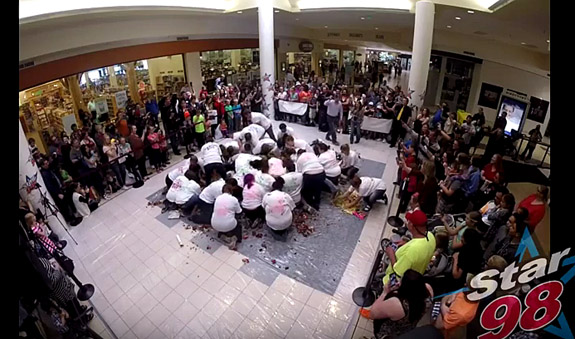
The 2nd Annual Diamond Dive was sponsored by local radio station Star 98 in conjunction with a local baker, who designed the cake, and a local jeweler, who provided the jewelry. In all, 16 rings were hidden in the cake, 15 of which were non-precious and represented other prizes. The grand prize was a genuine .50-carat princess-cut diamond engagement ring.
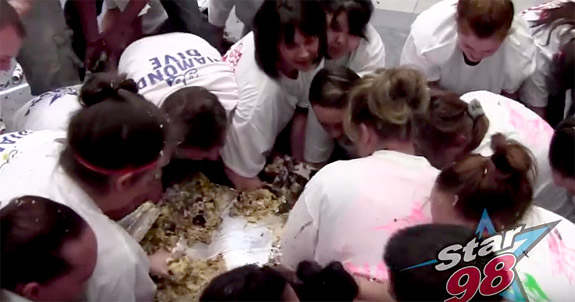
In order to qualify for the Diamond Dive, listeners of Star 98 had to call the station at designated times, starting on April 18. Forty people were eventually selected to participate in the messy, no-holds-barred cake-diving event.

To make the massive cake, the baker's team had to use 165 cake mixes, 54 dozen eggs, 192 pounds of sugar, 72 pounds of shortening and a quart of cake flavoring.

As the excitement unfolded on Saturday, the only person who knew the exact location of the diamond ring was the baker.

As if describing an Olympic event, Star 98 program manager Preston Lee joked to Local News 8, "So these are dedicated people. They've been training. They've been warming up for the past few years. Now, all that training is coming together for one moment, for the diamond dive."
All 16 rings were found within 15 minutes, and emerging victorious with the genuine engagement ring was Nick Musetti, who admitted he didn't have a significant other.
"I'm thinking about selling it because I don't have anyone to give it to," he lamented.
Check out the fun video below...
Images: Screen captures via YouTube; Facebook/Sugar Shell; Facebook/Star 98.
Music Friday Flashback: Lynn Anderson Nearly Let 'Rose Garden' Slip Away Because of the Diamond Ring Reference in the Lyrics
It's a little known fact that country music singer Lynn Anderson was nearly dissuaded from recording her signature song, "Rose Garden," in 1970 because of the diamond ring reference in the lyrics.
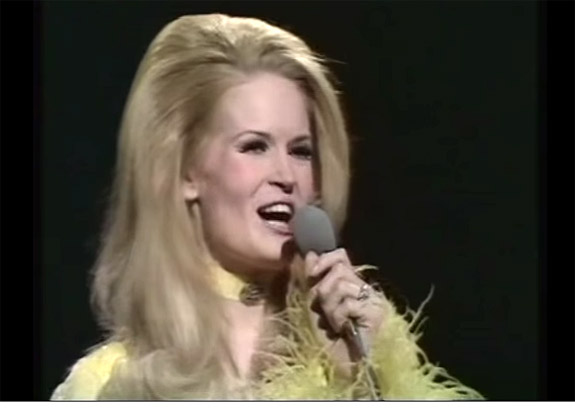
Although Anderson really liked the tune penned by Joe South, her producer (and husband) Glenn Sutton felt it was a "man's song" because of the following line: "I could promise you things like big diamond rings / But you don't find roses growin' on stalks of clover / So you better think it over."
As luck would have it, Anderson had some extra time left in one of her studio sessions and Sutton finally agreed to record the song with an up-tempo arrangement accompanied by a mandolin player and a full string section. Columbia executive Clive Davis was so impressed with the results that he insisted the song be released as a single for the country and pop markets.
The song not only topped the U.S. Billboard Country chart, but it also reached #3 on the U.S. Billboard Hot 100 and became a major pop hit internationally. It went to #1 in Australia, Canada, New Zealand, Ireland and Norway. "Rose Garden" is considered one of the most successful country crossover songs of all time.
Anderson told the Associated Press in 1987 that "Rose Garden" was perfectly timed to appeal to the youth of 1970.
"It was popular because it touched on emotions,'' Anderson said. "It was out just as we came out of the Vietnam years and a lot of people were trying to recover. This song stated that you can make something out of nothing. You take it and go ahead."
The song's key line, "I never promised you a rose garden," essentially means "I never told you it was going to be easy."
"Rose Garden" netted Anderson a Grammy Award for Best Female Country Vocal Performance in 1971, while South picked up two Grammy nominations, one for "Best Country Song" and the other for "Song of the Year."
Born in Grand Forks, N.D., Lynn Rene Anderson generated crossover hits throughout the 1970s and 1980s, and continued to tour until her death in July 2015 at the age of 67.
Singer Dolly Parton said at the time, "Lynn is blooming in God's Rose Garden now. We will miss her and remember her fondly."
Check out the video of Anderson performing "Rose Garden" for a German TV show. The video, which features some unusual dance moves by the studio audience, has been viewed about 1.6 million times. The lyrics are below if you'd like to sing along. Enjoy!
"Rose Garden"
Written by Joe South. Performed by Lynn Anderson.
I beg your pardon
I never promised you a rose garden
Along with the sunshine
There's gotta be a little rain some time
When you take you gotta give so live and let live
Or let go oh-whoa-whoa-whoa
I beg your pardon
I never promised you a rose garden
I could promise you things like big diamond rings
But you don't find roses growin' on stalks of clover
So you better think it over
Well if sweet-talkin' you could make it come true
I would give you the world right now on a silver platter
But what would it matter
So smile for a while and let's be jolly
Love shouldn't be so melancholy
Come along and share the good times while we can
I beg your pardon
I never promised you a rose garden
Along with the sunshine
There's gotta be a little rain some time
I beg your pardon
I never promised you a rose garden
I could sing you a tune and promise you the moon
But if that's what it takes to hold you
I'd just as soon let you go
But there's one thing I want you to know
You better look before you leap, still waters run deep
And there won't always be someone there to pull you out
And you know what I'm talkin' about
So smile for a while and let's be jolly
Love shouldn't be so melancholy
Come along and share the good times while we can
I beg your pardon
I never promised you a rose garden
Along with the sunshine
There's gotta be a little rain some time,
I beg your pardon
I never promised you a rose garden
Credits: Screen captures via YouTube.
Woman Loses Engagement Ring in Hawaiian Surf; Snorkeler Spots It By Chance Two Days Later
A New Englander's Hawaiian vacation went from glorious to disastrous — and then back to glorious — when a diamond engagement ring lost in the surf and presumed gone forever was miraculously spotted by another snorkeler only two days later.
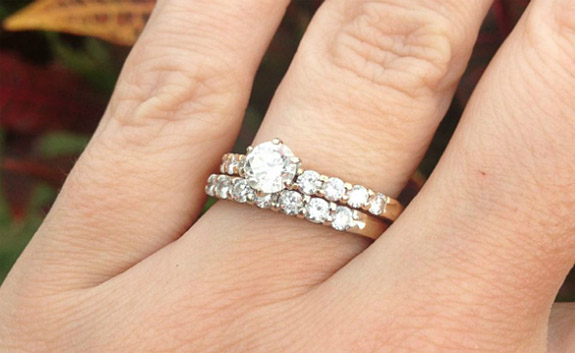
The hero of our story, Mike "Shay" Smith, said the brilliance of the gemstone made all the difference. While searching underwater for interesting shells, the glint of something unusual caught his eye.
“That was just random luck," Smith told KHON2. "While I was out snorkeling, I just happened to catch a glimpse of a sparkle at the bottom and scooped it up.”
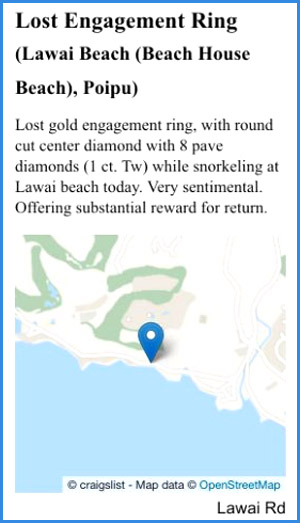
Smith intended to find the rightful owner by posting information about his precious find on Craigslist. While viewing the Lost-and-Found section, he was stunned by a post from vacationer Laura Mitrowski, who was looking for a similar ring.
Only a few days earlier, the Massachusetts resident had relished an afternoon snorkeling in the surf off Lawai Beach, Kauai. But, when she returned to the beach, she knew something didn't feel right...
“We’ve been married 12 years. As soon as I got out of the water my hands felt funny,” Mitrowski told ABC News. “I was sitting down in my chair and I’m like, ‘Oh no, it came off in the water,’ and my husband was still out in the water, and I was waving to him crying hysterically on the beach.”
Mitrowski enjoys the surf and loose rings have never been a problem in the past.
"I’ve been swimming tons of times and my rings have never fallen off," she told ABC News. "The fact we found it is unbelievable.”
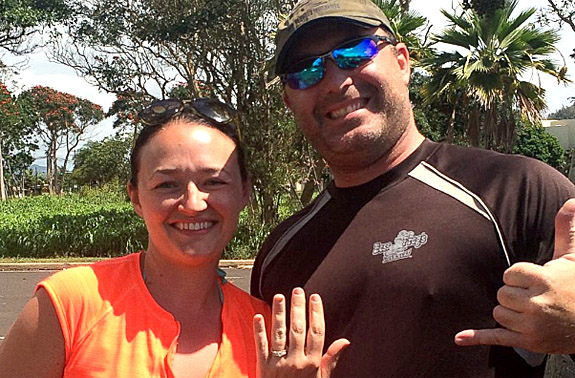
Smith replied to Mitrowski's ad and asked her to describe any unusual details about the ring. When she told him that the band was cracked, Smith knew he had the right woman. By the next day, the diamond ring was back on her finger.
“I was like in shock," Mitrowski told KHON2. "I didn’t think anyone was going to find it, because I figured if it was lost in the ocean, it was going to be lost forever. “I couldn’t believe it. I was in disbelief. I was crying.”
Mitrowski offered a $300 reward, which Smith refused, at first, and then accepted.
Credits: Images courtesy of Laura Mitrowski.